
 Need help?
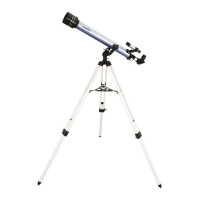
Do you have a question about the SKY-WATCHER 707AZ2 and is the answer not in the manual?
Step-by-step guide to assembling the tripod legs for stability.
Instructions for securely connecting the telescope mount to the assembled tripod legs.
Details on how to attach the accessory tray to the tripod legs.
Guide for connecting the main telescope tube to the alt-azimuth mount.
Instructions for mounting the finderscope onto the main telescope tube.
Steps for correctly inserting and securing an eyepiece into the diagonal.
Choose a distant object, center it in the main telescope view.
Use alignment screws to center the finderscope crosshairs on the object.
Guide to controlling telescope movements using the altitude and azimuth lock knobs.
Explanation of how a Barlow lens increases magnification and its placement.
Instructions for achieving a sharp image by adjusting the focus knobs.
How to swivel the telescope for azimuth and tilt for altitude adjustments.
Method for nudging the telescope to keep objects in the field due to Earth's rotation.
Explanation of altitude and azimuth measurements for pointing.
Factors affecting viewing quality: seeing (air steadiness) and transparency (air clarity).
Advice on choosing a good location for astronomical observation, away from lights and pollution.
Guidance on optimal times for observation based on atmospheric conditions and object position.
Importance of allowing the telescope to reach ambient temperature to minimize image distortion.
Tips for optimizing vision for observing, including dark adaptation and averted vision.
 General
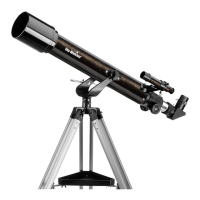
| Type | Refractor |
|---|---|
| Aperture | 70 mm |
| Focal Length | 700 mm |
| Focal Ratio | f/10 |
| Mount Type | Altazimuth |
| Finderscope | 5x24 |
| Eyepieces | 10mm, 25mm |
| Tripod | Aluminum |


 To Next Page