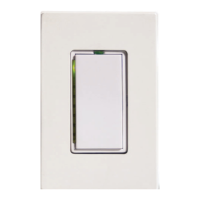
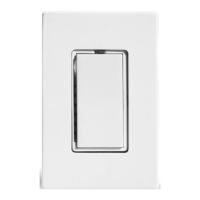
Disable Programming
Once the SwitchLinc is set up, it can be programmed to lockout any changes. Any
changes made at the unit or remotely will be ignored. Please note that all SwitchLinc,
LampLinc, and KeypadLinc modules that are plugged in or electrically active will receive
these commands and also be locked out.
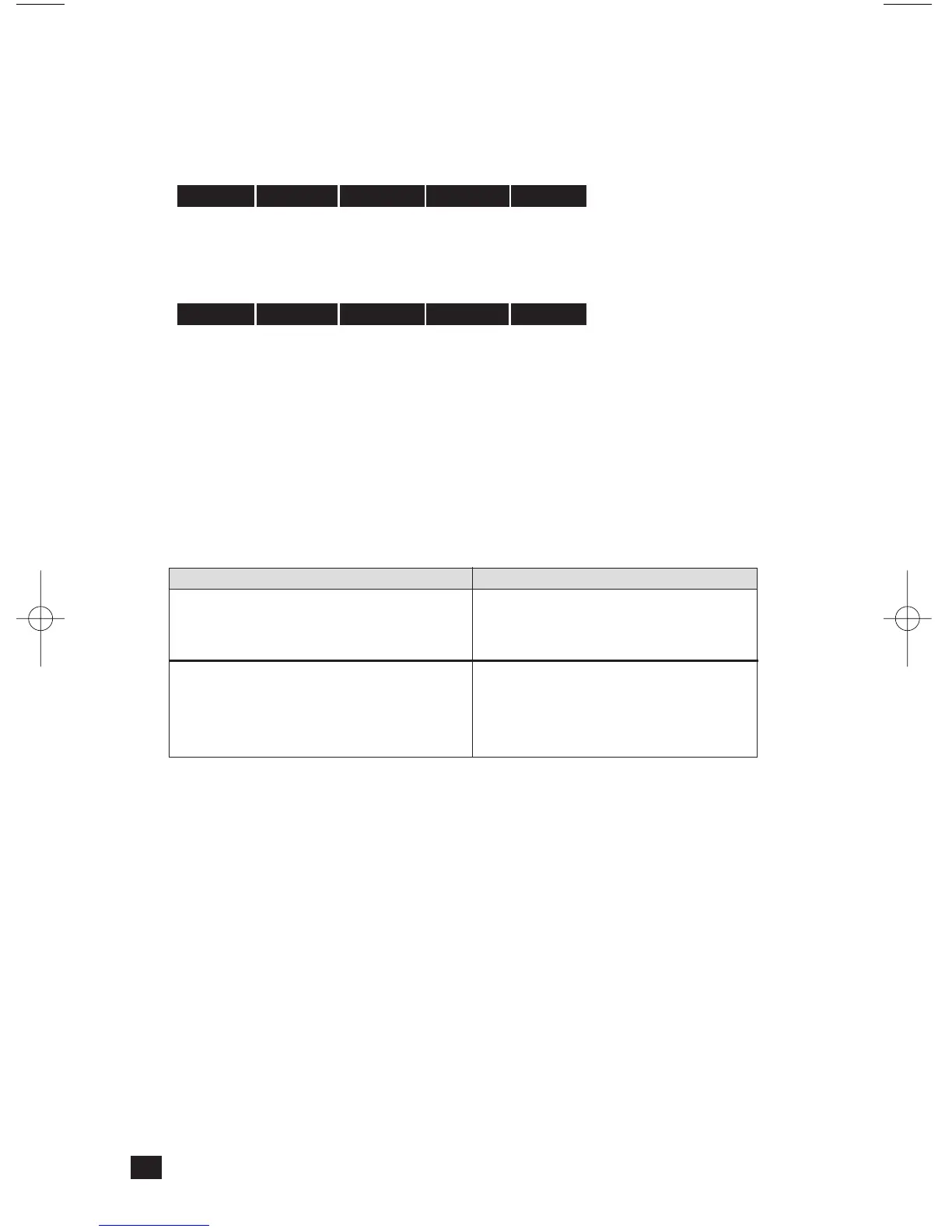
1. Send the following command sequence to disable the programming:
The light(s) will blink (if they are on) indicating the command was received.
Re-Enable Programming (default is enabled)
1. Send the following command sequence to enable programming:
The light(s) will blink (if they are on) indicating the command was received.
Other Features
Power Restore
In the event of a power loss, the SwitchLinc will automatically return the lighting circuit
being controlled to its last brightness level when the power was interrupted.
Querying SwitchLinc
It is possible with some home automation interfaces and products to query the status of
a SwitchLinc 2-Way Dimmer. It will respond to Status Request signals that are received
for its base address. The following is a sample session from a HouseLinc controller:
Example: SwitchLinc is on full Brightness
Sent by Interface
A Unit(1)
House A, Unit(1), Status Request
Received from SwitchLinc
House A, Unit(1), Status is ON
HC: A Unit(1)
House A, Unit(1), Preset Dim High 100%
Example: SwitchLinc is OFF
Sent by Interface
HC: A Unit(1)
House A, Unit(1), Status Request
Received from SwitchLinc
House A, Unit(1), Status is OFF
HC: A Unit(1)
House A, Unit(1), Off
N16 M16 O16 P16 P16
M16 O16 P16 N16 P16
How Powerline Signals Travel Around A Home
and How To Improve Reliability
Most homes in North America have two lines of 120 volts coming into the home from
the utility company. This split-single phase electricity is divided out at the home’s break-
er box into the circuits that feed light switches, plug-in outlets, and appliances. Half of
the electricity outlets and wall switches are fed by one of the 120-volt lines and the sec-
ond 120-volt line feeds the other half. The intermittent operation of PLC/X10 modules
usually happens when the transmitter is sending signals on one line and the receiver
module is plugged into an outlet on the other line. For the signals to get to the receiver,
it must leave the home, travel to the utility company transformer then come back in on
the other AC line. By the time the signal gets back to the home, travels through the
electrical meter and circuit breaker box, there may not be enough signal left to trigger
the module.
The first order of business will be to install a coupler-repeater, also known as amplifier.
A coupler-repeater will ‘see’ the incoming signal, re-generate it, and blast it out over
both lines of the 120 volts. We recommend that any home larger than 3000 square
feet install a coupler-repeater. In smaller homes, a passive phase coupler also known
as a signal bridge may give satisfactory results.
10


 To Next Page
 Loading...