Need help?
Do you have a question about the sol-ark 60K-3P-N and is the answer not in the manual?
Contact details for Sol-Ark including phone, email, and website.
Explains the meaning of various warning symbols used in the manual.
Provides critical safety instructions and warnings for installation and operation.
Guide for inspecting the product package upon delivery for damage.
Lists and identifies all included components in the product package.
Details battery type, capacity, voltage range, and charging parameters.
Outlines AC power capabilities, certifications, and safety protections.
Provides specific torque values for terminal blocks and screws.
Specifies recommended wire gauges for different connections like PV, AC, and battery.
Illustrates the layout of connection terminals on the inverter.
Shows a basic wiring example for DC solar input, battery, and AC connections.
Depicts wiring for off-grid operation with generator and smart load output.
Illustrates standard wiring for 277V/480V systems with various components.
Shows wiring configuration including a bypass transfer switch.
Wiring diagram for AC-coupled systems using micro-inverters on the load side.
Wiring diagram for AC-coupled systems using micro-inverters on the generator side.
Details wiring for connecting a standby generator with a transfer switch.
Wiring for grid-tied systems that also include a standby generator.
Wiring for parallel inverter installations featuring a bypass transfer switch.
Wiring for parallel 208V inverter systems with a bypass transfer switch.
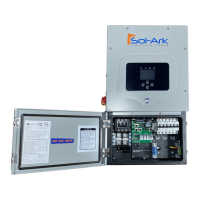
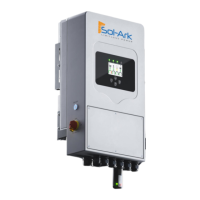
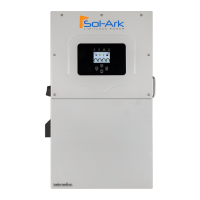
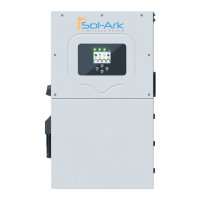
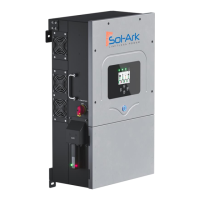
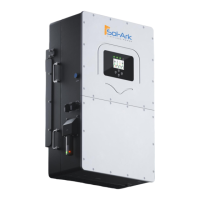
Identifies and describes the various components of the Sol-Ark inverter.
Guidance on selecting and sizing backup circuits for the system.
Instructions for installing a single system, including mounting and battery integration.
Guidance on installing multiple Sol-Ark inverters in parallel.
Details PV input limits, string configurations, and connection methods.
Explains how to connect generators of different sizes and configurations.
Settings to optimize generator and inverter efficiency and peak shaving.
Configuration for automatic generator start based on battery voltage or percentage.
Details connections for sensors, communication ports, and accessories.
Detailed instructions for installing, wiring, and orienting CT sensors.
Information on CANbus, RS485, Wi-Fi, and Emergency Stop signal connections.
Essential voltage checks before powering on the inverter.
Step-by-step procedure for safely powering up and cycling the inverter.
Describes the meaning of normal indicator lights (Green/Off) for DC and AC.
Explains the meaning of alarm indicator lights (Red/Off) and system status.
Steps for setting up Ethernet and Wi-Fi dongles for remote monitoring.
Information on downloading the PV Pro App and installer account setup.
Instructions for creating a user account and signing into the PowerView platform.
Guide for setting up a new plant, including scanning QR codes and entering details.
Steps to connect the Sol-Ark system to a local Wi-Fi network for internet access.
How to select a plant and view real-time data and graphed data.
Instructions for setting up IP addresses for PC or smartphone access.
Steps for logging into the web portal using a search browser.
Guide to connecting the system to your home Wi-Fi network.
Overview of main screen elements, including graphical data views.
Settings for brightness, time, seasons, and system alarms.
Configuration for load limits, peak shaving, CT ratio, and UPS time.
Detailed options for configuring battery charge, discharge, and smart load.
Settings for grid connection, selling power, and limiter functions.
Detailed explanations of graphical views for PV, Grid, INV, USP LD, and Battery.
Adjusting display, time, and system parameters.
Viewing system alarms and configuring parallel system settings.
Setting battery capacity, charge/discharge rates, and voltage limits.
Configuring charge settings like Float V, Gen Charge, and Grid Charge.
Setting voltage thresholds for inverter shutdown, low battery, and restart.
Configuring smart load behavior based on battery status and AC coupling.
Configuring grid sell, limited power to home, and load settings.
Settings for grid connection, generator input, and zero export power.
Options for limited power to load, home, grid sell, and time-of-use modes.
Configuring grid mode, frequency, reconnect time, and voltage levels.
Settings for IP configuration and protection against over/under voltage/frequency.
Adjusting inverter output based on grid frequency and voltage.
Configuring reactive power and power factor settings.
Detailed instructions for installing, wiring, and orienting CT sensors.
Procedure for automatically detecting and configuring limiter sensors.
Steps for auto-learning sensor settings and verifying configuration.
Common issues with limiter sensors and how to resolve them.
Specific tips for installing the system in off-grid mode.
Tips for grid-tied installations without batteries.
Troubleshooting common issues like no power, panel production, and generator start.
Addressing issues with LEDs, alarms, and system faults.
Resolving problems related to battery symbols, grid status, and system restarts.
Guidance on frozen screens, calibration, and constant faults.
Steps to diagnose and fix grid phase wrong errors.
Comprehensive list of error codes and their common causes/remedies.
A checklist for installers to verify proper system installation and configuration.
Details the terms, conditions, and exclusions of the product warranty.

 To Next Page
 General