EasyManua.ls Logo

Sony ICF-6800W - Page 7

Sony ICF-6800W
60 pages
Print Icon
To Next Page IconTo Next Page
To Previous Page IconTo Previous Page
Loading...
(1)
Down
to
minus
0.975
MHz
below
0.975
MHz
(2)
Below
3.5
MHz
and
above
2.075
MHz
Unless
within
the
ranges
of
(1)
and
(2)
above,
the
PLL
circuitry
will
not
function
normally.
(1)
is
determined
in
the
following
manner.
The
frequency
of
0.975MHz
is
an
absolutely
indispensable
frequency
because
of
the
relation-
ship
with
the
VFO.
Unless
the
frequency
of
VCO1
does
not
come
down
to
0.975
MHz
even
when
the
voltage
to
the
variable
capacitance
diode
is
lowered,
there
will
be
no
change
in
frequency
when
the
MW/SW
TUNING
DIAL
is
turned,
and
so
it
must
be
below
0.975
MHz.
Concerning
frecuency
below
0.975
MHz,
in
reality,
there
could
not
be
a
frequency
of
minus
0.975
MHz,
but
here,
we
shall
refer
to
anything
below
zero
as
a
minus
frequency.
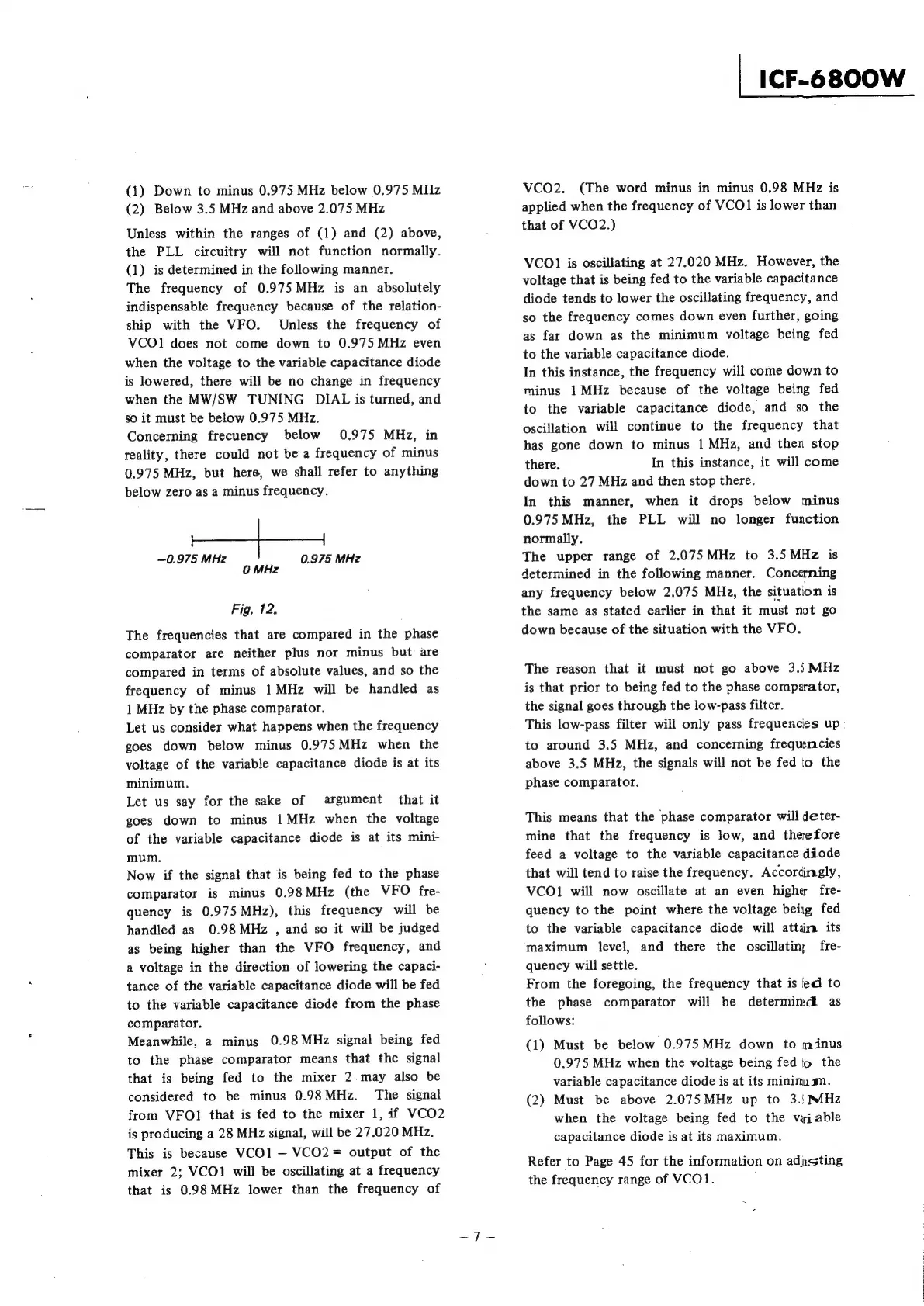
~-0.975
MHz
2
|
0.975
MHz
MHz
Fig.
12.
The
frequencies
that
are
compared
in
the
phase
comparator
are
neither
plus
nor
minus
but
are
compared
in
terms
of
absolute
values,
and
so
the
frequency
of
minus
1
MHz
will
be
handled
as
1
MHz
by
the
phase
comparator.
Let
us
consider
what
happens
when
the
frequency
goes
down
below
minus
0.975MHz
when
the
voltage
of
the
variable
capacitance
diode
is
at
its
minimum.
Let
us
say
for
the
sake
of
that
it
goes
down
to
minus
1MHz
when
the
voltage
of
the
variable
capacitance
diode
is
at
its
mini-
mum.
Now
if
the
signal
that
is
being
fed
to
the
phase
comparator
is
minus
0.98MHz
(the
VFO
fre-
quency
is
0.975
MHz),
this
frequency
will
be
handled
as
0.98
MHz
,
and
so
it
will
be
judged
as
being
higher
than
the
VFO
frequency,
and
a
voltage
in
the
direction
of
lowering
the
capaci-
tance
of
the
variable
capacitance
diode
will
be
fed
to
the
variable
capacitance
diode
from
the
phase
comparator.
Meanwhile,
2
minus
0.98
MHz
signal
being
fed
to
the
phase.
comparator
means
that
the
signal
that
is
being
fed
to
the
mixer
2
may
also
be
considered
to
be
minus
0.98MHz.
The
signal
from
VFO1
that
is
fed
to
the
mixer
1,
if
VCO2
is
producing
a
28
MHz
signal,
will
be
27.020
MHz.
This
is
because
VCO]
—
VCO2=
output
of
the
mixer
2;
VCO1
will
be
oscillating
at
a
frequency
that
is
0.98MHz
lower
than
the
frequency
of
argument
|
ICF~-6800W
VCO2.
(The
word
minus
in
minus
0.98
MHz
is
applied
when
the
frequency
of
VCO1
is
lower
than
that
of
VCO2.)
,
VCO1
is
oscillating
at
27.020
MHz.
However,
the
voltage
that
is
being
fed
to
the
variable
capacitance
diode
tends
to
lower
the
oscillating
frequency,
and
so
the
frequency
comes
down
even
further,
going
as
far
down
as
the
minimum
voltage
being
fed
to
the
variable
capacitance
diode.
In
this
instance,
the
frequency
will
come
down
to
minus
1
MHz
because
of
the
voltage
being
fed
to
the
variable
capacitance
diode,
and
so
the
oscillation
will
continue
to
the
frequency
that
has
gone
down
to
minus
1
MHz,
and
then
stop
there.
In
this
instance,
it
will
come
down
to
27
MHz
and
then
stop
there.
In
this
manner,
when
it
drops
below minus
0.975
MHz,
the
PLL
will
no
longer
function
normally.
The
upper
range
of
2.075MHz
to
3.5
MHz
is
determined
in
the
following
manner.
Concerning
any
frequency
below
2.075
MHz,
the
situation
is
the
same
as
stated
earlier
in
that
it
must
not
go
down
because
of
the
situation
with
the
VFO.
The
reason
that
it
must
not
go
above
3.5
MHz
is
that
prior
to
being
fed
to
the
phase
compsrator,
the
signal
goes
through
the
low-pass
filter.
This
low-pass
filter
will
only
pass
frequencies
up
to
around
3.5
MHz,
and
concerning
frequencies
above
3.5
MHz,
the
signals
will
not
be
fed
to
the
phase
comparator.
This
means
that
the
phase
comparator
will
deter-
mine
that
the
frequency
is
low,
and
therefore
feed
a
voltage
to
the
variable
capacitance
diode
that
will
tend
to
raise
the
frequency.
Accordingly,
VCO1
will
now
oscillate
at
an
even
highe
fre-
quency
to
the
point
where
the
voltage
beiig
fed
to
the
variable
capacitance
diode
will
attain
its
maximum
level,
and
there
the
oscillatin;
fre-
quency
will
settle.
From
the
foregoing,
the
frequency
that
is
led
to
the
phase
comparator
will
be
determimd
as
follows:
(1)
Must
be
below
0.975
MHz
down
to
minus
0.975
MHz
when
the
voltage
being
fed
to
the
variable
capacitance
diode
is
at
its
minimum.
(2)
Must
be
above
2.075MHz
up
to
3.)MHz
when
the
voltage
being
fed
to
the
viable
capacitance
diode
is
at
its
maximum.
Refer
to
Page
45
for
the
information
on
adjssting
the
frequency
range
of
VCO1.
,

Other manuals for Sony ICF-6800W

Related product manuals