EasyManua.ls Logo

Sony PS-1150 - Automatic Return Operation Mechanics; Motor Engagement via Tonearm Lever; Return Pawl and Trip Pawl Interaction; Lead-out Groove Engagement Sequence

Sony PS-1150
8 pages
Print Icon
To Next Page IconTo Next Page
To Previous Page IconTo Previous Page
Loading...
REST
REITA
SaeaREEE
PRTEERTT
Tene
Sa
og
eae
ook
SECTION
1
OUTLINE
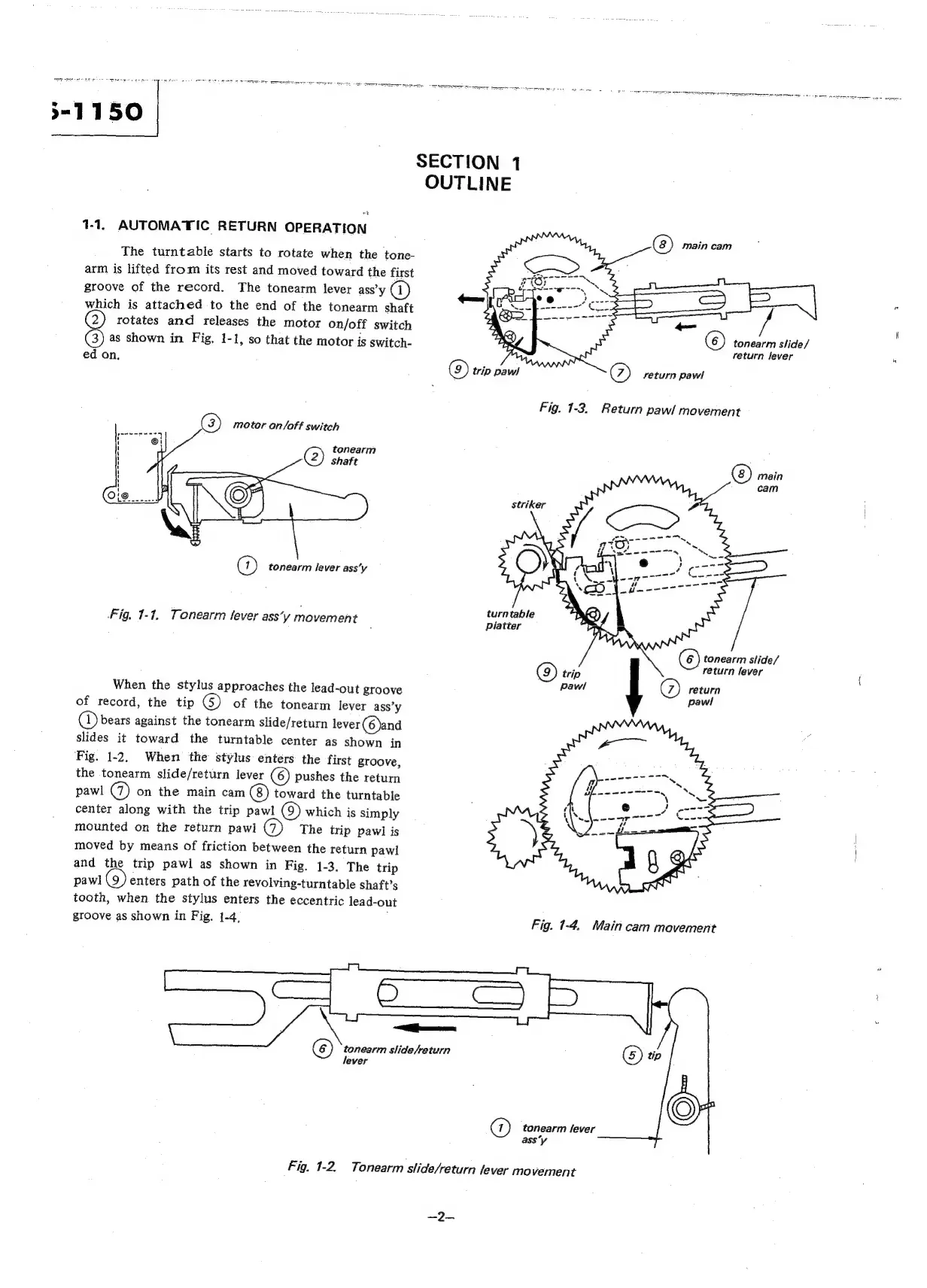
1-1,
AUTOMATIC
RETURN
OPERATION
The
turntable
starts
to
rotate
when
the
tone-
arm
is
lifted
from
its
rest
and
moved
toward
the
first
groove
of
the
record.
The
tonearm
lever
ass’y
Qa)
jun
which
is
attached
to
the
end
of
the
tonearm
shaft
rotates
and
releases
the
motor
on/off
switch
(3)
as
shown
in
Fig.
1-1,
so
that
the
motor
is
switch-
Oy
ed
on.
;
()
trip
paw!
©)
tonearm
slide/
return
lever
@)
return
pawl
Fig.
1-3.
Return
pawl
movement
(3)
motor
on/off
switch
peewee
ees
tonearm
striker
Q)
tonearm
leverass’'y
NL
at
hae
turntable
Fig.
1-1.
Tonearm
fever
ass’y
movement
piatter
tonearm
slide/
return
lever
return
When
the
stylus
approaches
the
lead-out
groove
pawl
of
record,
the
tip
G)
of
the
tonearm
lever
ass’y
4)
bears
against
the
tonearm
slide/return
lever
(6)and
slides
it
toward
the
turntable
center
as
shown
in
Fig.
1-2.
When
the
stylus
enters
the
first
groove,
the
tonearm
slide/return
lever
©)
pushes
the
return
pawl
GP
on
the
main
cam
toward
the
turntable
center
along
with
the
trip
pawl
9)
which
is
simply
mounted
on
the
return
pawi
(7
The
trip
pawl
is
moved
by
means
of
friction
between
the
return
pawl
and
the
trip
pawl
as
shown
in
Fig.
1-3.
The
trip
pawl
enters
path
of
the
revolving-turntable
shaft’s
tooth,
when
the
stylus
enters
the
eccentric
lead-out
groove
as
shown
in
Fig.
1-4,
Fig.
1-4.
Main
cam
movement
tonearm
slide/return
lever
q)
tonearm
fever
assy
Fig.
1-2.
Tonearm
slide/return
lever
mo
vement
Posy
ja

Related product manuals