Generally, the insulation
resistance of
the
oxide
layer in MOS IC structures
is
very
high, and the oxide
layer
is very thin. Because
of
this,
it
is
possible
that
the static
voltages
usually
present
on clothes and
the
human body
will be
enough
to
generate
a
potential
difference across
the insulator,
high enough
to cause
a breakdown
of the insulating
layer.
The
following
precautions
should be taken while
handling these ICs.
(Particular
care should
be taken under conditions
of
low
humidity.)
Precautions
in Replacing
MOS
lCs
l.
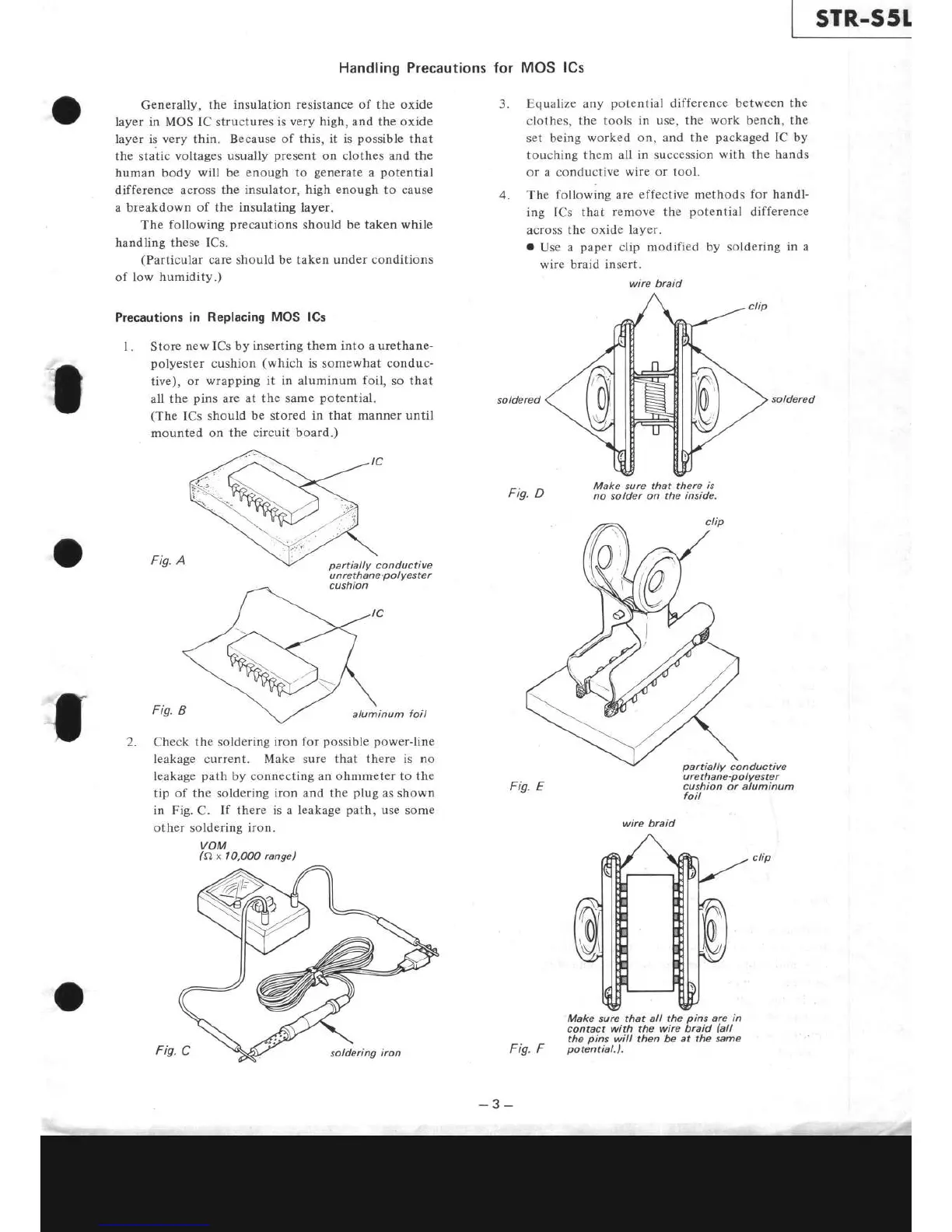
Store
new ICs by
inserting them into a urethane-
polyester
cushion
(which
is
somewhat
conduc-
tive),
or wrapping
it in
aluminum
foil,
so that
all the
pins
are at the same
potential.
(The
ICs
should
be stored in that manner until
mounted
on the circuit board.)
Fig. A
partially
conductive
unrethane-polyester
cushion
Fig.
B
aluminum
foil
Handling Precautions for MOS
lCs
soldered
Fis.
D
Fis.
E
Fis. F
-3-
Equalize any
potential
difference between
the
clothes, the tools
in use, the work bench,
the
set being
worked on, and the
packaged
IC by
touching them all in succession
with the hands
or a conductive
wire or tool.
The
following
are
effective methods
for handl-
ing ICs
thai
remove
the
potential
difference
across
the oxide layer.
o
Use
a
paper
clip
modified by soldering
in a
wire braid
insert.
J.
4.
2.
Check
the soldering
iron for
possible power-line
leakage current.
Make sure that there is
no
leakage
path
by connecting
an ohmmeter to the
tip
of the soldering iron and the
plug
as shown
in Fig.
C.
If there is a leakage
path,
use some
other
soldering
iron.
VOM
(9x
1O.0OO range)
Make sure
that there
is
no solder on
the inside.
cltp
soldered
partially
conductive
urethane-polyester
cushion
or
aluminum
foil
Make
sure that
all the
pins
are in
contact
with the wire braid
hll
the
pins
will then be
at the same
potential.).
wire braid
wire braid



 To Next Page