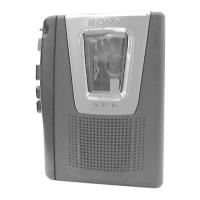
This document is a service manual for the Sony TCM-16 Cassette-Corder, specifically the E Model (East European Model). It provides detailed information for servicing and maintaining the device.
Function Description
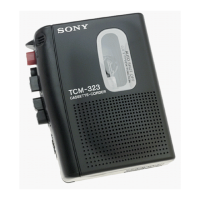
The Sony TCM-16 is a monaural cassette-corder designed for recording and playback of audio on cassette tapes. It features a built-in microphone for recording and an earphone jack for private listening. The device is portable, powered by batteries, and includes basic controls for tape transport: STOP, PLAY, REW/REVIEW, FF/CUE, and PAUSE, as well as a VOL (volume) control and a REC (record) button.
Important Technical Specifications
- Recording System: 2-track, 1 channel monaural. This indicates that the device records and plays back in mono, utilizing two tracks on the cassette tape.
- Frequency Range: 250 - 6,300 Hz. This specifies the range of audio frequencies the device can capture and reproduce.
- Speaker: Approximately 3.6 cm (1 7/16 in.) in diameter. This is the size of the integrated speaker for audio output.
- Power Output (at 10% harmonic distortion): 130 mW. This indicates the maximum audio power the device can deliver to the speaker before significant distortion occurs.
- Output: Earphone jack (minijack) for 8 - 300 Ω earphones. This allows for connection of external earphones with a specified impedance range.
- Power Requirements: 3 V DC, supplied by two R6 (AA) batteries. This highlights the portable nature and battery dependency of the device.
- Dimensions (w/h/d) (incl. projecting parts and controls): Approximately 112 × 36.6 × 90.3 mm (4 1/2 × 1 1/2 × 3 5/8 in.). These are the physical dimensions of the cassette-corder, including any parts that protrude.
- Mass (not incl. batteries): Approximately 180 g (6.4 oz.). This is the weight of the device without batteries, emphasizing its lightweight design.
- Tape Transport Mechanism Type: MT-323-118. This is a specific identifier for the internal tape transport mechanism, which is also used in the TCM-343 model.
Usage Features
The TCM-16 is designed for straightforward operation with essential controls clearly labeled.
- Recording: The built-in microphone allows for direct audio capture. The REC button, likely in conjunction with PLAY, initiates recording.
- Playback: The PLAY button starts tape playback.
- Tape Navigation: REW/REVIEW (rewind and review) and FF/CUE (fast forward and cue) buttons enable quick navigation through the tape.
- Pause Function: A PAUSE control allows temporary interruption of recording or playback without stopping the tape transport entirely.
- Volume Control: A VOL knob adjusts the audio output level.
- Portability: Its compact dimensions and battery power make it suitable for on-the-go use.
Maintenance Features (from Service Manual sections)
The service manual provides comprehensive instructions for disassembly, mechanical and electrical adjustments, and parts replacement, indicating that the device is designed to be serviceable.
- Disassembly: Detailed steps are provided for disassembling key components such as the Lid Sub Assy (cassette lid), Main Board, Mechanism Deck, Belt, Magnetic Head, and Pinch Roller. This includes diagrams showing screw locations and component removal order.
- Mechanical Adjustment: This section would cover procedures for adjusting mechanical parts to ensure proper tape transport and operation.
- Electrical Adjustment: This section outlines procedures for calibrating electrical components. For example, it mentions "REC/PB Head Azimuth Adjustment" and "Tape Speed Adjustment," which are crucial for optimal audio quality and tape compatibility. Specific test tapes (WS-48A, P-4-A063) and measurement tools (torque meter, frequency counter) are recommended for these adjustments.
- Diagrams: The manual includes an IC Block Diagram, a general Block Diagram, a Schematic Diagram, and a Printed Wiring Board layout. These are essential for troubleshooting and understanding the device's electronic circuitry.
- Exploded Views: Detailed exploded diagrams of the Cabinet Section and Mechanism Deck Sections (MT-323-118) are provided, along with part numbers and descriptions for all components. This facilitates ordering replacement parts.
- Parts List: A comprehensive electrical parts list categorizes components (capacitors, diodes, ICs, resistors, switches, miscellaneous) with their specifications and part numbers.
- Repair Notes:
- Chip Component Replacement: Emphasizes not reusing disconnected chip components and caution regarding heat damage to tantalum capacitors.
- Flexible Circuit Board Repairing: Provides guidelines for soldering iron temperature (around 270°C), avoiding repeated contact with the same conductor, and preventing force on conductors during soldering/unsoldering.
- Parts Ordering: Notes that "-XX, -X" parts are standardized and may differ slightly from originals, and starred "*" items are not routinely stocked, potentially causing delays.
The service manual is a critical resource for technicians, ensuring the longevity and proper functioning of the Sony TCM-16 Cassette-Corder through detailed repair and maintenance guidance.

 Need help?


 To Next Page
 General