EasyManua.ls Logo

Sony UP-890MD - Page 41

Sony UP-890MD
72 pages
Print Icon
To Next Page IconTo Next Page
To Previous Page IconTo Previous Page
Loading...
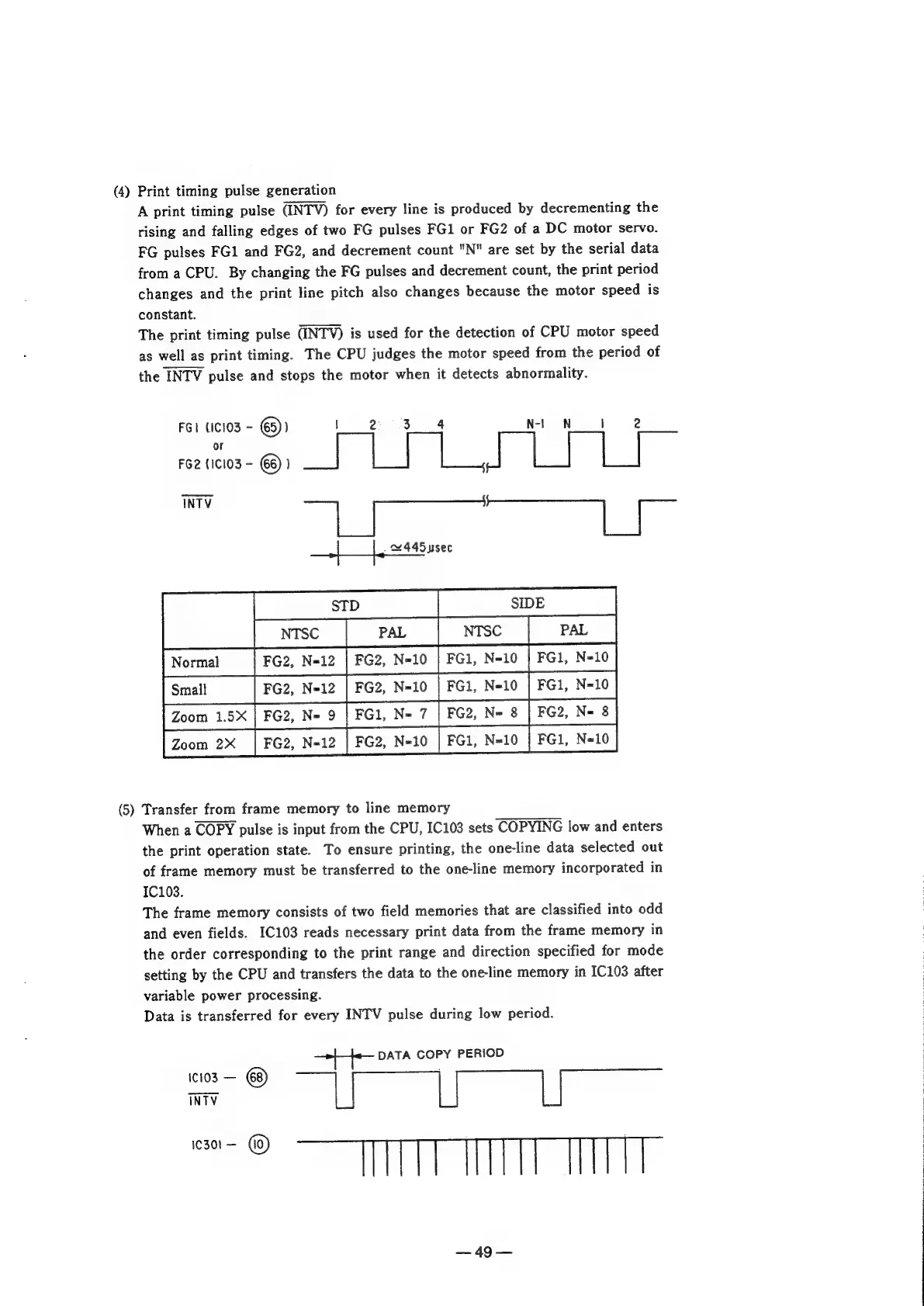
(4)
Print
timing
pulse
generation
A
print
timing
pulse
(INTV)
for
every
line
is
produced
by
decrementing
the
rising
and
falling
edges
of
two
FG
pulses
FG1
or
FG2
of
a
DC
motor
servo.
FG
pulses
FG1
and
FG2,
and
decrement
count
"N"
are
set
by
the
serial
data
from
a
CPU.
By
changing
the
FG
pulses
and
decrement
count,
the
print
period
changes
and
the
print
line
pitch
also
changes
because
the
motor
speed
is
constant.
The
print
timing
pulse
(INTV)
is
used
for
the
detection
of
CPU
motor
speed
as
well
as
print
timing.
The
CPU
judges
the
motor
speed
from
the
period
of
the
INTV
pulse
and
stops
the
motor
when
it
detects
abnormality.
FGI
(Iclo3
-
@))
or
ee
eae
Se
N-l
N
1
2
FG2
(1C103
-
@6))
a
ee
ae
ee
INTV
ic
(anaes
(i
2445
usec
STD
SIDE
eee
Pa
FG2,
N=
9
FG2,
N=
8
|
FG2,
N=
8
af
(5)
Transfer
from
frame
memory
to
line
memory
When
a
COPY
pulse
is
input
from
the
CPU,
IC103
sets
COPYING
low
and
enters
the
print
operation
state.
To
ensure
printing,
the
one-line
data
selected
out
of
frame
memory
must
be
transferred
to
the
one-line
memory
incorporated
in
1C103.
The
frame
memory
consists
of
two
field
memories
that
are
classified
into
odd
and
even
fields.
IC103
reads
necessary
print
data
from
the
frame
memory
in
the
order
corresponding
to
the
print
range
and
direction
specified
for
mode
setting
by
the
CPU
and
transfers
the
data
to
the
one-line
memory
in
IC103
after
variable
power
processing.
Data
is
transferred
for
every
INTV
pulse
during
low
period.
aa
ke
ae
DATA
COPY
PERIOD
Iclo3
INTV
dg

Other manuals for Sony UP-890MD

Related product manuals