This document provides a comprehensive guide for disassembling, cleaning, and repairing an original Xbox console and its components, including the console itself, the controller, and the DVD drive. It also covers advanced topics such as USB port installation, using a PC DVD drive with the Xbox, hard drive upgrades, FTP networking, and installing Linux on the Xbox.
Xbox Console Disassembly and Repair
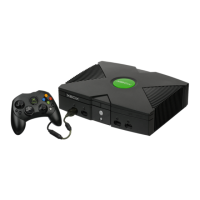
Function Description: The Xbox console is a home video game console developed by Microsoft. This section details how to open the console for internal access, which is necessary for various repairs, upgrades, and modifications.
Usage Features:
Controller Cleaning and Repair
Function Description: This section guides users through disassembling and cleaning an Xbox controller to fix sticky buttons, improving responsiveness and preventing gameplay issues.
Usage Features:
- Tools Required: Philips #1 screwdriver.
- Procedure:
- Start with a controller exhibiting sticky buttons.
- Locate the screw holes on the back of the controller.
- Unscrew and remove all screws.
- Flip the controller back over so the screw holes are facing down.
- Lift off the top cover.
- The buttons will likely fall out; don't worry, they are easy to reassemble.
- Safely remove all buttons and their rubber cups.
- Cleaning:
- Give all buttons and the D-pad a bath in warm, soapy water.
- If the circuit board is drenched with liquid, use a rag with mild soapy water to clean it. Avoid window cleaner and other harsh cleaners. Soapy water can be used on the board, but do not soak it. Avoid getting liquid on components as much as possible.
- Crucially, allow all components to dry COMPLETELY before reassembly.
- The drain in the author's sink has a bar small enough to prevent Xbox buttons from falling down, which is a convenient design feature.
- Note the controller's design: rubber pads act as liquid cups, controller sticks act as umbrellas to protect internal components, and buttons are keyed to fit only one way.
- Once buttons are clean and dry, retrieve the top cover and begin placing the buttons back in their correct positions.
- Place the keyed rubber cups in their proper orientation.
- Align the bottom cover and lower it onto the buttons and top cover.
- Replace all screws.
Maintenance Features:
- Cleaning Tips: Do not soak the top cover in water, as the emblem may become misty (though it typically clears up). Clean button sockets with a rag if soaking doesn't fully clean them.
Xbox DVD Drive Cleaning and Repair
Function Description: This section addresses common "dirty disk errors" and other DVD drive issues by guiding users through cleaning the drive's lens and mirror, and adjusting the potentiometer.
Usage Features:
- Tools Required: Torx #10, Philips #1, Q-Tips, Lens Cleaner, Compressed air. A magnetized Philips #1 or screw grabber is helpful.
- Words of Advice:
- Leave the small ribbon cables connecting internal drive components alone if possible. If disconnection is necessary, note that a brown wedge in each socket must be pulled out to release the ribbon.
- DO NOT BLOW CANNED AIR INTO THE DRIVE WITHOUT OPENING IT. This will likely redistribute dust and coat the optics, worsening the problem.
- Procedure:
- Disassembly:
- Remove the four screws holding the drive together: two in the rear and two in the top, mid-drive. The mid-drive screws can be difficult; a screw grabber helps. Shaking the drive upside down also works.
- Remove the bottom tray first. Flip the drive so the bottom faces up. Pull the metal tab in the back over the IDE connector, then it will slip off. Pull out, then up.
- Remove the top cover. Push in two catches near the front on either side of the drive to tip up the front of the top panel.
- Access to the lens and mirror is now available.
- Cleaning:
- Blast the optics with canned air, then blast the rest of the DVD chassis to remove dust from the optics.
- Using a Q-tip and high-quality lens cleaner (anti-static lens cleaner or any glass cleaner; plain alcohol has also been used), clean the mirror and the lens. The goal is a streak-free finish. Use one end of the Q-tip to clean and the other to dry.
- BE CAREFUL NOT TO SCRATCH THE MIRROR.
- Updated Cleaning Information (from CPU64): Cleaning only the top lens and bottom mirror is often insufficient. The lens piece (without the top lens section) contains 11 sections that need cleaning to restore full drive potential. The SENSOR is detached from the main body; the small opening between the sensor and the last focus lens is the most important area to clean and can be done with compressed air.
- Re-assembly: Reverse the disassembly process. Start with the top, then attach the bottom. A screw grabber or magnetized screwdriver is helpful for the top two screws.
- Pinch the top and bottom together and shift them back and forth to align the screw holes. Finish by replacing the rear screws, reassembling the Xbox, and hoping the repair was successful.
Troubleshooting Dirty Disk Errors:
- Symptoms: Constant dirty disk errors, freezing during games.
- Causes: Drives getting out of adjustment, weakening, or actual dirt.
- Solutions (in order of recommendation):
- Standard CD/DVD Cleaner: Use a cleaner disc with miniature brushes. This only cleans the lens and may be sufficient.
- Manual Lens and Mirror Cleaning: Follow the manual cleaning tutorial above.
- Adjust the Potentiometer (Pot) on the Laser: This is a last resort. (Tutorial link provided in original document).
- Replace the Drive: If none of the above work, the drive is likely dead.
Xbox DVD Drive Tray Alignment Procedure
Function Description: This procedure fixes DVD drives that won't open/close, stay open/closed, or make grinding/popping noises.
Usage Features:
- Procedure: The quick fix is to re-align the tray. This is common in CD players/changers. Normal use can cause gears to skip or tracks to jump. By removing the tray, aligning internal parts to their starting position, and re-inserting the tray, the drive can often be revived. (Link to "Thompson DVD Drive Tray Alignment Procedure" provided in original document).
USB Port Installation
Function Description: This section describes how to add standard USB ports to an Xbox for use with Linux, replacing the non-standard Xbox connectors.
Usage Features:
- Tools Required: Standard USB connectors (e.g., from a PCI plate), pliers, soldering equipment.
- Procedure:
- Xbox peripherals use standard USB but with non-standard connectors. It's possible to replace the connectors in the Xbox itself. Opening the case is assumed knowledge.
- The author used standard USB connectors retrieved from a PC (Maplin order code LY53H).
- Port Selection: Be mindful of the effect on multi-player games if you remove existing ports. The author removed ports 3 and 4 as the Xbox would no longer play Xbox games.
- Remove the two screws and cables, then carefully remove the plastic bridge holding the ports using pliers. It's a tight fit.
- Solder the black, green, white, and red cables together. Ignore the yellow cable, which is an extra non-USB cable for time-critical signaling. Ensure all joins are well insulated from each other and from metallic parts.
- Trim the tabs off the USB connector and possibly the sides for a tight fit. Insert it at an angle.
- Push it down into place, being careful not to slip or damage the motherboard. The author's fit was tight enough not to require glue, but Araldite or equivalent may be needed depending on tolerance and plastic type. Alternatively, modify the removed port block to reuse the black plastic bridge, being careful not to snap it.
Using a PC DVD Drive with Xbox
Function Description: This section explains how to connect a PC DVD drive to an Xbox, primarily for booting backups or Linux, as the Xbox still requires its original drive for certain functions.
Usage Features:
- Procedure:
- Remove the power cable from the Xbox drive.
- Attach a power cable splitter (available from PC stores) and plug both the Xbox drive and the PC drive into it.
- Place the PC drive on top of the Xbox drive.
- Remove the IDE cable from the Xbox drive and insert it into the PC drive.
- Limitations: The PC drive cannot fully replace the Xbox drive, as the Xbox still needs to access its original drive via the yellow cable. To play original games, the Xbox drive must be plugged back in.
- Boot Methods:
- Put a disc in the PC drive and reset the Xbox.
- If the first method fails, put an original disc in the Xbox drive and your backup in the PC drive.
Hard Drive Upgrades Tutorial
Function Description: This tutorial outlines the process of upgrading the Xbox's hard drive for more storage space.
Important Technical Specifications:
- HDD Size: Less than 137 GB is recommended.
- HDD Brands: Western Digital and Maxtor are good brands.
- RPM: 5400 RPM drives are preferred due to heat concerns with 7200 RPM drives, though some users install cooling fans for 7200 RPM drives.
Usage Features:
- Prerequisites:
- BIOS with HDD swap feature (X2 4976.02 is the latest).
- Latest Evox dashboard installed on the Xbox.
- Procedure (Outline):
- Backup the original C: and E: drives to your PC's HDD via FTP networking.
- Create an Evox boot disc with
evox.ini configured to format the drive. Burn it to a CD-RW or DVD-RW that your Xbox can read.
- Open the console (assuming a working modchip is installed).
- Unplug the original HDD and replace it with the new one.
- Reassemble the Xbox.
- Boot the Xbox with the disc you made. Evox will start, and a menu option to set up the drive will be available (if
evox.ini settings are correct). Format the new drive.
- Copy the C: and E: drives from your PC's HDD back to your new HDD.
- Remove the disc, then boot the Xbox again.
- Keep the original HDD as a backup; it can be unlocked and used in a PC.
- The extra space will be on the F: drive.
FTP Masterclass
Function Description: This section provides a guide to setting up FTP networking between an Xbox and a PC, enabling file transfers for backups and upgrades.
Usage Features:
- What You Need:
- Modded Xbox (any modchip).
- CD burner and compatible discs for your Xbox.
- PC with a network card.
- Network Cable (ideally Crossover).
- FTP software.
- Evox dashboard downloaded (preferably the latest version).
- Network Cable Types:
- Patch Cable: Pin-to-pin, used with Hubs and switches.
- Crossover Cable: Has some pins crossed, used for direct PC-to-Xbox connections.
- Identification: Compare the ends of the cable. If identical, it's a patch cable (requires a hub for PC-to-Xbox). If some cables are moved, it's a crossover cable. A crossover cable is ideal.
- Evox Boot Disk:
- Download and burn the EvoX ISO disk.
- Boot your Xbox with this disk and set a static IP in the settings area (ensure STATIC IP is set to "yes").
- With the Xbox booted with the Evox Boot disk and connected to your PC with the correct cable, you are ready to connect.
- Xbox/PC Networking Basics:
- IP Address: A numerical address identifying a device on a network.
- Dynamic (DHCP) vs. Static IP:
- Dynamic (DHCP): IP may change each time the device powers on, assigned by the PC. Xbox cannot assign IPs; the PC must be set up to do so.
- Static IP (Recommended): The author prefers static IPs for consistency. Set it on both the Evox Dashboard and your PC to be the same.
- What IP Address to Use:
- No two devices on the same network can have the same IP.
- They must be able to "see" each other, requiring the same subnet.
- Subnet: The first three numbers (octets) of the IP address should be the same, but the last number must be different.
- Example:
- PC IP: 192.168.0.1
- Xbox IP: 192.168.0.2
- Default Gateway (Xbox setting): 192.168.0.1 (PC's IP)
- Subnet (Xbox & PC setting): 255.255.255.0
4. PC Network Settings: Set the PC's IP in the network settings (Control Panel > TCP/IP settings) to 192.168.0.1 and the subnet to 255.255.255.0.
5. Connection: Once configured, the PC and Xbox should be on the same network. Reboot both if necessary.
6. FTP Connection: Use an FTP program (e.g., FlashFXP or CuteFTP) to connect to the Xbox using its IP (192.168.0.2), username "xbox," and password "xbox." You can then access the Xbox drives.
Linux on your XBOX
Function Description: This section details how to install Linux on an Xbox, transforming it into an inexpensive desktop computer for email, web browsing, a web server, or a node in a Linux cluster.
Usage Features:
- What You Need BEFORE You Start:
- Copy of Wayno's Linux Auto-Installer (purchased separately).
- Modded Xbox (any chip will work, F drive not required).
- Some basic Linux knowledge.
- USB Adapters, USB Keyboard, and mouse (for running X-Windows).
- Instructions (assuming Wayno's Linux Auto-installer is purchased):
- Plug in your keyboard and mouse using Xbox-USB adapters.
- Insert the disc labeled "Linux Install Disc."
- Tux will appear in the top left corner, and Linux will boot up.
- The screen will go blank briefly, then X-Windows will load.
- Shell Command Prompt:
- Type
su (then press Enter).
- Enter password "xbox."
- Type
XBOXLinuxInstall (then press Enter). Commands are case-sensitive.
- A dialogue box will appear. Highlight "XboxLinux inside the game save partition" (option one) and click next. This installs Linux on the E: drive.
- Click Yes to the next dialogue box.
- Leave the swap size at 256MB and click next.
- Leave the system size as 2000 and click next.
- LinuxInstaller will copy files to your Xbox HDD (approximately 15 minutes).
- After copying, a dialogue box will ask for the IP address, Subnet mask, and gateway. Enter these based on your network connection (or click next if not connecting to a network/internet).
- Right-click the desktop and click exit.
- At the Desktop Manager screen, click System and shutdown.
- Linux is now installed. To boot Linux, use the disc labeled "Linux Boot Disc."
- Adding Linux to Evolution-X Dash: If using the Evolution-X dash, create a folder named "Linux" in your apps folder. Copy everything from the boot disc into it, then reboot. Linux will appear in the Apps Menu.
- Licensing: Everything on the install and boot disc is licensed under the GNU General Public License (GPL).

 Need help?
 General

 To Next Page