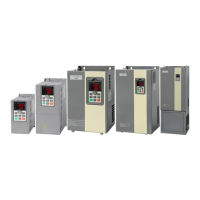
Chapter 2 Standard specifications
11
The current limiting algorithm is used to reduce the inverter over
current probability, and improve whole unit anti-interference
capability.
Timing control function: time setting range (0m to 6500m)
Keyboard/terminal/communication
10 frequency settings available, including adjustable DC (0 to 10V/
-10V to 10V), adjustable DC (0 to 20mA), panel setting, etc.
At most 16-speed can be set (run by using the multi-function
terminals or
program
)
Interrupt
controller output
When the protection function is active, you can automatically or
manually
reset the fault condition.
Including
DC (0 to 10V), DC (0 to 20mA)
Motor
status
display, stop, ac/deceleration, constant speed,
program running status.
Contact capacity :normally closed contact 3A/AC 250V, normally
open
contact 5A
/AC 250V, 1A/DC 30V.
Two-way analog output, 16 signals can be selected such as
frequency,
current
, voltage and other, output signal range (0 to 10V
/ 0 to 20mA).
At most 4-way output, there are 40 signals each way
Limit frequency, jump frequency, frequency compensation, auto-
tuning, PID control
Built-in PID regulates braking current to ensure sufficient braking
torque under no overcurrent condition.
Three channels: operation panel, control terminals and serial
communication port. They can be switched through a variety of
ways.
Total 10 frequency sources: digital, analog voltage, analog current,
multi-speed and serial port. They can be switched through a variety
of ways.
8 digital input terminals, compatible with active PNP or NPN input
mode, one of them can be for high-speed pulse input (0 to 100 kHz
square wave); 3 analog input terminals for voltage or current input.
2 digital output terminals, one of them can be for high-speed pulse
output(0 to 100kHz square wave); one relay output terminal; 2
analog output terminals respectively for optional range (0 to 20mA
or 0 to 10V), they can be used to set frequency, output frequency,
speed and other physical parameters.
Overvoltage protection, undervoltage protection, overcurrent
protection, overload protection, overheat protection, overcurrent
stall protection, overvoltage stall protection, losting-phase
protection (optional), communication error, PID feedback signal
abnormalities, PG failure and short circuit to ground protection.
Displays current temperature IGBT


 To Next Page
 Loading...