Page 10 of 23 Guide for Installation and use of Southwire C
7
Overhead Conductor
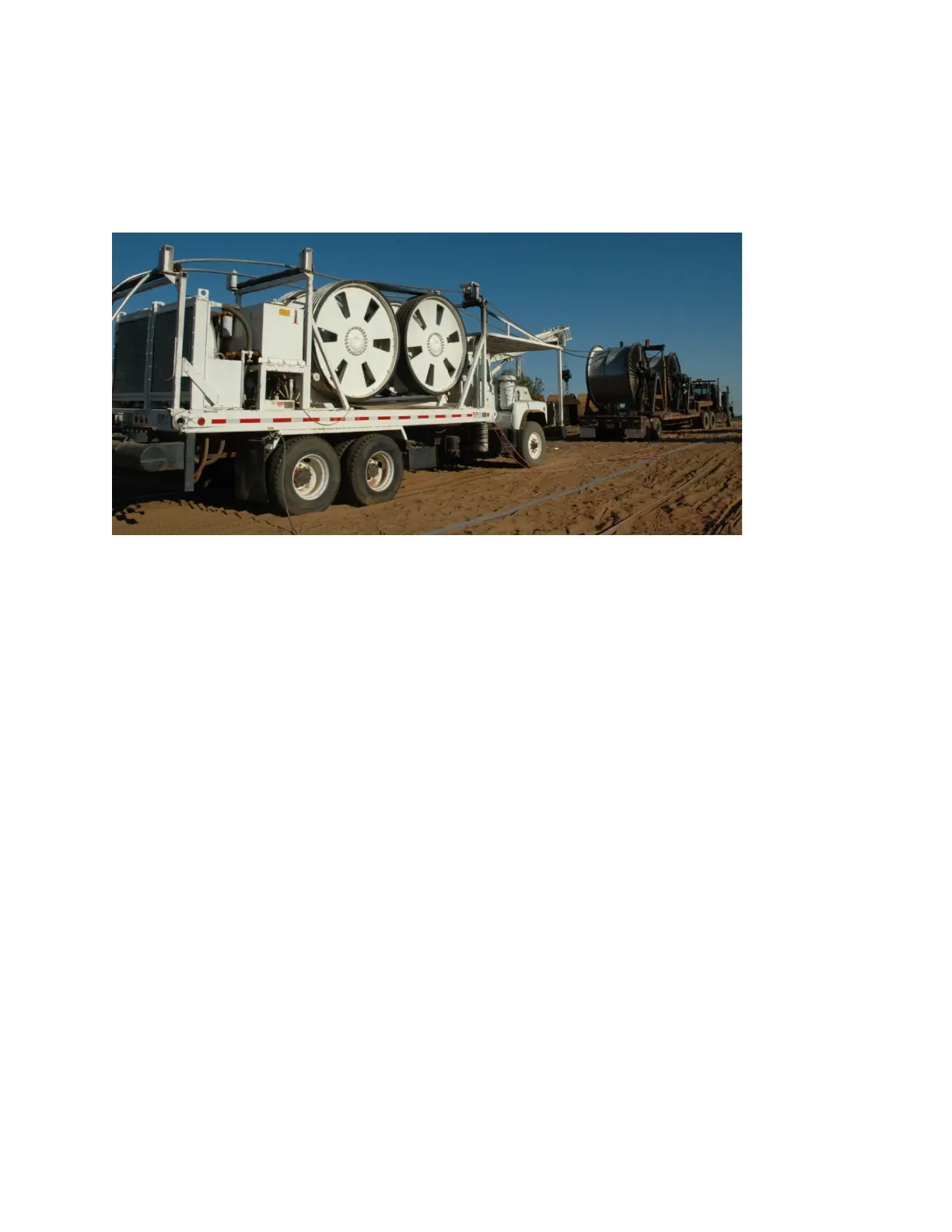
Bullwheel
Only dual drum multi-groove bullwheel tensioners are recommended for C
7
conductor. The
bullwheel drums may be offset or tilted so that the offset will be approximately one-half the
groove spacing.
Figure 11: Dual drum bullwheel, courtesy of ONCOR Power Delivery.
Semicircular grooves with depths of 0.5 or more times the conductor diameter and flare angles
of 5-15° from vertical are recommended. For multilayer conductors, the number of grooves in
the bullwheel must be sufficient to prevent the outer layer of wires from slipping through
underlying layers. The minimum bottom groove diameter of the bullwheel must be 35 times
the conductor diameter. Additional sizing charts and diagrams can be found in IEEE Standard
524. Bullwheels must be properly sized and lined to prevent scuffing and damaging of the
conductor.
The outer layer of wires on all standard stranded bare overhead aluminum conductors has a
right-hand direction of lay. The conductor should be reeved through the bullwheels such that,
when facing in the direction of puller, the conductor will enter the bullwheel on the left side
and exit from the right. This orientation is necessary to avoid any tendency to loosen the outer
layer of strands.
Elastomer- or thermoplastic polymer-lined grooves are recommended to avoid permanent
scuffing of the surface of the conductor. Semiconducting linings should not be relied on for
grounding purposes.
The bullwheel should be set up in line with the pull and 3-4 times as far from the base of the
structure as the height of the entrance block at the first structure. This orientation will provide
between a 14-19° angle as the conductor exits the bullwheel and also as it enters the entrance
or breakover sheave.



 To Next Page