Page 7 of 23 Guide for Installation and use of Southwire C
7
Overhead Conductor
exceeding the bending limits, external damage to the aluminum strands should be
visible upon inspection. Damaged sections should be cut out and a full-tension splice
installed. Consider sending potentially damaged sections to Southwire for evaluation.
Prior to sagging, the full length of the line should be inspected for any signs of localized
bending. Any kink or birdcage must be evaluated. If in doubt, take a photograph and e-mail it
to Southwire for evaluation. Handling accidents during transmission line construction are
almost unavoidable. What is critical is that damage get reported and repaired before the line is
pulled up to sag.
Protected against excessive bending and protected from crushing, C
7
conductor will outlast a
steel core conductor for the reason that steel will eventually corrode, whereas the composite
core is immune to all known chemicals in the natural environment. C
7
conductor can be
installed using conventional techniques developed over the past 100 years of conductor
installation. IEEE 524, Guide to the Installation of Overhead Transmission Line Conductors, is an
excellent guide and is endorsed by Southwire for both conventional conductors and C
7
conductor installation practices. Southwire’s installation guides are reviewed to ensure they
are compatible with the guidelines in IEEE 524.
Reel Handling and Storage
Unloading equipment must never come in contact with the conductor. Lifting must be
performed using a fork lift or crane as described below.
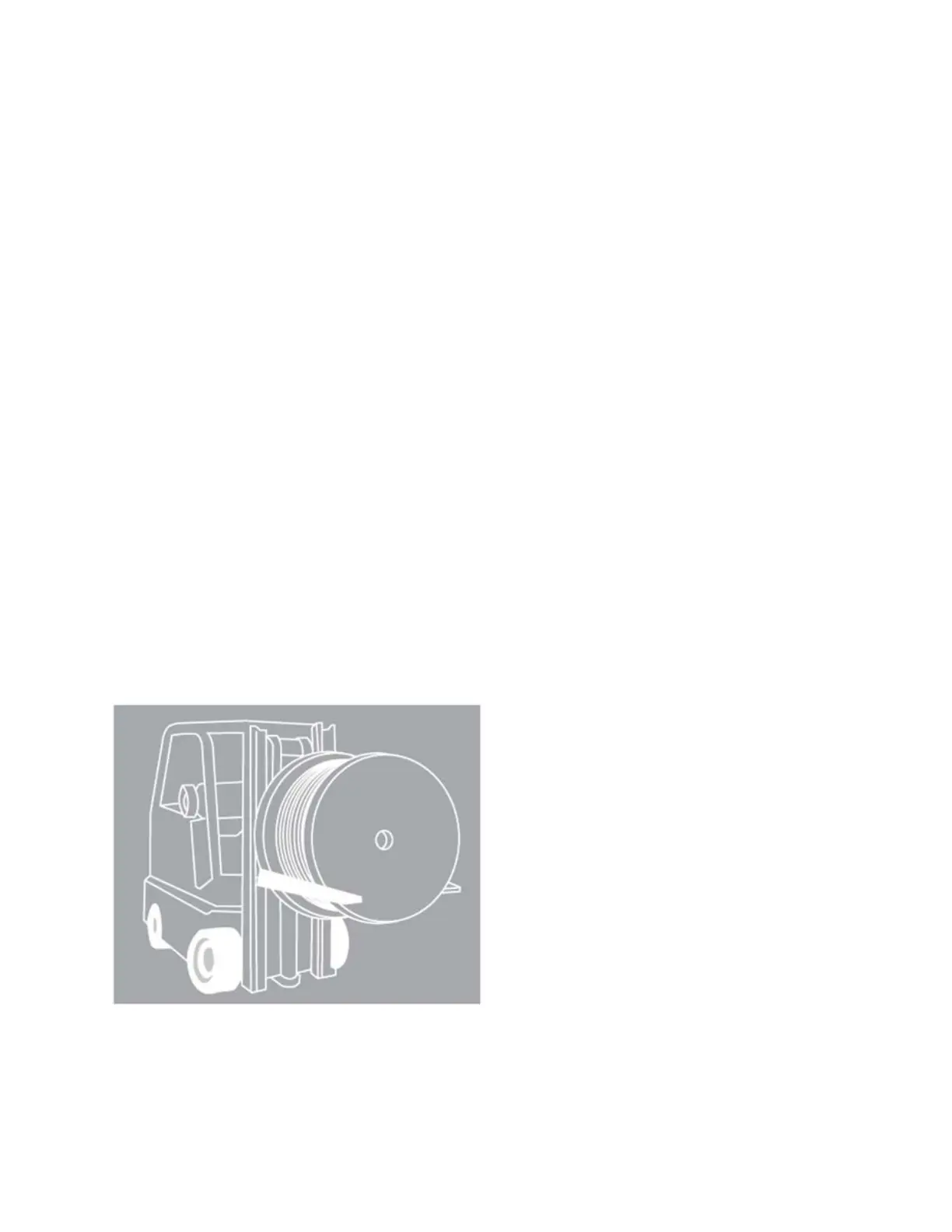
When using a fork lift, the forks shall be placed under both flanges, with the flange facing the
operator.
Figure 7: Forklift handling of reels.
When using a crane, a spreader bar must be used in conjunction with either “J” hooks or an
axle to prevent damage to the reel flange and conductor. “J” hooks should be placed in the
arbor holes. Axles should be inserted through the arbor holes and lifted with straps.



 To Next Page