CHARGE SET-POINT ADJUSTMENT
CHARGE SET-POINT ADJUSTMENT SHOULD ONLY BE ATTEMPTED WITH CAUTION.
IMPROPER CALIBRATION CAN RESULT IN BATTERY AND EQUIPMENT DAMAGE.
CAUTION - The standard charging set-points of the MARK/(15,20) will be proper for a majority of the
applications, however the MARK/(15,20) allows field adjustment of these set-points. Caution should be
used. It is a common belief that increasing a set-point up will correct an under-charged battery. In fact,
this adjustment will not affect the battery level but instead will cause the battery to overcharge once the
sizing problem is corrected. For under-charged batteries, refer to BATTERY PROBLEMS in the
TROUBLESHOOTING section (Page 19).
STANDARD SET-POINT: 14.4 volts for charge termination. Once the charging stops, the voltage will
immediately drop to a lower voltage.
WHEN ADJUSTMENT IS NOT NEEDED:
An adjustment will not make the batteries charge faster.
An adjustment will not increase the output of the panels.
An adjustment will not add more power to a battery that is usually undercharged.
An adjustment is not recommended to correct for a voltage drop in the battery connection.
WHEN ADJUSTMENT IS NEEDED: Adjusting the charge set-points is recommended for certain
situations which might otherwise result in under or over-charging the batteries. These recommendations
are approximate and can be influenced by specific conditions. Contact the battery manufacturer or
supplier to verify proper settings.
SOME BATTERIES REQUIRE DIFFERENT CHARGING VOLTAGES: Sealed, maintenance-free and
gel-cell batteries may require a lower charging voltage. Generally, for these batteries, the controller
should be set for 14.1 to 14.3 volts.
WHEN BATTERY WILL SEE PROLONGED TEMPERATURE EXTREMES: For colder areas (average
temperatures below 50°F (10°C) for many weeks) the set-point should be raised .3 volts (14.7 volts).
For hotter areas (average temperatures above 90° F (32°C) for many weeks) the set-point should be
lowered .3 volts (14.1 volts). Be sure to return to original settings when temperature moderates.
IN SYSTEMS WITH EITHER EXTREMELY HIGH OR LOW CHARGE RATES: Systems with very low
charge rates (1 amp per 100 amp hour of battery) should have the set-points lowered to about 14.0 to
14.2 volts. Systems with very high charge rates (over 20 amps per 100 amp hours of battery) should
increase the charging set-point to 14.8 to 15.0 volts.
PROCEDURE
1. COMPLETE BATTERY CONNECTION - Connect the battery to the MARK/(15,20) according to the
normal installation instructions.
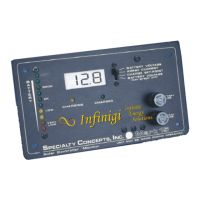
2. SET SWITCH TO “CHARGE SET-POINT” - Slide the front switch to the third position.
3. LOCATE ADJUSTMENT POT - The adjustment pot is located on the backside of the controller on the
circuit board. The adjustment pot appears as a small, square, component with a slotted circle in the
middle. (Refer to FIGURE 2 - BACK VIEW) (Page 9)
4. DETERMINE NEW VOLTAGE SET-POINT - Decide on a new voltage termination set-point. Note that
changing the shut off voltage will also change the "charge resumption" set-point by an equal amount. If
adjusting above 15.0 volts, check to see what the operating limits of other equipment may be, as some
electrical equipment (fluorescent lights, inverter) may be damaged or not operate at voltages over 15
volts.
5. ADJUST POT - Turning the pot counter-clockwise increases the set-point, clockwise decreases it.
Carefully adjust the pot to change the voltage reading to the desired setting. Do not force the dial
beyond the end stops.
6. MONITOR – After adjustment, monitor the batteries. For unsealed batteries: If you constantly need to
add water, they are set too high. If you do not hear them boil once in a while, they may be too low.
11


 To Next Page