8
8. TECHNICAL DATA AND COMPONENTS
Note: Spencer Italia S.r.l. reserves the right to make changes to specifications without notice.
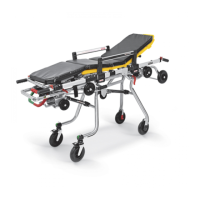
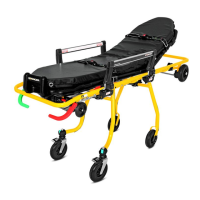
See Callout Image P2 – P3 – P4 – P5
Frame – Stretcher supporting
structure
Crossbar for front fixing – Element
needed to secure the stretcher to the
fixing system
Trendelenburg control lever, tilts the
foot end of the patient bed
Variable height unlocking lever –
Unlocks movement toward the outside
of the front leg, allowing the stretcher
to be positioned at the intermediate
height position
Sidebar unlocking lever – Allows the
siderails to be lowered
Sidebars – Lateral restraining of the
patient during transport.
Complete fifth wheel – Element
needed for coupling with the fixing
systems
Backrest piston – Adjusts the backrest
inclination
Trendelenburg/Fowler Lever – If
present, it excludes the presence of the
former. In addition to the former, it
also allows the Fowler position
Trend./Fowler Board – If present, it is
the TF version of the patient bed
Loading trolley wheels – These rest
on the ambulance floor during
stretcher loading, supporting it while
the front legs fold down.
Sharp System (if present) – Optional
mechanical system that allows the
stretcher to be released from the fixing
without intervening on the fixing itself
Front leg – When closed, it allows the
stretcher to be loaded into the
ambulance; two wheels are attached
to the stretcher, which are necessary
for its movement.
Sharp system drive handle
(if present) – Control part of the Sharp
System
Front wheel - needed to move the
stretcher
TEC TH Rear leg unlocking lever
Front piston – element needed to
move the leg
TEC TH Front leg unlocking lever
Rear leg – When closed, it allows the
stretcher to be loaded into the
ambulance; two wheels are attached
to the stretcher, which are necessary
for its movement.
Telescopic handle On the TH version
only, allows the stretcher to be raised,
for example for climbing steps.
Rear wheel with bracket - These
steer the stretcher by pivoting; they
have a brake to stabilise the stretcher
when it is not being moved
Stretcher shortening unlocking
mechanism – Allows the loading trolley
to be folded to facilitate handling in
confined spaces
Rear piston – element needed to
move the leg
Folding loading trolley – The loading
trolley can be folded downwards when
the release mechanism is activated
Front leg unlocking handle - Unlocks
the movement of the front legs,
allowing stretcher loading into the
ambulance
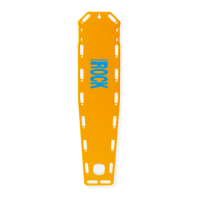
Spine board – B-bak pin – inserted into
the dedicated Carrera Pro slot
Rear leg unlocking handle - Unlocks
the movement of the rear legs,
allowing stretcher loading into the
ambulance


 To Next Page