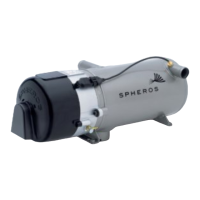
Thermo E 200 / 320 7 Servicing
701
7 Servicing
7.1 General
The general safety regulations (see 1.5.2) must be
observed.
7.1.1 Heater servicing
Only briefed and/or personnel trained by Spheros
may perform work on the heater.
For risk of overheating, the battery main current may not
be disconnected, while the heater is operating or in purge
cycle.
Make sure that the circulating pump is running while the
heater is switched on for tests/inspections.
7.2 Servicing
In order to ensure long-term functional reliability, the
following maintenance activities should be performed on
the heater at least yearly, at the latest before the cold
weather season starts.
NOTE
If FAME is used (max. 30%!), the fuel pump and
fuel lines must be replaced according to the latest
technical information.
You can find an actual overview of all technical infor-
mation on the Spheros homepage under Service /
Technical Documents.
• In order to prevent malfunctions, the fuel filter and/or
strainer as well as the fuel pump filter (screen) must
be replaced at least once a year, in case of heavily
contaminated fuel even more often.
• Yearly visual inspection of the fuel pump, fuel and
coolant lines for leakage. In case of a leakage they
must be replaced immediately otherwise after 5 years
service time.
• Yearly atomizer nozzle replacement.
The atomizer nozzle is a consumable thus not
covered by warranty.
• Yearly visual inspection of inspection glass and flame
detector glass body, clean as needed.
• Yearly visual inspection of the combustion chamber
and heat exchanger interior for contamination and
soot, clean as needed.
• Inspection of combustion air intake openings and
exhaust port for contamination. Clean as needed.
• Outside the heating period, the heater should be
operated every 4 weeks for 10 min. with the heater set
to "warm" and cold vehicle engine.
7.2.1 CO
2
Measurement and setting
CO
2
Measurement
The exhaust should not be measured directly at the
exhaust outlet of the heat exchanger, as this may cause
inaccuracies.
Exhaust fumes should be sampled from the exhaust pipe
in a distance of 350 mm after the heat exchanger. If no
exhaust pipe is connected for this measurement a flexible
hose of approx. 500 mm length (see accessories catalog)
can be installed. At this place also the measurement of the
exhaust gas temperature should be performed.
Increased exhaust temperature may indicate a sooted
heat exchanger (see 5.5.2).
1. After a combustion period of approx. 3 min. measure
the CO
2
content in the exhaust and compare it with
the target value in Table 701.
2. Determine smoke number as needed: Target value
according to Bacharach: ≤ 4.
The combustion air amount change is permitted an can be
achieved by rotation of the adjustment ring.
The measurement of the CO
2
content in the exhaust gas
and the adjustment of the combustion air amount is to be
performed:
• after repairs at the burner
• in case of combustion irregularities
• in the course of a functional inspection
• after atomizer nozzle replacement
• for application adaption
• for permanent operation at large altitudes
CO
2
Setting
1. Measure the heater input voltage
2. Operate the heater approx. 3 min.
3. Measure the CO
2
content and the smoke number and
compare readings with the appropriate diagram (see
Fig. 701).
4. Loosen the fixation screw (see Fig. 702) and rotate
the adjustment ring with the fixation screw until the
target value is reached.



 To Next Page