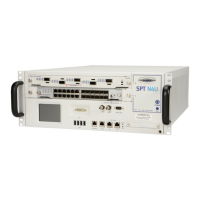
Spirent C1 and C2 Installation Instructions
Rack Mounting Considerations
Spirent C1 and C2 Installation Instructions | 21
PN 71-008959 Rev A April 2020
Site Selection
The Spirent SPT-C2 is a network testing device that should be installed in a dust free and
dry environment with adequate airflow, power, and cooling.
• SPT-C2 is designed with front to rear airflow and both ventilation locations must
remain unobstructed for proper operation. Inadequate cooling or airflow can result in
an over-temperature situation that will cause an automatic system shut-down.
• Inlet air temperature must be in the range of 41° to 95° F (5° to 35° C); 20% to 80%
relative humidity
• SPT-C2 appliance requires one (1) 115V power outlet on a 15A circuit.
Rack Mounting Considerations
• SPT-C1 appliance requires 2U of rack-mount space (roughly 4” high x 10” deep x 13”
wide). A rack-mount kit (ACC-0030) is available separately for revision D appliances
only. Appliance models prior to revision D should use a rack shelf if rack-mounting is
required.
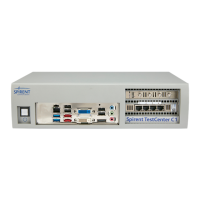
• SPT-C2 appliance dimensions are 11.22” x 13.9” x 3.5”. The SPT-C2 does not have a
rack mount kit.
Note: The SPT-C1/SPT-C2 may require safety agency evaluation, certification, and
licensing. Check with your building inspector for requirements applicable to your
location.
Notes on Rack Mounting
• Elevated operating ambient—If installed in a closed or multi-unit rack assembly, the
operating ambient temperature of the rack environment may be greater than room
ambient. Therefore, consider installing the equipment in an environment compatible
with the maximum ambient temperature of 30°C (86°F).
• Reduced air flow—Install the equipment in a rack such that the amount of airflow
required for safe operation of the equipment is not compromised.
• Mechanical loading—Mount the equipment in the rack such that a hazardous
condition is not achieved due to uneven mechanical loading. Do not stack other
equipment on top of a system that is already rack-mounted.
• Circuit overloading—Consider the connection of the equipment to the supply circuit
and the effect that overloading of the circuits might have on over-current protection
and supply wiring. Refer to equipment rating labels to ensure appropriate electrical
loading of this system in a rack.
• Reliable earthing—Maintain reliable earthing of rack-mounted equipment. Pay
particular attention to supply connections other than direct connections to the branch
circuit (for example, use of power strips).


 To Next Page