Need help?
Do you have a question about the SPRT SP-POS88V and is the answer not in the manual?
Details the print method, paper width, density, speed, and reliability of the printer.
Specifies the thermal paper model, type, width, and thickness.
Describes the available character sets and their specifications.
Details the RS-232C serial, parallel, and Ethernet interface specifications.
Covers character, graphics, and barcode print commands supported by the printer.
Specifies the power adapter voltage, current, and socket model.
Outlines the recommended operating and storage temperatures and humidity.
Provides the physical dimensions and weight of the printer.
Lists different printer models and their supported interfaces.
Illustrates and labels the external components and ports of the printer.
Provides instructions for installing and loading thermal paper.
Step-by-step guide for loading thermal paper roll into the printer.
Troubleshooting steps for resolving paper jams and cutter issues.
Details the various interfaces and their pin assignments for connectivity.
Explains the RS-232C serial port, pinout, and data structure.
Describes the parallel interface, its compatibility, and pin assignment.
Details the RJ-11 socket for cash drawer connection and its pinout.
Explains the power adapter connection, socket model, and pinout.
Identifies the FEED button and POWER/ERROR indicators, and their functions.
Procedure for performing a self-test to check printer functionality.
How to enter and use hexadecimal printing mode for debugging.
Steps to enter parameter setting mode and configure printer settings.
Instructions for entering firmware upgrade mode for the printer.
Overview of general settings configurable via buttons.
Configuration options for baud rates using the FEED button.
Selection of language settings for the printer.
Settings related to print speed, density, and font selection.
Configuration for buzzer, paper-out reprint, and black mark mode.
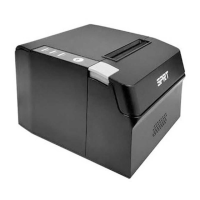
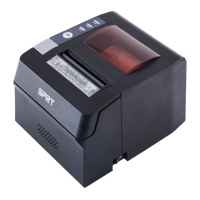
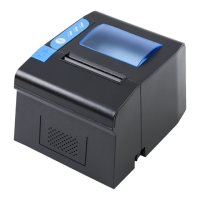
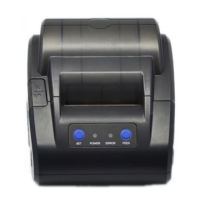
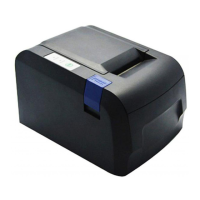
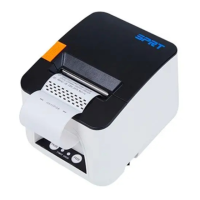
The SPRT SP-POS88 V is a line thermal receipt printer designed for fast, low-noise, and reliable printing with excellent print quality, eliminating the need for ribbons and regular maintenance. Its compact size, simple operation, and extensive application make it particularly suitable for commercial cash registers, PC POS, bank POS, and various receipt printing needs.
The printer's primary function is to produce thermal receipts. It supports various print control commands, including character printing with adjustable line spacing, double-width, and double-height options for ANK characters, user-defined characters, and Chinese characters. It also supports graphics printing, including bit-map graphics with different densities and downloadable bit-map graphics. For barcode printing, it supports UPC-A, UPC-E, EAN-13, EAN-8, CODE39, ITF25, CODABAR, CODE93, CODE128, PDF417, and QR bar codes.
The printer features a self-test function that checks its operational status and prints a self-test receipt containing 96 ANK characters, default code page, Chinese character library name, interface settings, and software version. It also has a hexadecimal printing mode, which allows all input to be printed as hexadecimal numbers, useful for debugging and advanced diagnostics. Parameter settings, such as baud rate, language, font, and print density, can be configured through a dedicated setting mode. The device also supports a program upgrade mode for firmware updates.
The printer is designed for ease of use. Paper loading involves holding down the upper cover button, opening the cover, placing the paper roll, drawing a length of paper, positioning the paper end on the print head, and closing the cover. Users are cautioned to pay attention to the paper loading direction, avoid manually feeding or drawing paper, and keep the print head clean to maintain print quality.
The printer includes a FEED button for manual paper feeding. Its functionality (enabled/disabled) can be set via print commands. Pressing the FEED button starts paper feeding, and releasing it stops it.
Indicators provide clear status feedback:
Error conditions are communicated through the indicators and an internal buzzer:
In case of an error, the "nFault" pin of the parallel interface changes to "0" level, and the printer can send a 1-bit wrong code via serial TXD or its state by responding to an ESC v command.
The printer is designed for minimal maintenance due to its ribbon-less thermal printing method. However, specific procedures are outlined for addressing issues like paper jams. If a cutter jam occurs, turning the power off and on again should reset the cutter to its original position. If a paper jam occurs, opening the paper cover and removing the paper is recommended. If the cutter remains stuck, the cutter cover can be opened, and the white plastic gear can be manually turned in the suggestive direction to return the cutter to its original position.
Keeping the print head clean is crucial for maintaining print quality, as advised in the paper loading instructions. The print head has a long life of 150 km, and the cutter is rated for 1.5 million cuts, indicating robust design and reduced need for frequent component replacement.

 To Next Page
 General