The Radiodetection RD7200 is a precision utility cable and pipe locator system designed for underground utility surveys. It comprises a locator and a transmitter, both ergonomically designed for extended use in various environments. The system offers a comprehensive range of features and accessories to meet specific customer needs for locating, tracing, and identifying buried lines.
Function Description
The RD7200 system is primarily used for precision utility cable and pipe location. It operates by applying a signal to a target utility (cable or pipe) using the transmitter, and then detecting that signal with the locator. This allows operators to trace the path of buried utilities, determine their depth, and identify specific lines in congested areas. The system supports various operating modes and frequencies to adapt to different applications and environmental conditions.
Key functions include:
- Active Location: Tracing the path of buried lines by applying a signal from the transmitter.
- Passive Location: Detecting naturally radiating signals from buried conductors (Power, Radio, CPS).
- Depth Measurement: Automatically calculating the depth of buried cables, pipes, and sondes.
- Current Measurement: Identifying target utilities and assessing cable insulation or pipe coating conditions.
- Fault-Finding: Locating cable sheath faults and insulation faults on pipelines using specific fault find signals and an A-frame accessory.
- Sonde Location: Tracing the paths of pipes, ducts, sewers, and drains, and precisely locating blockages or collapses using battery-operated transmitters (sondes).
- Inductive Search: A more certain technique for locating unknown lines, involving a two-person sweep with a transmitter and locator.
- Nulling Out: A technique to eliminate induction signals directly beneath the transmitter while inducing signals onto other nearby utilities that were previously undetectable.
Important Technical Specifications
While specific numerical specifications are not fully detailed in the provided manual, the following technical aspects are highlighted:
- Battery Type: Supports Lithium-Ion, Alkaline, or Nickel Metal Hydride (NiMH) batteries for both locator and transmitter. Li-Ion battery packs are standard.
- Power Output (Transmitter): Operates in low voltage (30V) or high voltage (90V) modes. The Tx-10 model features a "Boost" mode for maximum output power for specified durations.
- Frequencies: Supports a wide range of active frequencies (e.g., 512Hz, 8kHz, 33kHz, 100kHz and Over) and passive frequencies (Power, Radio, CPS). Specific models (PDL, PDLU, PXL, TL, PL, DL, SL, SLQ, H2O+, RD4K, 72, 82) support different combinations of frequencies and operation modes (DC, Induction, Clamp, LPC/LCC).
- Depth Accuracy: Depth measurements are stated to be precise to ±3% under suitable conditions.
- Environmental Rating (Submersible Antenna): The submersible antenna is pressure tested to IP68 for depths up to 100m (300ft).
- Clamp Diameter: Standard locator clamps are suitable for cables up to 130mm (5") diameter, small clamps up to 50mm (2"). Transmitter clamps handle cables up to 130mm (5½") diameter.
- FlexiTrace: Maximum power rating of 1W, minimum bend radius of 250mm, for locating small diameter, non-metallic pipes to a depth of 3 meters.
Usage Features
The RD7200 system incorporates several features designed to enhance usability and accuracy:
- Antenna Modes:
- Peak: Most sensitive and accurate for location and depth, providing a sharp Peak response.
- Peak+: Combines Peak bargraph with Null or proportional Guidance arrows for distortion indication or rapid line tracing.
- Guidance: Offers good performance in distorted fields with proportional arrows and a ballistic directional 'needle' for tracing the general path.
- Null: Provides a quick left/right indication of the path, best used in interference-free areas.
- Keypad and Menu System: Intuitive navigation for selecting frequencies, adjusting gain, changing settings, and accessing various modes. Shortcuts are available for common actions.
- LCD with Auto Backlight: Improves visibility in different lighting conditions.
- Compass Indicator: Provides a visual indication of the target cable, pipe, or sonde's direction relative to the locator.
- TruDepth™ Measurement: Automatic depth measurement when the locator is correctly oriented over the target line.
- StrikeAlert™: Detects possible shallow utilities with flashing asterisks and an audible alarm.
- Swing Warning: Alerts operators to excessive swinging or tilting of the locator, which can affect accuracy.
- Dynamic Overload Protection™ (DOP): Integrated feature to maintain accuracy in areas with high electromagnetic interference.
- Vibration (Haptic) Warnings: Provides tactile feedback for alarms like shallow cables/pipes, overload, and swing warning, useful in noisy environments.
- SideStepauto™: Recommends a general-purpose locate frequency by measuring target impedance, improving accuracy and prolonging battery life.
- Eco Mode (Transmitter): Extends battery life when using alkaline D-Cells by reducing power output as batteries deplete.
- Measure Mode (Transmitter): Allows for impedance and voltage measurements across connection leads.
- Accessories: Supports a wide range of accessories including headphones, locator clamps, transmitter clamps, sondes, stethoscopes, submersible antennas, and various connection leads and kits.
Maintenance Features
The RD7200 is designed for durability and ease of maintenance:
- Robust and Weatherproof Design: Built to withstand various environmental conditions.
- Regular Cleaning: Recommended to keep the equipment clean and dry, especially after contact with foul water or contaminants, using a soft, moistened cloth and appropriate disinfectants. Abrasive materials or high-pressure hoses should be avoided.
- Battery Management: Instructions for inserting, removing, and charging battery packs (Li-Ion, D-cell Alkaline, NiMH). Warnings against complete discharge for alkaline batteries and handling hot batteries are provided.
- Enhanced Self-Test: An on-board diagnostic feature that checks the integrity and performance of the locator's circuitry. Recommended weekly or before each use, performed away from large metallic objects or strong electrical signals.
- eCert: A thorough test for the RD7200's locating circuitry, providing a Radiodetection Calibration Certificate upon a positive test result. Requires connection to an internet-enabled PC with RD Manager Online software.
- RD Manager Online: PC companion software for managing and customizing the locator, including software upgrades, setting date/time, activating/de-activating frequencies, and configuring functions like StrikeAlert. Also used for product registration to extend warranty.
- Service and Calibration: Designed to minimize regular calibration needs, but annual servicing by Radiodetection or an approved repair center is recommended (and may be legally required).
- No User-Serviceable Parts: Users are advised not to attempt disassembly, as this may damage the equipment and void the warranty.
The manual emphasizes safety warnings throughout, particularly regarding potentially lethal voltages from the transmitter, the importance of proper connections, and reducing audio levels when using headphones. It also highlights the need for qualified and trained personnel to operate the equipment and adhere to local safety procedures and regulations.

 Need help?
 General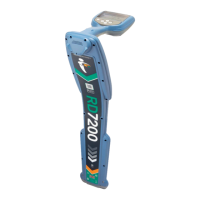

 To Next Page