© 2022 Radiodetection Ltd 34
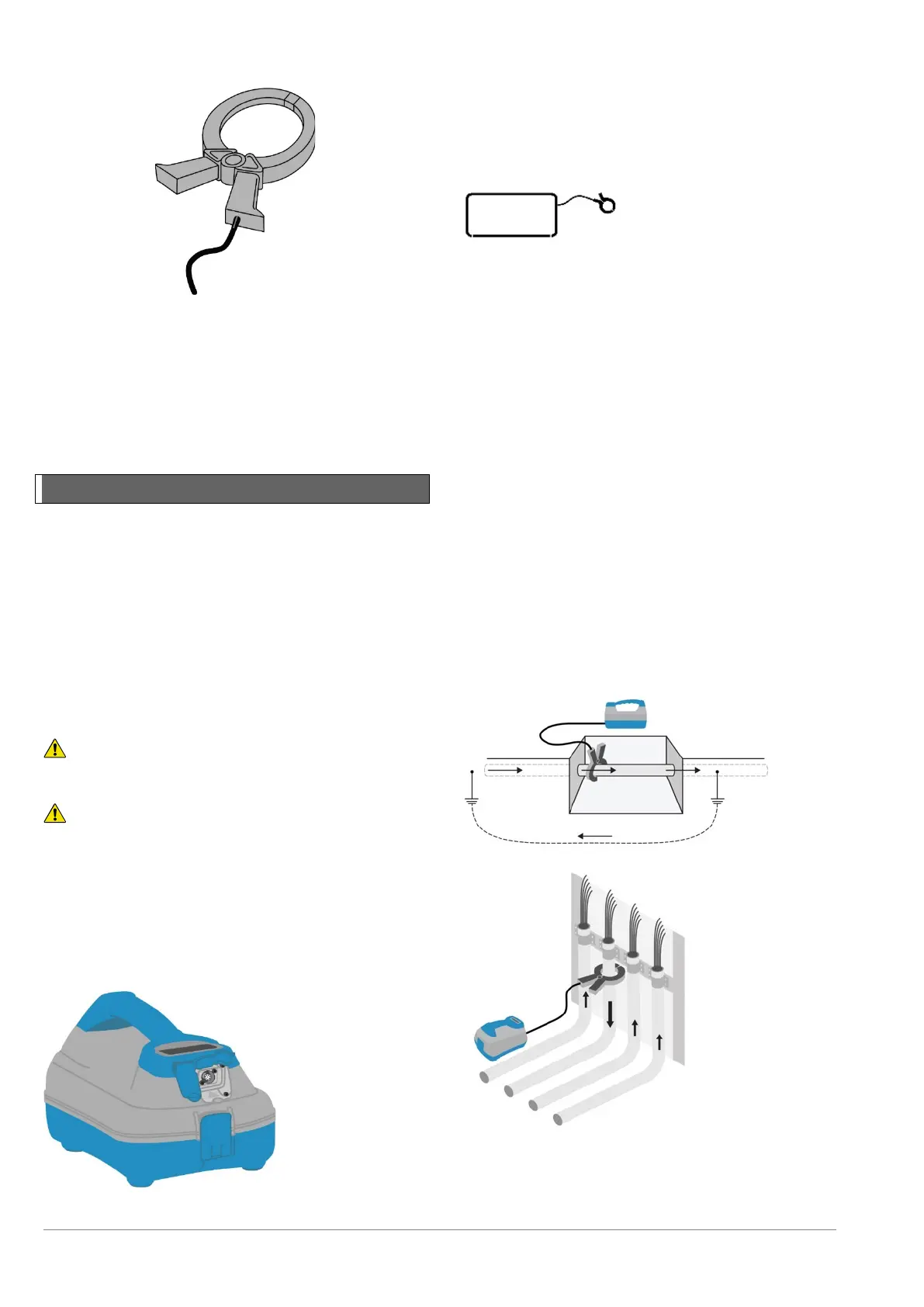
Figure 9.2: Standard Clamp
Small clamp
The small clamp performs the same function as the
standard clamp but is useful in cramped situations where
there is insufficient access for the standard clamp.
The small clamp is suitable for cables up to 50mm (2”)
diameter.
9.4 Transmitter clamps
The transmitter clamp fits around a pipe or cable and
safely applies a signal to a live insulated cable without
interrupting or disconnecting the supply. The clamp
applies a very discriminating signal to a target line with
reduced coupling to other lines. A clamp can sometimes
be a more effective method of applying the signal than
Direct Connection.
The target line will carry the strongest signal. The other
lines will carry the weaker return signal. If the system
comprises only two conductors, they may carry equal
signals.
WARNING! Do not clamp around uninsulated live
conductors
WARNING! Before applying or removing the clamp
around a power cable, ensure that the clamp is connected
to the transmitter at all times.
The clamp may buzz or vibrate if it is placed around a
power cable that has significant net current flow. This is
normal and does not harm the equipment.
Connecting the clamp
Figure 9.3 Transmitter output socket
7 Plug the clamp into the transmitter output socket.
8 Put the clamp around the pipe or cable and ensure
that the jaws are closed. Switch the transmitter on.
The display will show the Clamp connected icon
Figure 9.4 Clamp connected icon
The line should be grounded (earthed) on each side of
the clamp for the signal to transfer to the line. Ground
the line if necessary. An insulated cable may be traced
even if it has no actual ground connection, providing a
reasonable length is buried either side of the clamp to
provide capacitive coupling to ground (earth).
NOTE: It is not necessary to make a ground connection
from the transmitter when using the clamp.
Transmitter clamp range
Although transmitter and locator clamps look the same,
they have different internal windings. To prevent the
wrong clamp being connected, transmitters and locator
clamps have plugs of a different orientation.
Standard signal clamps
The standard clamps apply the transmitter signal very
selectively and effectively to a target cable up to 130mm
(5¼”) in diameter using frequencies from 8kHz to
200kHz.
Figures 9.5 – 9.6: Connecting transmitter clamps


 To Next Page