© 2022 Radiodetection Ltd 37
locator to behind the sonde ensuring that the locator
blade is always in line with the sonde. Find the null
positions A and B (See Figure 8.10). Measure the
distance between them and multiply by 0.7 to give an
approximate depth measurement.
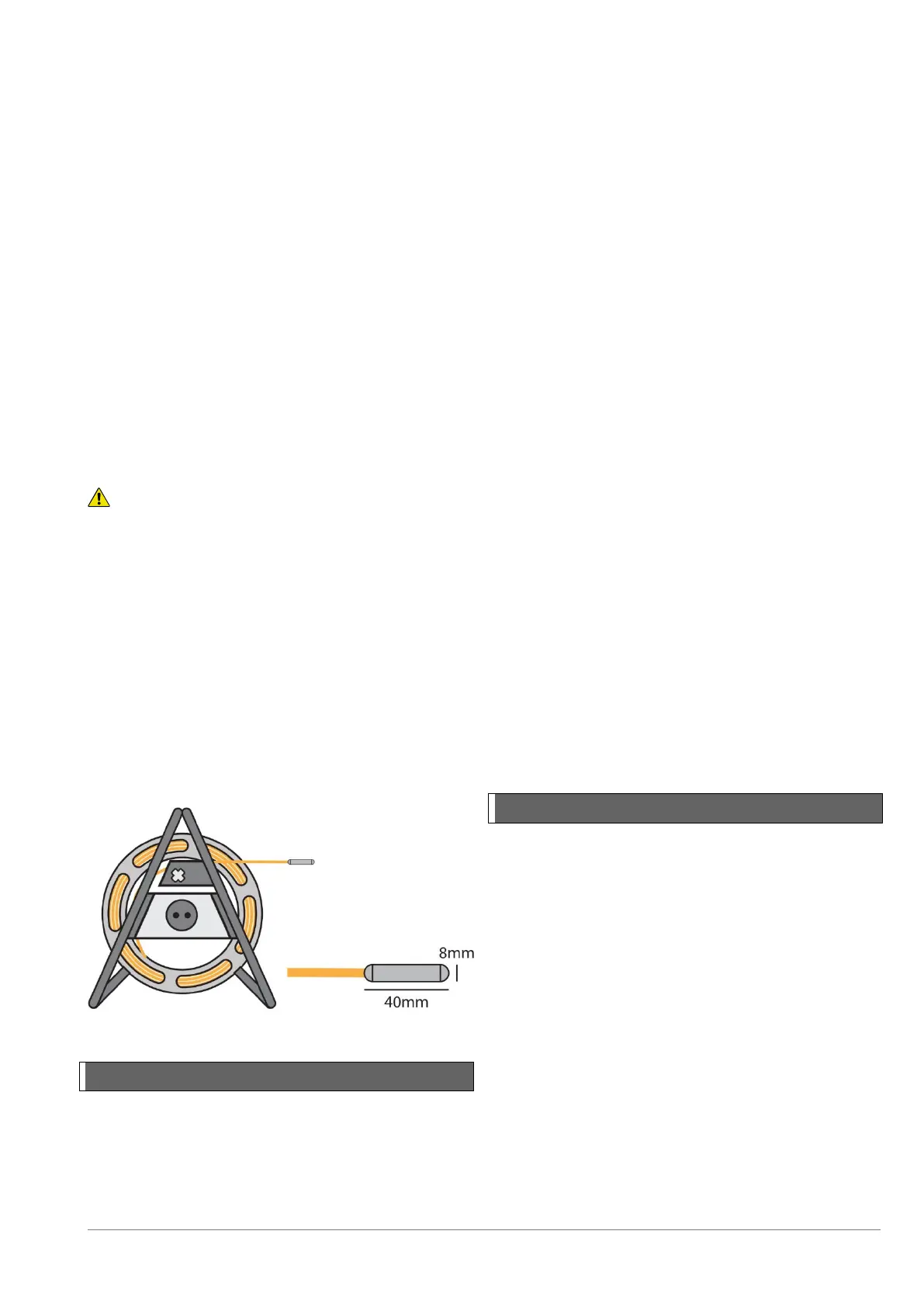
Flexitrace
The Flexitrace is a traceable plastic covered fiberglass
rod incorporating wire conductors and is used for
locating small diameter, non-metallic pipes to a depth of
3 meters. The Flexitrace can be inserted into a pipe or
duct as small as 9mm / 3/8” internal diameter, and it has
minimum bend radius of 250mm. Batteries are not
required, as the FlexiTrace is powered by any
Radiodetection transmitter.
The FlexiTrace has a maximum power rating of 1W.
When using the FlexiTrace with a Radiodetection Tx-5
or Tx-10 transmitter the output limit must be set to 1W in
the MAX P menu and the output voltage limit set to LOW
in the MAX V menu.
WARNING! Failure to follow the Tx-5 or Tx-10
instructions above may result in the tip of the FlexiTrace
becoming too hot to touch, resulting in risk of personal injury
and damage to the equipment.
The FlexiTrace can be used in two modes: Sonde mode
or Line mode. In sonde mode only the tip of the
FlexiTrace is energized whilst in line mode its whole
length is energized.
To use as a sonde, connect both transmitter leads to the
FlexiTrace stud terminals. As the FlexiTrace terminals
are not color coded it does not matter to which terminals
the leads are connected. To use the FlexiTrace in line
mode, connect the red transmitter lead to one of the
FlexiTrace terminals and connect the black transmitter
lead to a suitable ground connection.
9.7 Stethoscopes
When to use a stethoscope
At times, it may not be possible to put a clamp around a
cable because of congestion or because of
inaccessibility. A stethoscope antenna should be used in
place of a clamp to identify the target cable(s).
How to use a stethoscope
Plug the stethoscope into the locator accessory socket.
Press the concave head against each cable in turn to
detect a maximum signal.
Stethoscope range
Large stethoscope antenna
The large stethoscope antenna, which plugs into the
locator accessory socket, is used for cable identification
in situations where the cable is exposed. It is particularly
useful for identifying heavy cables lying in a tray where
it is not possible to fit a clamp. The concave detector
head on the end of the insulated, flexible gooseneck is
placed firmly against the cable to be identified. If there
are a number of cables, the stethoscope antenna will
give the strongest response from the cable to which the
transmitter signal has been applied.
Small stethoscope antenna
The small stethoscope antenna has a 25mm (2”)
concave head at the end of a 2m (6½ ft) lead. The small
stethoscope can be screwed into an extension rod or
used at the end of several extension rods joined together
for identifying inaccessible small cables.
Miniature hi-gain stethoscope
The miniature stethoscope is similar to the small
stethoscope but has no handle or facility for extension
rods.
The miniature stethoscope can also be used as a
miniature antenna for locations where the bulk of the
locator makes it inconvenient for use, such as locating
pipes or cables in walls.
9.8 Submersible antenna
When to use a submersible antenna
Tracing buried pipes and cables across waterways and
estuaries are frequent and critical locating applications.
Less frequent but equally important is tracing and
locating lines between the mainland and offshore
islands. When locating pipes and cables the locator
sensing antennas should be as close as possible to the
target line so it is not practical to locate lines buried
under a river or seabed from the surface. In most cases,
it is necessary to measure the depth of cover to ensure
the line is protected from dragging anchors or other
underwater hazards.
The submersible, double depth antenna is suitable for
use under water for tracing pipes or cables. There is a
weight at the bottom of the antenna for stability and the
unit has been pressure tested to IP68 to a depth of 100m
(300ft).
The antenna is supplied with 10m of submersible marine
umbilical cable as standard, but lengths of up to 100m
Figure 9.10: FlexiTrace


 To Next Page