Introduction
Page 9
3.2 Typical Coast Station system installation
A typical application for the Coast Station is relaying AIS messages received at the coast to viewing and
database applications via the Internet. The Coast Station is connected to a VHF antenna for AIS reception
and provided with an Ethernet connection to an Internet access point.
The Coast Station is configured to stream the received AIS data to a pre-configured network destination
specified with an IP address and port number. The Coast Station can support both TCP and UDP operation,
and can operate either as a server or a client. Typically the Coast Station is configured as a TCP client
configured to push data to the public IP address of a central database server.
Alternatively the Coast Station can be connected directly to a PC via USB. Note that the tag block feature
described in section
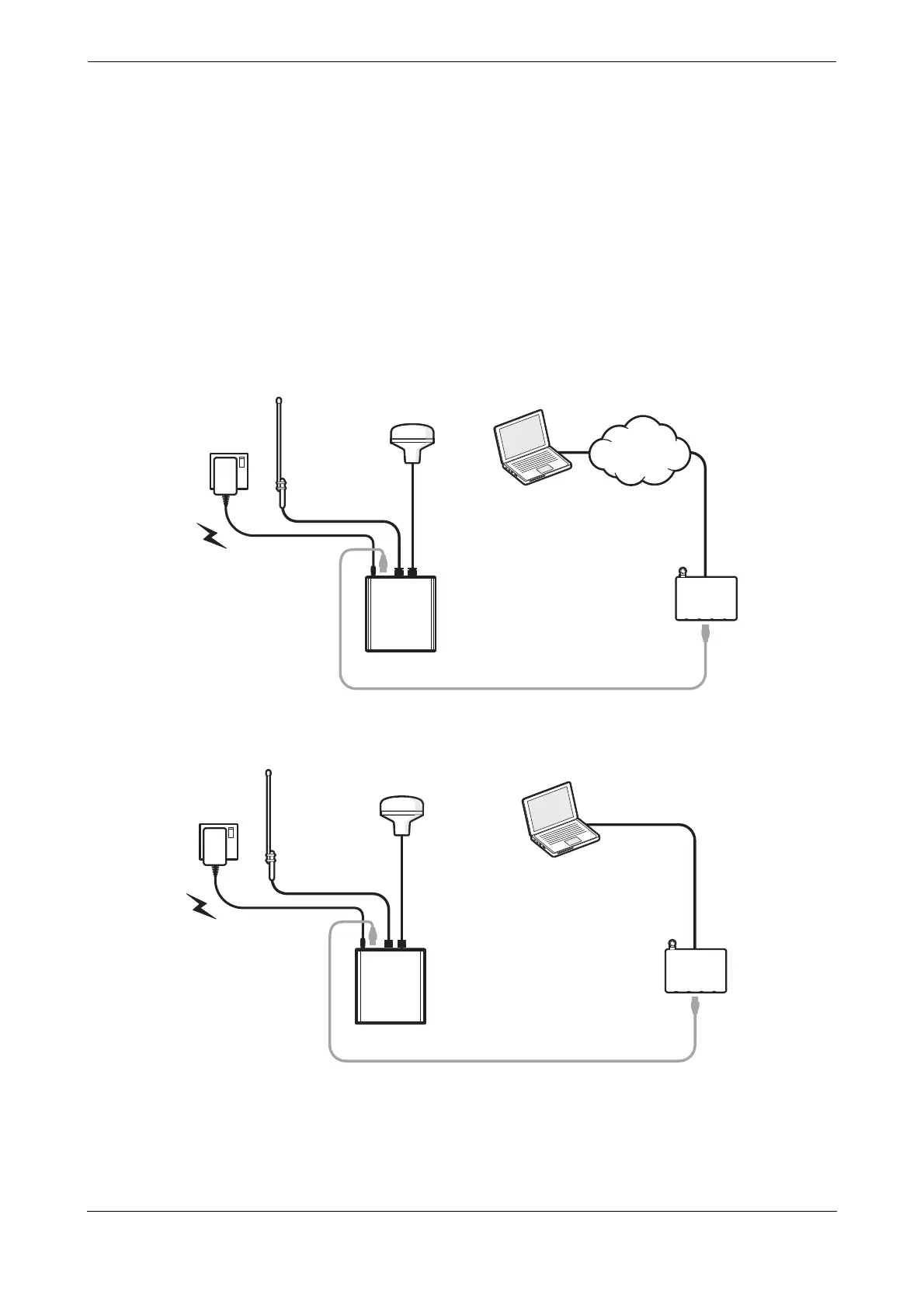
6 is not supported over the USB connection. Figure 2, Figure 3 and Figure 4 show possible
connection schemes.
Figure 2 Coast Station installation for connection to a remote viewer/database via Ethernet
Figure 3 Coast Station installation for connection to a local viewer/database via Ethernet
Viewer / database
applications
WWW
Mains
power
VHF antenna
GPS antenna
AIS Coast
Station
Network
router
Ethernet cable
VHF antenna
GPS antenna
AIS Coast
Station
Network
router
Ethernet cable
PC
Mains
power



 To Next Page