Need help?
Do you have a question about the Ssl DDC28B and is the answer not in the manual?
Guidelines for safely handling audio discs to prevent damage and ensure playback quality.
General safety advice regarding fire, electric shock, interference, and repair.
Important warnings about lithium battery cell leakage, disposal, and keeping them away from children.
Warning against inserting foreign objects into car radio openings like disc compartment or USB jack.
Warning about not switching on the car radio for long periods with the engine off to prevent battery discharge.
Specifies the required dashboard opening dimensions for the double-DIN car receiver installation.
Detailed procedure for installing the car radio, including wiring and faceplate attachment.
Visual representation and list of electrical connections, including power, speakers, and auxiliary inputs.
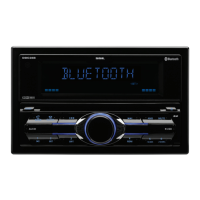
Detailed identification and numbering of all buttons and controls on the car radio's front panel.
Instructions for powering the car radio unit on and off using the front panel or remote control.
How to adjust volume and navigate through audio settings like Bass, Treble, Balance, and EQ.
Procedure for displaying and setting the clock time in either 12-hour or 24-hour format.
How to switch between different audio sources like RADIO, Bluetooth, DISC, USB, SD Card, and AUX-IN.
How to activate mute, loudness for enhanced bass, and select equalizer presets (OFF, FLAT, POP, ROCK, CLASS).
Information on using the USB port for media playback and charging, and the SD card slot for media playback.
Details on connecting external devices via the 3.5mm AUX input and the hands-free microphone.
Instructions for resetting the system to factory default settings using the reset button.
How to switch between USA and Europe frequency bands for radio reception.
How to change radio bands (FM1-3, AM1-2) and perform manual or auto seek tuning.
Guide to memorizing up to six stations per band and recalling them using preset buttons.
How to automatically scan and store the strongest stations, and recall them.
How to select reception modes for stronger (LOCAL) or weaker (DX) signals and improve audio quality (STEREO/MONO).
Instructions for inserting discs, USB devices, and SD cards for playback.
Procedure for safely ejecting discs, USB devices, and SD cards from the unit.
How to play, pause, skip tracks, fast forward, and rewind media playback.
Using INT (Intro Scan), RPT (Repeat), and RDM (Random) functions for media playback.
How to navigate through tracks and folders using specific buttons for discs, USB, and SD cards.
Methods to search for MP3 files by track number, folder, or file name.
How to connect MP3 players or other audio devices via front panel AUX jack or rear RCA connectors.
Instructions for switching to AUX input mode to listen to external devices.
Step-by-step guide to pair a Bluetooth-enabled mobile phone with the car audio system.
How to make calls, redial numbers, answer, reject, and end calls using the hands-free system.
How to switch audio between the car system and the mobile phone during a call.
How to adjust the volume during a call and mute the sound.
Instructions for streaming audio from a Bluetooth device and controlling playback (play, pause, skip).
Instructions to remove the protective plastic tab before first use of the remote control.
Procedure for replacing the lithium battery cell in the remote control.
Tips on positioning the remote, its operating angle, and maximum distance for effective control.
Identification and explanation of all buttons on the remote control and their corresponding functions.
Details on chassis dimensions, power requirements, current consumption, and maximum power output.
Technical details for FM and AM radio reception, including frequency ranges and usable sensitivity.
Information on supported audio formats, USB port type, card type, pre-amp output, and frequency response.
Details on supported Bluetooth profiles (A2DP, AVRCP, HFP) and frequency range.
Solutions for when the car radio does not turn on, checking ignition switch and fuses.
Troubleshooting steps for discs that cannot be loaded or ejected, including disc condition and insertion direction.
Solutions for lack of sound or intermittent sound, checking volume, wiring, and disc condition.
Troubleshooting for non-responsive operation keys, checking installation angle and front panel fit.
Solutions for no radio reception or failure to stop at transmitting stations, checking antenna connection and signal strength.
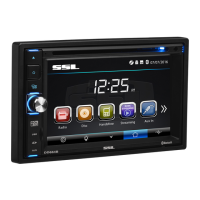
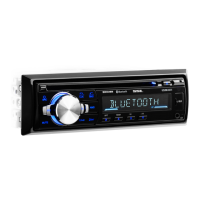
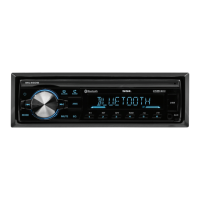
The DDC28B is a double-DIN MP3/CD AM/FM receiver with Bluetooth® connectivity, designed for in-car entertainment and communication. This unit allows users to play various audio formats, tune into radio stations, and manage calls hands-free.
The core function of the DDC28B is to provide a comprehensive audio experience in a vehicle. It supports playback of MP3 and CD discs, as well as digital audio files from USB devices and SD cards. The integrated AM/FM tuner allows access to radio broadcasts, with the ability to store and recall preset stations. Bluetooth® functionality enables wireless audio streaming (A2DP) from mobile devices and hands-free calling (HFP), enhancing convenience and safety while driving. An auxiliary input (AUX-IN) is also available for connecting external audio sources via a 3.5mm jack or RCA connectors.
The unit can be turned on or off by pressing any button or by pressing and holding the power button. Volume is adjusted using the VOL knob or dedicated VOL+/VOL- buttons on the remote control. Menu options such as BASS, TREBLE, BALANCE, FADER, EQ settings (OFF, FLAT, POP, ROCK, CLASS), LOUDNESS, DX/LOCAL, STEREO/MONO, VOL LAS/ADJ, AREA US/EU, CLOCK 12/24, and BEEP ON/OFF can be accessed and adjusted via the SEL button and VOL knob. The clock can be set by pressing and holding the CLK button and then using the tune up/down buttons to adjust hours and minutes. The source can be changed by pressing the MODE button, cycling through RADIO, BT (Bluetooth), DISC, USB, CARD, and AUX-IN modes. A MUTE button allows for temporary silencing of audio, and LOUDNESS can be toggled to reinforce bass frequencies. Preset EQ settings offer quick sound adjustments.
Users can switch between USA and Europe frequency areas by rotating the VOL knob in radio mode. Bands (FM1, FM2, FM3, AM1, AM2) are changed using the BAND button, with each band capable of storing up to six preset stations. Manual tuning is achieved by pressing and holding the tune up/down buttons, while auto seek tuning quickly finds the next/previous available station. Stations can be stored by selecting a desired station and then pressing and holding one of the preset buttons (1-6). Recalling a preset station involves briefly pressing the corresponding preset button. The Automatic Store Station (AMS) function allows the unit to scan and store the six strongest stations in the current band. LOCAL/DX mode can be toggled to search for strong or weaker signals, and STEREO/MONO mode adjusts reception quality for FM stations.
Discs are inserted with the label facing upward into the disc slot, and playback begins automatically. For USB devices, the sliding door for the USB port is opened, and the device is inserted. SD cards require removing the front panel, inserting the card into the SD slot, and then reattaching the front panel. Ejecting a disc, USB device, or SD card involves pressing the play/pause button to stop playback, then the eject button (for discs) or removing the device/card. Playback can be paused or resumed using the play/pause button. Users can navigate to the next or previous track, fast forward or backward by pressing and holding the respective buttons. The INT (introduction scan) function plays the first 10 seconds of each track. The RPT (repeat) function repeats the current track, and RDM (random) plays all tracks in random order. Track/folder navigation allows users to jump 10 tracks backward or forward, or navigate between folders on MP3 discs, USB, or SD cards.
External audio devices can be connected to the 3.5mm AUX-IN jack on the front panel or to the RCA auxiliary input connectors on the rear. Once connected, pressing the MODE button switches the unit to AUX input mode, allowing audio playback from the external device. It's important not to use both the front AUX-IN jack and the rear RCA connectors simultaneously, as this can disable the auxiliary function.
To use Bluetooth®, mobile devices must first be paired and connected. The unit's Bluetooth® name ("SSL DDC28B") will appear on the mobile device. Once connected, the BT logo on the LCD will stop flashing. Mobile phone audio will automatically transfer to the car audio system for calls and music. Calls can be made by dialing directly from the mobile phone or by using the unit's dial telephone number mode, inputting numbers via the remote control. The last dialed number can be redialed by pressing and holding the call button. Incoming calls display the number on the LCD and can be answered or rejected using the call button. Active calls can be ended with the call button. Audio can be switched between the car audio system and the mobile phone during a call using the VOL knob/button. Talk volume can be adjusted with the VOL knob or VOL+/VOL- buttons, and the MUTE button can silence the sound. Audio streaming (A2DP) allows wireless playback of music from a Bluetooth® mobile device, with control over tracks (next/previous) and playback (pause/resume) via the unit's front panel using AVRCP.
The remote control comes with an insulating sheet that must be removed before first use. The lithium battery cell in the remote control needs to be replaced when it becomes weak. This involves pressing and holding a movable block, pulling out the cell holder, replacing the old cell with a new one (ensuring correct polarity), and re-inserting the holder. Warnings are provided regarding cell leakage, not throwing cells into fire, and keeping them out of reach of children. The remote control operates best within 5 meters of the unit's sensor window, with an optimal angle of about 30 degrees.
Discs should be handled by their edges, avoiding touching the playing surface. They should be wiped clean from the center outward with a soft, dry, lint-free cloth. Solvents or thinners should not be used. After removal, discs should be placed in a sleeve or case to prevent scratches. Paper or tape should not be stuck on disc surfaces. The unit should not be repaired by the user; all service should be referred to a qualified technician. High volume levels should be avoided to prevent distracted driving. If the car has been in direct sunlight, the unit's temperature may need to be reduced before use. Disconnecting or changing the battery will reset the unit's memory. The unit is designed for horizontal installation; avoid installing it at an angle for optimal performance. Excessive force should not be used when removing or attaching the faceplate, and the display and buttons should not be gripped tightly to prevent damage. Foreign objects should never be placed into the disc compartment, USB jack, card slot, or AUX-IN connection. The car radio should not be switched on for long periods when the motor is off, as this can discharge the car battery.
If the LCD displays abnormally, sound is distorted, or controls are disabled, the unit can be reset to factory default settings. This is done by using a thin, pointed object to depress the RESET button.
A troubleshooting chart is provided to help diagnose common issues such as no power, disc loading/ejection problems, no sound, sound skips, unresponsive operation keys, and poor radio reception. Solutions include checking ignition, replacing fuses, removing discs, inserting discs correctly, cleaning discs, allowing the unit to cool, checking wiring, adjusting installation angle, and ensuring the front panel is properly installed. For radio issues, solutions include checking antenna connections and manually selecting stations if automatic search fails due to weak signals.
 General
| Bluetooth | Yes |
|---|---|
| USB Input | Yes |
| SD Card Slot | Yes |
| Aux Input | Yes |
| Display Type | LCD |
| Remote Control | Yes |
| Frequency Response | 20Hz - 20kHz |
| Radio Tuner | AM/FM |
| Power Output | 50 Watts x 4 Channels |
| Supported Media | MP3, WMA |
| Display | LCD |
| Peak Power Output | 50 Watts x 4 Channels |

 To Next Page