Handshake sequence allows the computation of internal parameters and apply them for next range.
The handshake must be performed by the user of the bare driver. Minimizing the delay in enabling a new ranging
after a new measurement has been received is key to maximizing the system measurement rate
2.2 Timing considerations
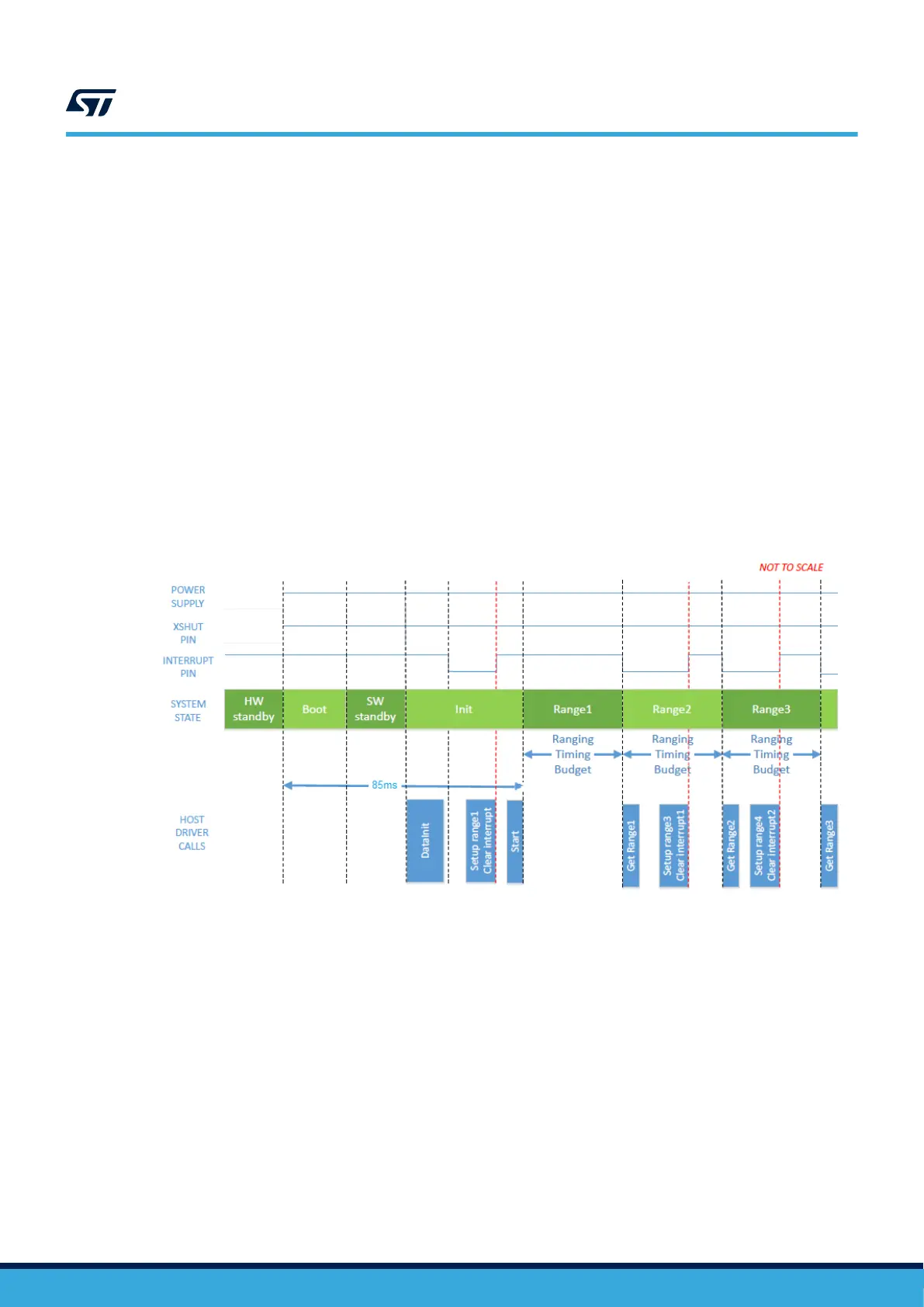
Timings are presented in Figure 3. Ranging sequence and timing targets.
The host can get the latest available ranging during the duration (ranging timing budget) of the current range.
If a delay to clear the interrupt is introduced by the host, the next ranging will be stalled until the pending interrupt
is cleared.
Note: Timings indicated in Figure 3. Ranging sequence and timing targets are typical timings.
The host can change the default timing budget by using a dedicated driver function described in
Section 5.1 Timing budget. The host can change the timing budget either to synchronize on the application,
or to increase ranging accuracy.
In the following figure, the “Boot”, “SW standby” and “Init” lasts 85 ms. This time is needed to initialize the device,
and is independent for the platform or the ranging timing budget. The first range, “Range1”, is the wrap-around
check, and is not valid. This means that the first valid ranging value is “Range2”, available after 85 ms plus twice
the timing budget duration.
Figure 3. Ranging sequence and timing targets
UM2923
Timing considerations
UM2923 - Rev 2
page 5/25


 To Next Page