SECTION FOUR – Routine Maintenance and Professional Servicing
LL
LL
oo
oo
cc
cc
aa
aa
tt
tt
ii
ii
oo
oo
nn
nn
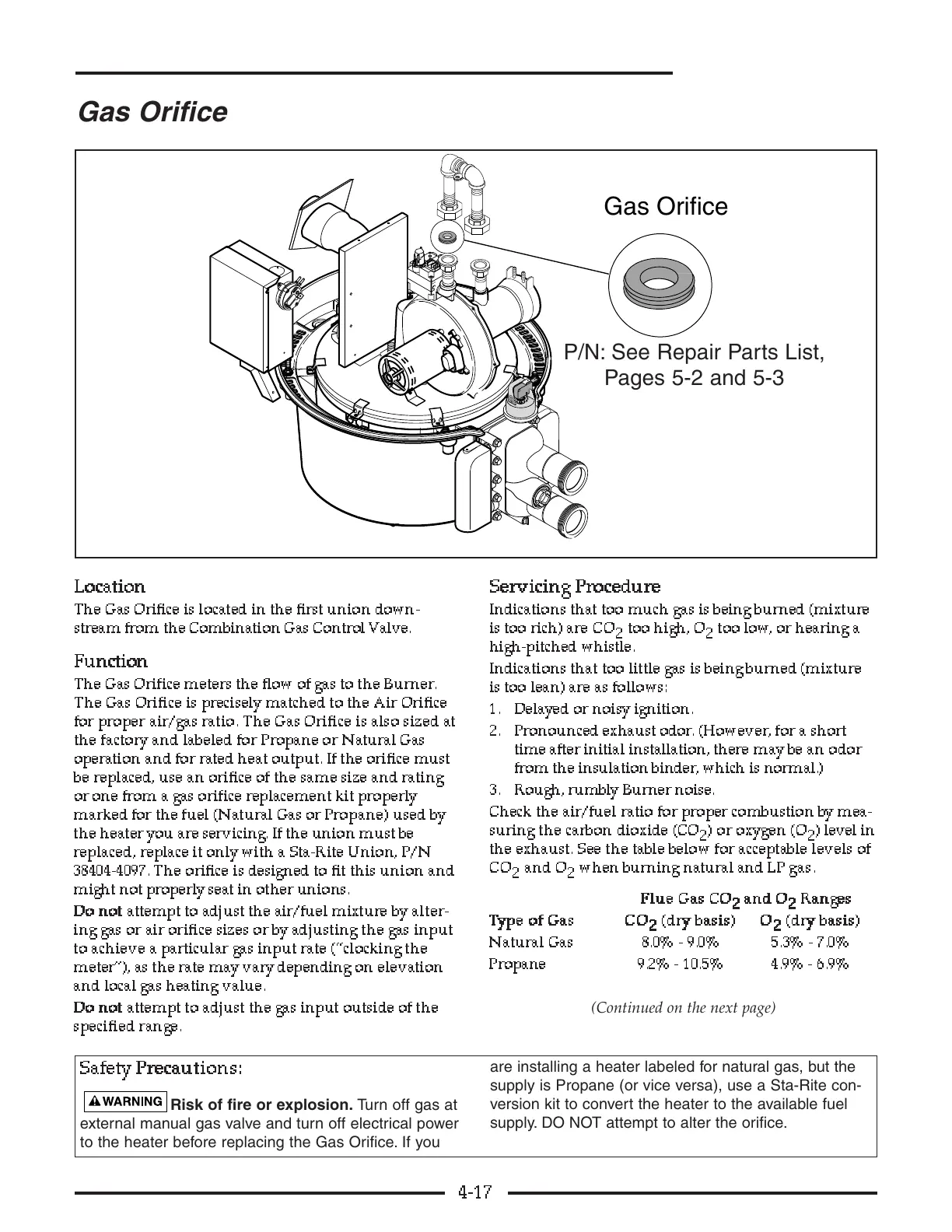
The Gas Orifice is located in the first union down-
stream from the Combination Gas Control Valve.
FF
FF
uu
uu
nn
nn
cc
cc
tt
tt
ii
ii
oo
oo
nn
nn
The Gas Orifice meters the flow of gas to the Burner.
The Gas Orifice is precisely matched to the Air Orifice
for proper air/gas ratio. The Gas Orifice is also sized at
the factory and labeled for Propane or Natural Gas
operation and for rated heat output. If the orifice must
be replaced, use an orifice of the same size and rating
or one from a gas orifice replacement kit properly
marked for the fuel (Natural Gas or Propane) used by
the heater you are servicing. If the union must be
replaced, replace it only with a Sta-Rite Union, P/N
38404-4097. The orifice is designed to fit this union and
might not properly seat in other unions.
DD
DD
oo
oo
nn
nn
oo
oo
tt
tt
attempt to adjust the air/fuel mixture by alter-
ing gas or air orifice sizes or by adjusting the gas input
to achieve a particular gas input rate (“clocking the
meter”), as the rate may vary depending on elevation
and local gas heating value.
DD
DD
oo
oo
nn
nn
oo
oo
tt
tt
attempt to adjust the gas input outside of the
specified range.
SS
SS
ee
ee
rr
rr
vv
vv
ii
ii
cc
cc
ii
ii
nn
nn
gg
gg
PP
PP
rr
rr
oo
oo
cc
cc
ee
ee
dd
dd
uu
uu
rr
rr
ee
ee
Indications that too much gas is being burned (mixture
is too rich) are CO
2
too high, O
2
too low, or hearing a
high-pitched whistle.
Indications that too little gas is being burned (mixture
is too lean) are as follows:
1. Delayed or noisy ignition.
2. Pronounced exhaust odor. (However, for a short
time after initial installation, there may be an odor
from the insulation binder, which is normal.)
3. Rough, rumbly Burner noise.
Check the air/fuel ratio for proper combustion by mea-
suring the carbon dioxide (CO
2
) or oxygen (O
2
) level in
the exhaust. See the table below for acceptable levels of
CO
2
and O
2
when burning natural and LP gas.
FF
FF
ll
ll
uu
uu
ee
ee
GG
GG
aa
aa
ss
ss
CC
CC
OO
OO
22
22
aa
aa
nn
nn
dd
dd
OO
OO
22
22
RR
RR
aa
aa
nn
nn
gg
gg
ee
ee
ss
ss
TT
TT
yy
yy
pp
pp
ee
ee
oo
oo
ff
ff
GG
GG
aa
aa
ss
ss
CC
CC
OO
OO
22
22
((
((
dd
dd
rr
rr
yy
yy
bb
bb
aa
aa
ss
ss
ii
ii
ss
ss
))
))
OO
OO
22
22
((
((
dd
dd
rr
rr
yy
yy
bb
bb
aa
aa
ss
ss
ii
ii
ss
ss
))
))
Natural Gas 8.0% - 9.0% 5.3% - 7.0%
Propane 9.2% - 10.5% 4.9% - 6.9%
(Continued on the next page)
4-17
Gas Orifice
SS
SS
aa
aa
ff
ff
ee
ee
tt
tt
yy
yy
PP
PP
rr
rr
ee
ee
cc
cc
aa
aa
uu
uu
tt
tt
ii
ii
oo
oo
nn
nn
ss
ss
::
::
Risk of fire or explosion. Turn off gas at
external manual gas valve and turn off electrical power
to the heater before replacing the Gas Orifice. If you
are installing a heater labeled for natural gas, but the
supply is Propane (or vice versa), use a Sta-Rite con-
version kit to convert the heater to the available fuel
supply. DO NOT attempt to alter the orifice.
P/N: See Repair Parts List,
Pages 5-2 and 5-3



 To Next Page