Approach at idle RPM at an angle approximately 45
degrees to the dock. When the bow is within a few
metres of the dock (starboard side) the stern can
be brought alongside by turning hard to port. Next,
turn to starboard and at idle RPM put the boat into
reverse. This will stop the boat and bring the stern
closer to the dock. These steps are reversed for
docking to port. A precaution should be taken not to
allow limbs between the boat and the dock.
Mooring
To attach lines to deck cleats, make a loop in one
end of the line and pass it through the hole in the
base of the cleat; then pass the loop back over the
entire cleat. The line can now be used to secure the
boat. Lines may be kept this way while underway,
providing they are coiled and cannot become tangled
in deck gear or props. In heavy sea conditions, all
lines should be removed from the deck. Fenders
should also be used when mooring the vessel to
protect the side of the vessel.
Leaving the Dock
Take into account the wind, tide, current and other
forces that affect manoeuvring when leaving the
dock. Most manoeuvring to and from a dock is best
accomplished at idle speeds. Do not forget to release
the mooring lines and stow the fenders.
When leaving a dock on the starboard side and the
bow cannot be pushed away from the dock first
observe the following points:
Start forward with the steering wheel turned to
starboard for two or three feet.
Then shift to reverse with steering full to port.
Repeat if necessary to shift the stern far enough away
from the dock to be clear of other boats that may be
moored ahead. (Reverse these steps when leaving a
dock located to port.)
DO NOT tow your boat or use your boat to tow other
boats:
Damage caused to a boat due to towing behind
another vessel or towing another vessel WILL NOT be
covered under warranty. The stress caused by towing
in this way is outside the design specifications for
our boats. A customer using a boat as a tender for
a larger vessel must transport the boat on the larger
vessel.
Anchoring
Pick a spot where the boat has room to swing
around the anchor without hitting other boats or
objects.
Avoid anchoring in channels or narrows where you
may interfere with traffic. You could cause another
boat to run aground or you might be run down by
larger craft.
Never tie up to, or obstruct the view of a buoy. This
contravenes marine law.
Approach the site slowly, keep the bow into wind or
current, whichever is stronger. Drift into position and
lower the anchor.
When anchoring, lower the anchor and chain from
the bow - don’t drop or throw it. When the anchor
reaches the bottom, drift or reverse slowly until the
anchor holds. Feed out line 3 to 6 times the depth
of the water. Keep feet and legs clear of the line.
WARNING
• Usecautionwithskierintowastowropemay
backlash into cockpit when released,
• Onlytowwaterskis,wakeboardsorrecreational
towables,
• Donottowparasails,kites,otherboatsorany
device that is designed to become airborne
when towed behind a boat,
• Donottowmorethanonepersonatonetime,
• Alwayswearanapprovedpersonalflotation
device (PFD),
• Donotallowanyonenearthepropeller(s),even
when engine is switched off. Propeller blades
can be sharp and can continue to turn after
engine is off.
HANDY TIP
To tie up, run the line from the boat around the
dock cleat and then back to the boat. This way
you can untie the line without jumping from the
deck to dock and back again. Instead, just cast
off one end of the line and bring the whole length
back on board.
Turn the line around the bow cleat and tie a hitch.
To raise the anchor, inch forward under power as
you take in line. When the line is vertical, raise the
anchor. If it’s not free, tie the line off on a cleat and
then circle the anchor slowly, keeping the line under
strain.
Don’t let the line get close to the propeller.
Boat Performance
Boat speeds are affected by many factors. Some
such as temperature and altitude, cannot be
changed, but some factors can. When loading, only
take the necessary equipment with you. Keep weight
at the lowest level possible and evenly distributed.
Weeds, barnacles and other growth will degrade
performance. Keep the bottom of the boat clean.
When the boat starts “growing grass”, it will slow
down greatly.
Running Your Motor
Outboard engines usually deliver their best fuel
economy at around 4,000-4,500 rpm. So, always try
and set the boat up in this range when travelling any
distance. The amount of load in the boat will also
influence fuel economy to a degree, so don’t fill the
boat up with unnecessary items.
If you do not have a tacho to monitor revs, locate
a spot between half and two thirds throttle where
the hull is sitting up on top of the water and
planing cleanly. It is likely the optimum rev range
is at this point.
Propeller
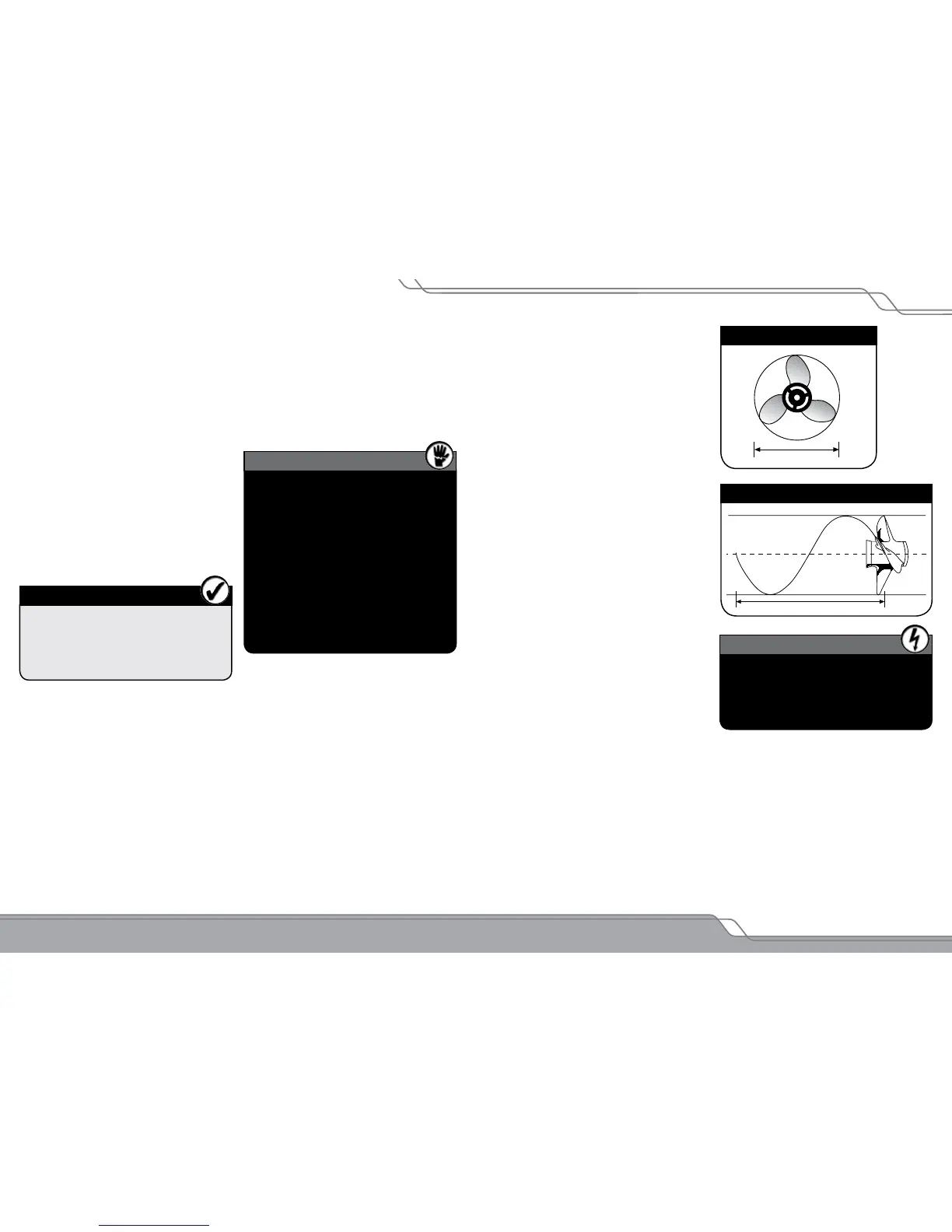
Propellers have two basic characteristics, 1)
diameter and 2) pitch. Diameter applies to the
circle inscribed by the blade tips, measured in
inches. Pitch is the theoretical distance (measured
in inches) a propeller travels when it has rotated
one complete revolution. For example, a propeller
with a 21 inch pitch, when rotated 360 degrees
advances 21 inches through the water. Because of
the essential phenomenon of blade angle attack and
slippage, a propeller cannot advance further than
about 90 percent of the pitch number, though 80 to
85 percent is quite common.
1) Diameter
2) Pitch
Replace Damaged Propellers
Propellers should be free from major nicks,
excessive pitting and any distortions that alter the
original design.
Operating your boat with a damaged propeller may
cause the following:
• Reducetopspeed.
• Introduceundesirablehandlingcharacteristics
• Reducefueleconomy.
• Createunpleasantvibrationsleadingtoincreased
sound level. Excessive vibrations hasten wear to
rotating and reciprocating engine components,
which may cause costly damage.
DANGER
Persons in the water can be seriously injured, or
killed if struck by a rotating propeller. Operate the
motor only when an operator is seated securely at
the controls. Turn the motor off when swimmers
are entering or leaving the boat or in the water
near the stern.
10 Owner’s Manual 11



 To Next Page