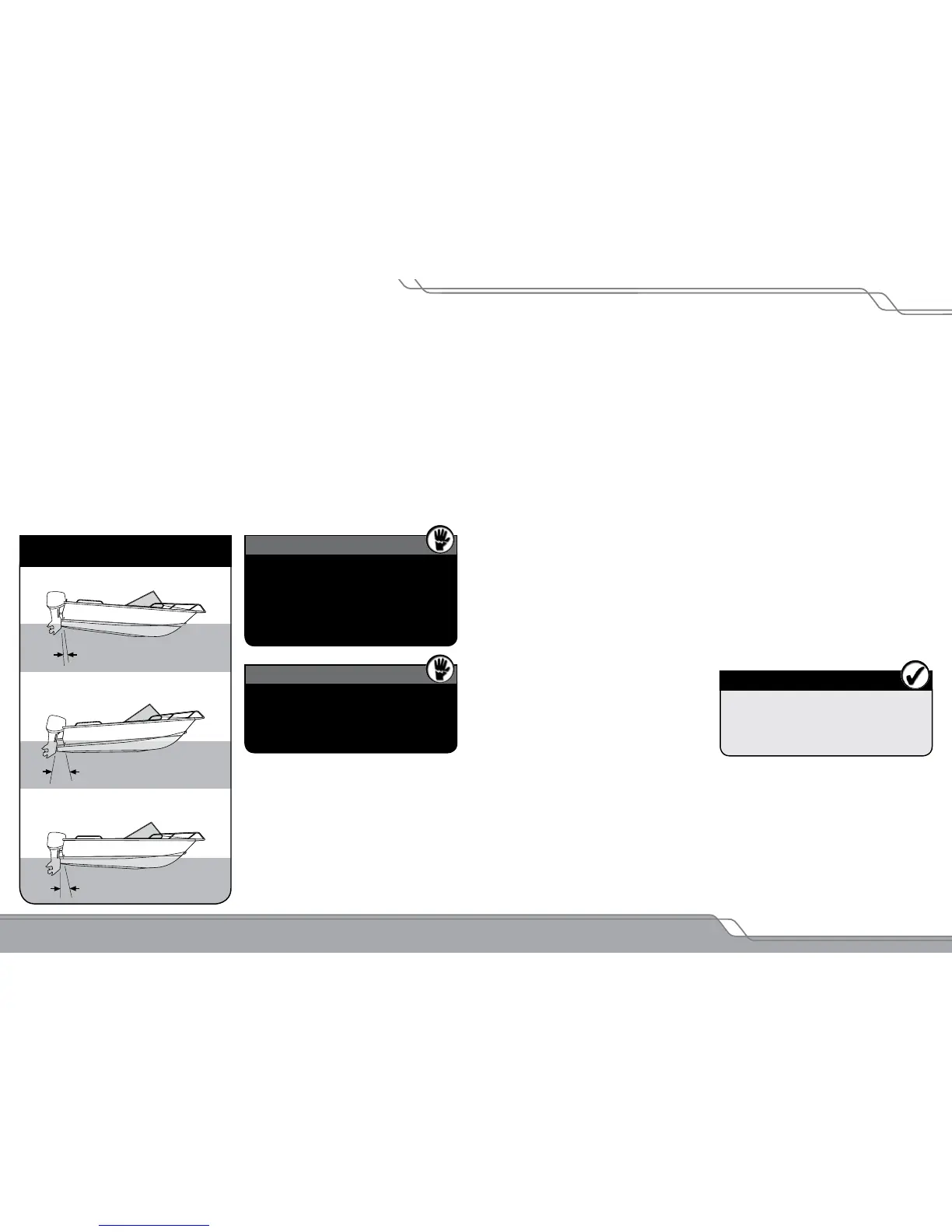
Trimming the Engine
for Maximum Performance
Trimming engine down (in) characteristics:
• Willhelpyougetontheplanequicker,particularly
with a heavy load.
• Usuallyimprovesrideinchoppywater.
• Inexcess,cancauseboattoveertotheleftor
right (bow steer).
• Transferssteeringtorquehardertoright(orless
to the left).
• Improvesplaningspeedacceleration(bymoving
tilt pin one hole closer to transom).
WARNING
Excessive trim out also may reduce the stability
of some high speed hulls. To correct instability
at high speed, reduce the power GRADUALLY and
trim the motor slightly before resuming high speed
operation. Rapid reduction in power will cause a
sudden change of steering torque and may cause
additional momentary instability.
WARNING
Excessive speed at minimum trim in may cause
undesirable and/or unsafe steering conditions.
Each boat should be tested for handling
characteristics after any adjustment is made to
the tilt angle (tilt bolt relocation).
Trim Adjustments
When trimming the engine from a mid-trim position
(trim tab in neutral straight fore-and-aft position),
expect the following results:
Trimming engine up (out) characteristics:
• Willliftbowofboat,generallyincreasingtop
speed.
• Transferssteeringtorquehardertolefton
installations below 23” (58 cm) transom height.
• Increasesclearanceoversubmergedobjects
(depends on speed/latitude)
• Inexcess,cancauseporpoisingand/or
ventilation.
• Iftrimmedoutbeyondthewaterpickup,reduced
water supply can cause serious overheating.
Temperature Gauge (if fitted)
The temperature gauge indicates engine coolant
temperature by monitoring a signal from a sending
unit installed in the engine water jacket. When the
gauge reads in the danger area, shut off the engine
and diagnose the problem.
A common cause of overheating is picking up a
foreign object in the water intake. Usually, raising
and lowering the outboard will free it. Backing up in
reverse gear, then pulling ahead in forward gear for
2 - 3 (two to three) metres is helpful too.
Oil Pressure Gauge (if fitted)
The oil pressure gauge indicates engine lubricating
oil pressure. Low oil pressure readings are generally
caused by low oil quantity. In any case, immediately
shut down the engine and diagnose the problem.
Fuel Gauge (if fitted)
The fuel gauge indicates fuel level. Since boats
are exposed to rough water conditions and varying
degrees of trim, fuel gauge readings are often
inaccurate. It is always good to keep track of
your running time as a double check against an
inaccurate gauge.
Compass (if fitted)
Many factors affect the operation of your
compass, such as local magnetic variation and
deviation (induced needle deflection caused by
metal components and the operation of electrical
equipment aboard your boat). Each compass must
be “swung’ (compensated) to adjust for individual
boat characteristics, and for the particular compass
installation. It is vitally important, therefore, that
you have your compass professionally swung before
using it for serious marine navigation. Contact your
dealer for more details.
HANDY TIP
Before each trip ensure the battery is fully
charged and the charging system (if applicable to
your model) is fully operational. Insure the battery
CCA (cold cranking amps) rating is suitable for the
engine fitted to the vessel.
Electrical System
Battery (if fitted)
The key to a good marine electrical system is the
battery. On some models the condition of the battery
can be read on the voltmetre when the ignition
switch is in the ON position.
With the engine not running, voltmetre readings in
the 11.5 to 12.5 volt range are considered normal.
Readings in the 10 to 11.5 volt range indicate a
marginal charge condition. Readings below 10 volts
indicate a seriously discharged condition.
With the engine running (over 1500 RPM), voltmetre
readings of 13 to 14 Volts are considered normal.
Readings below this indicate a severely discharged
battery or a non-functioning charging system.
Check the battery electrolyte level regularly. Remove
the caps on top of the battery and observe the level
of the fluid inside. If the zinc plates are exposed,
add distilled water until they are covered again.
Corroded terminals can impair battery performance
and charging ability.
Clean terminals with baking soda and water; then
coat with a preservative or a light film of grease. Be
sure all battery connections are tight. When storing
the boat, it is best to remove the battery, give it
a full charge and store inside away from extreme
temperatures.
14 Owner’s Manual 15



 To Next Page