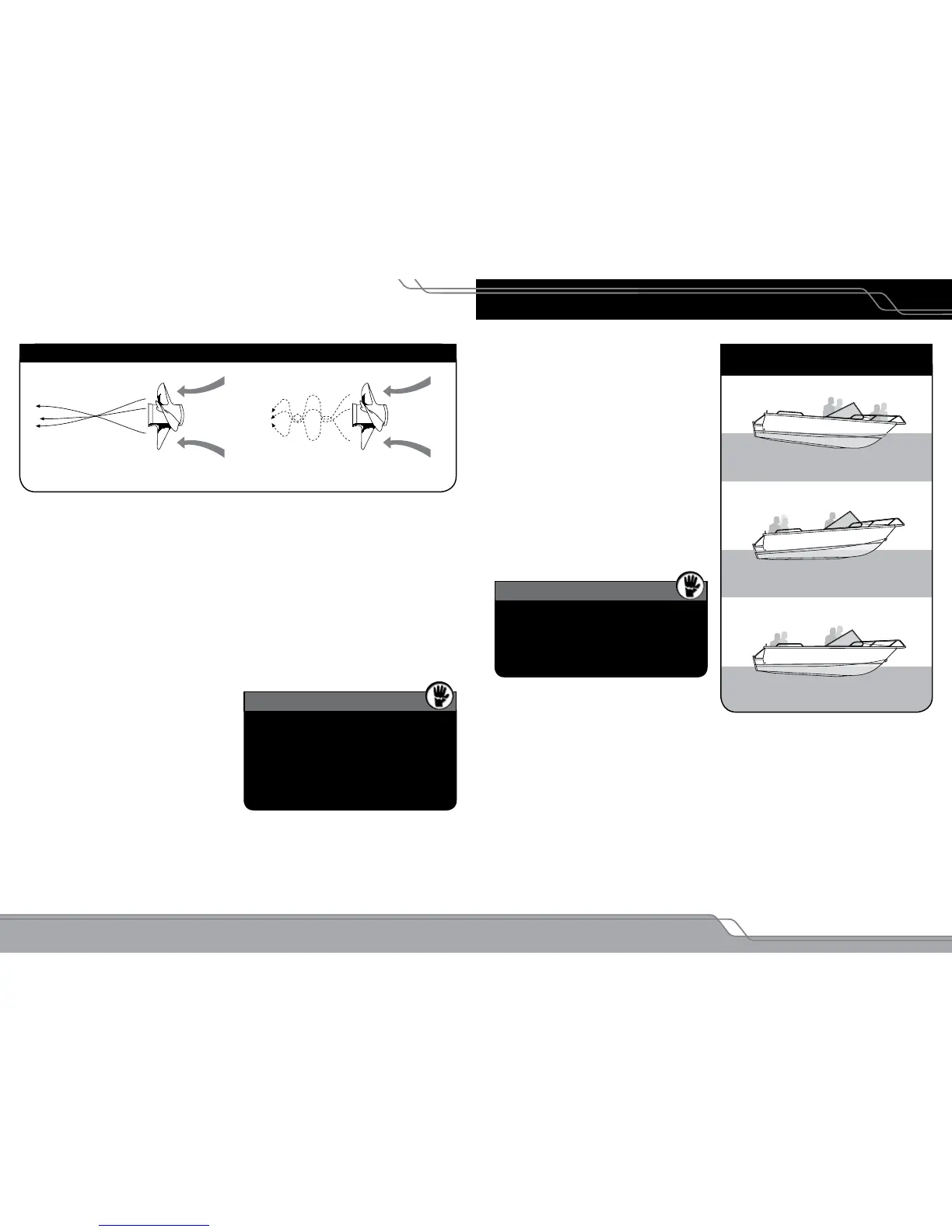
Ventilation Causes Less than Optimum Performance
While often called cavitation, ventilation is really a different effect.
Ventilation
While often called cavitation, ventilation is really
a different effect. At times when a boat enters or
leaves a sharp turn, the propeller seems to slip
and lose thrust and the engine may over rev. This
problem is normally caused by air or aerated water
entering the propeller. This can be rectified by one
or more of the following:
• Replaceadamagedorincorrectpropeller.
• Setoutboardatalessertrimangle(trimunit
inward).
• Useacuppedpropellerifoneisnotalreadyinuse.
• Contactyourdealertocheckthemotorheight.
Boat Running Attitude
If your boat runs with the bow too high at cruising
speeds, observe the following points to achieve a
more correct and efficient cruising attitude:
Move some weight forward in the boat.
Adjust the thrust angle of the engine (reduce the
distance between the bottom of the transom and the
drive unit).
This is commonly referred to as trimming down or in,
or applying ‘negative trim’. See your engine owner’s
manual for further trimming instructions.
If your boat runs with the bow too low at cruising
speeds (usually indicated by water coming off
the hull too far forward and steering difficulty or
veering off course). Raise the bow by performing the
opposite of the steps above. This is referred to as
trimming up or out, or applying ‘positive trim’.
For maximum effectiveness when planing, the hull
should be at a 3 to 4 (three to four) degree angle to
the water.
Steering Wheel Pressure
This pressure, or pull, is corrected by adjusting the
trim position of your outboard so the prop shaft is
parallel to the surface of the water. If this is not
possible, the trim tab located under the aft end of
the anti-ventilation plate can be adjusted by your
dealer.
The trailing edge of the trim tab should be turned in
the direction the boat is pulling. Small adjustments
should be made until the steering has neutral torque
(pull) at the desired speed.
We suggest using your normal cruising speed. When
running faster or slower than this speed, a minimal
amount of torque will be present.
WARNING
There is a risk of falling or ejecting out of the
boat if standing or moving while the boat is in
motion. If someone must stand while the boat is
in motion, avoid speed changes that could cause
the standing person to lose balance. Bow riders
should not have people in the bow standing or
kneeling or changing positions while the boat is
in motion.
Performance
Passenger and Gear Loading
Passenger and Gear Loading
As passengers occupy different seat positions you
will notice the boat’s speed change. Passengers
must never change seat location while the boat is
moving. As this shift in passenger weight alters the
planing angle of the hull in much the same manner
as though the drive unit angle were changed (trim
was altered).
A shift of passenger or gear load forward or aft will
often correct minor boat riding deficiencies.
Take care when placing items such as cooler box,
water jugs, tackle box, anchor, tools, portable fuel
tanks, etc., to help create more desirable running
attitudes.
For best boat and motor performance, the boat
should be trimmed as described in “Boat Running
Attitude” or to suit the prevailing conditions.
Passengers and equipment should be distributed in
the boat so it is evenly balanced both front to back
and side to side.
Instruments
While under way, instruments should be checked
frequently for possible indications of trouble.
Tachometer (if fitted)
A tachometer is an electrical instrument that
indicates engine Revolutions Per Minute (RPM). The
tachometer is useful for monitoring engine speed
to avoid exceeding the maximum RPM rating. In
addition, it can be used to detect performance
changes by comparing speedometer readings at
various RPMs.
WARNING
Your boat has been constructed for normal
boating conditions. Using your boat in adverse
conditions or outside of its design limits could
affect it structurally and may void your warranty.
It is the operator’s ultimate decision on what
conditions the boat is used in.
12 Owner’s Manual 13



 To Next Page