EasyManua.ls Logo

Stanley PD45 - User Manual

Stanley PD45
20 pages
Print Icon
To Next Page IconTo Next Page
Loading...
© 2014 STANLEY Black & Decker, Inc.
New Britain, CT 06053
U.S.A.
59010 2/2018 Ver. 12
USER MANUAL
Safety, Operation and Maintenance
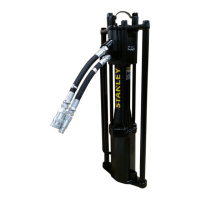
PD45
HYDRAULIC
POST DRIVER

Questions and Answers

  • G
    Gary WalkerAug 2, 2025
    Why is my Stanley DC Drives tool not running?
    • K
      Kimberly MartinAug 3, 2025
      Your Stanley DC Drives tool might not be running due to several reasons. It could be that the power unit isn't functioning correctly, so check the power source for proper flow and pressure (7-9 gpm / 26-34 lpm, 2000 psi / 140 bar). Alternatively, there might be a blockage in the couplers or hoses, in which case you should remove the restriction. Also, ensure that the pressure and return line hoses are connected to the correct ports. Finally, a mechanical failure of the piston or automatic valve could be the cause; disassemble the post driver and inspect for damaged parts.
  • L
    Logan MccoyAug 15, 2025
    What to do if my Stanley DC Drives tool does not hit effectively?
    • K
      Kevin HeathAug 15, 2025
      If your Stanley DC Drives tool isn't hitting effectively, several factors could be responsible. A low accumulator charge might be the issue (indicated by a pressure hose pulsing more than normal); recharge the accumulator and replace the diaphragm if charge loss continues. Also, check the power unit for proper flow and pressure (7-9 gpm / 26-34 lpm, 2000 psi / 140 bar), as the power unit might not be functioning correctly. Blocked couplers or hoses could also be the cause, so remove any restrictions. If the fluid is too hot (above 140°F / 60°C), provide a cooler to maintain the proper oil temperature (130°F / 55°C maximum). Finally, the anvil might not be sliding freely in the post driver foot; remove, clean, lubricate, and replace the anvil as required.
  • J
    James GarciaAug 20, 2025
    Why does my Stanley DC Drives tool get hot?
    • E
      Eric HarrisonAug 21, 2025
      If your Stanley DC Drives tool is getting hot, it might be due to hot fluid running through it. Check the power unit to ensure the flow rate isn't too high, causing fluid to pass through the relief valve. Use a cooler to keep the fluid temperature at the right level (140°F / 60°C max). Also, check the relief valve setting and eliminate any flow control devices.
  • S
    sharon07Aug 27, 2025
    What to do if there is oil leakage on the post of my Stanley DC Drives?
    • J
      jonathan59Aug 27, 2025
      If you notice oil leakage on the post of your Stanley DC Drives tool, it's likely due to a lower piston seal failure. You should replace the seal.
  • J
    Jody RodriguezNov 7, 2025
    What to do if my Stanley DC Drives tool operates slowly?
    • B
      Benjamin MathisNov 8, 2025
      If your Stanley DC Drives tool is operating slowly, there are several potential causes. First, check the power source for proper flow (7-9 gpm / 26-64 lpm) because there might be a low gpm supply from the power unit. High backpressure could also be the reason, so check the hydraulic system for excessive backpressure (over 250 psi / 17 bar). Other possible causes include blocked couplers, hoses, or orifices, all of which require removing the restriction. The fluid temperature might be too hot (above 140°F / 60°C) or too cold (below 60°F / 16°C), so check the power source for proper fluid temperature, bypassing the cooler to warm the fluid or providing a cooler to maintain the proper temperature. Additionally, the relief valve might be set too low, requiring adjustment to 2100-2250 psi / 145...

Summary

Safety and Warranty Information

Critical Repair Safety Warning

Warns of serious injury or death from improper repair; service must be by authorized dealers.

Safety Precautions for Operation

Operator and Work Area Safety

Emphasizes operator training, situational awareness, and protective gear.

Tool Handling and Connection Safety

Covers safe practices for connecting, operating, inspecting, and maintaining the tool.

Utility and Environmental Hazards

Warns about risks from underground utilities and potential hazardous dust from materials.

Clothing and General Safety

Advises against loose clothing and general safety measures during operation.

Tool Identification Stickers and Tags

Critical DANGER Warnings on Tags

Lists crucial DANGER warnings related to electrical hazards, hose integrity, and proper connections.

Hydraulic Hose Recommendations

Hose Diameter and Length Chart

Chart providing minimum hose diameters for various flow rates and lengths for optimal performance.

HTMA;EHTMA Hydraulic System Requirements

HTMA System Requirements by Tool Type

Details flow, pressure, and viscosity requirements for HTMA Type I, II, RR, and III.

Tool Operation Procedures

Pre-Operation Checks and Setup

Guides on checking power source, installing adapters, and connecting hoses before operation.

Connecting Hydraulic Hoses

Details steps for cleaning couplers, connecting hoses, and ensuring proper flow direction.

Standard Tool Operation

Instructions for starting, operating, and stopping the post driver, emphasizing down pressure.

Accumulator Testing and Charging

Procedure for Testing Accumulator

Step-by-step instructions for testing the accumulator's pressure and identifying low charge.

Procedure for Charging Accumulator

Step-by-step instructions for charging the accumulator to the specified pressure.

Tool Protection and Care

Professional Tool Service

States that repair should only be done by experienced personnel and mentions relief valves.

Troubleshooting Common Issues

Tool Not Running or Ineffective

Solutions for when the tool fails to operate or hit effectively, covering common causes.

Technical Specifications

PD45131 Parts Illustration

PD45131 Parts List

PD45132;PD45151 Parts Illustration

PD45132;PD45151 Parts List

Stanley PD45 Specifications

General IconGeneral
BrandStanley
ModelPD45
CategoryPower Tool
LanguageEnglish

Related product manuals