
 Need help?
Do you have a question about the Static Solutions OHM-STAT RT-1000 and is the answer not in the manual?
Lists the items included in the Ohm-Stat RT-1000 meter test kit.
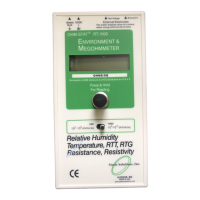
Describes the Ohm-Stat RT-1000 as a portable meter for measuring temp, humidity, and resistivity.
Explains that specific test procedures depend on industry needs and standards.
Details features like Test Button, Selector Switch, External Test Jacks, AC Power Adapter, Ground Shield Jack, Battery Compartment, Parallel Test Probes, and Case.
Guides on preparing surfaces and performing surface resistivity measurements.
Details connecting probes, pressing the button, and multiplying resistivity by 10.
Explains RTT measurement, probe placement, voltage selection, and test button operation.
Describes RTG setup, ground connection, probe placement, and test button operation.
Advises on cleaning probes and case, and precautions when not in use.
States the meter is NIST traceable calibrated and how to verify accuracy.
Details resistivity ranges for 10V/100V, battery supply, and adapter use.
Provides physical dimensions, accuracy ratings, and meter weight.
Lists included probes and optional accessories.
Details conditions under which the express warranty does not apply.
Defines the extent of liability for special, incidental, or consequential losses.
Explains why temperature/humidity are important and when to use 10V vs 100V.
Discusses alphanumeric display superiority and rechargeable battery use.
Answers questions about battery drain, meter origin, re-zeroing, and low battery operation.
Explains RTT, RTG, resistivity, concentric ring probe usage, and low battery impact.
Addresses voltage drop, probe replacement, and ISO-9000 traceability.
Covers overseas power, meter failure, usage locations, industries, products, and standards.
Explains acclimation time, high resistance precautions, cleaning, and case safety.
Details testing chairs/smocks, other accessories, and calibration.
Details required components, opening the meter, locating pots, and equilibration.
Explains how to adjust calibration pots, verify readings, and record data.
Title and purpose of the standard for ESD control programs.
Approved date and details of the standard for ESD control programs.
Explains the purpose of ESD standards and how interpretations are handled.
Covers ESD control program requirements and fundamental principles like bonding and grounding.
Lists members of the committee and contributing individuals for the standard.
Lists military and U.S. government documents referenced in the standard.
Lists industry standards referenced in the standard.
Defines the standard's purpose to provide administrative and technical requirements for ESD control.
Applies to activities handling ESD susceptible items, excluding explosives.
Warns about hazardous electrical conditions and need for safety compliance.
Outlines the need for administrative and technical requirements in the program.
Details the requirement for an ESD Control Program Plan document.
Specifies the need for ESD awareness and prevention training for personnel.
Requires a plan to ensure compliance with standard requirements through audits.
Ensures ESDS items, personnel, and conductors are at the same electrical potential.
Covers bonding personnel to ground when handling ESD sensitive items.
Defines requirements for handling ESDS items in protected areas and humidity control.
Details ESD protective packaging requirements and guidance.
Covers requirements for AC/battery tools and automated handlers.
Establishes requirements and guidance for handling ESDS items.
Discusses factors influencing ESD sensitivity and test models (HBM, MM, CDM).
Describes HBM testing, its parameters, and sources for sensitivity data.
Guidance on protective circuitry and techniques for assemblies and equipment.
Details test methods for direct contact and indirect contact scenarios.
Lists military and U.S. government documents referenced in the standard.
Lists industry standards referenced in the standard.
Title and purpose of the standard for seating resistance measurement.
Defines the standard's purpose for evaluating seating resistance and electrostatic discharge control.
Provides test methods for measuring seating resistance for ESD control.
Warns of potential hazardous electrical conditions during testing.
Details requirements for resistance meters, electrodes, and environmental chambers.
Outlines procedures for specimen preparation, cleaning, and humidity conditioning.
Describes measurement steps for seating resistance, including voltage and electrode placement.
Specifies data to be reported, including resistance, voltage, temp, and humidity.
Details procedures for acceptance and periodic testing of seating.
Title and context of the standard for ESD protection of garments.
Explains the nature of draft standards and how to provide comments.
Details the purpose of ESD standards and interpretation policies.
Defines the standard's purpose for evaluating garment resistance and controlling static charge.
Describes measuring electrical integrity of groundable points on garments.
Provides test methods for evaluating electrical resistance of static control garments.
Warns of potential hazardous electrical conditions during testing.
Specifies humidity conditions (low/moderate) and sample quantity for testing.
Details the procedure for measuring resistance across garment sleeves.
Details the procedure for measuring resistance between any two points on a garment.
Lists requirements for resistance measuring equipment, electrodes, and environmental chambers.
Covers sample preparation, sketch, and humidity conditions for testing.
Addresses measuring electrical integrity of groundable points on garments.
Lists meter features: resistivity, resistance, temp, humidity, display, probes, voltage settings.
Describes the footwear tester, its features, and compatibility.
Details the miniature probes, their specifications, and conformance.
Describes the concentric ring probe, its features, and testing capabilities.
Details the five pound resistance probes, their use, and standards conformance.
Describes the ground/circuit tester, its features, and EOS 20/20 protection.
Details the garment clips, their use, and compatibility with the RT-1000 meter.
States the one-year warranty, repair/replacement policy, and shipping instructions.
Details warranty exclusions and limits on liability for losses or damages.
 General
| Brand | Static Solutions |
|---|---|
| Model | OHM-STAT RT-1000 |
| Category | Measuring Instruments |
| Language | English |

 To Next Page