33
Basic Set-up
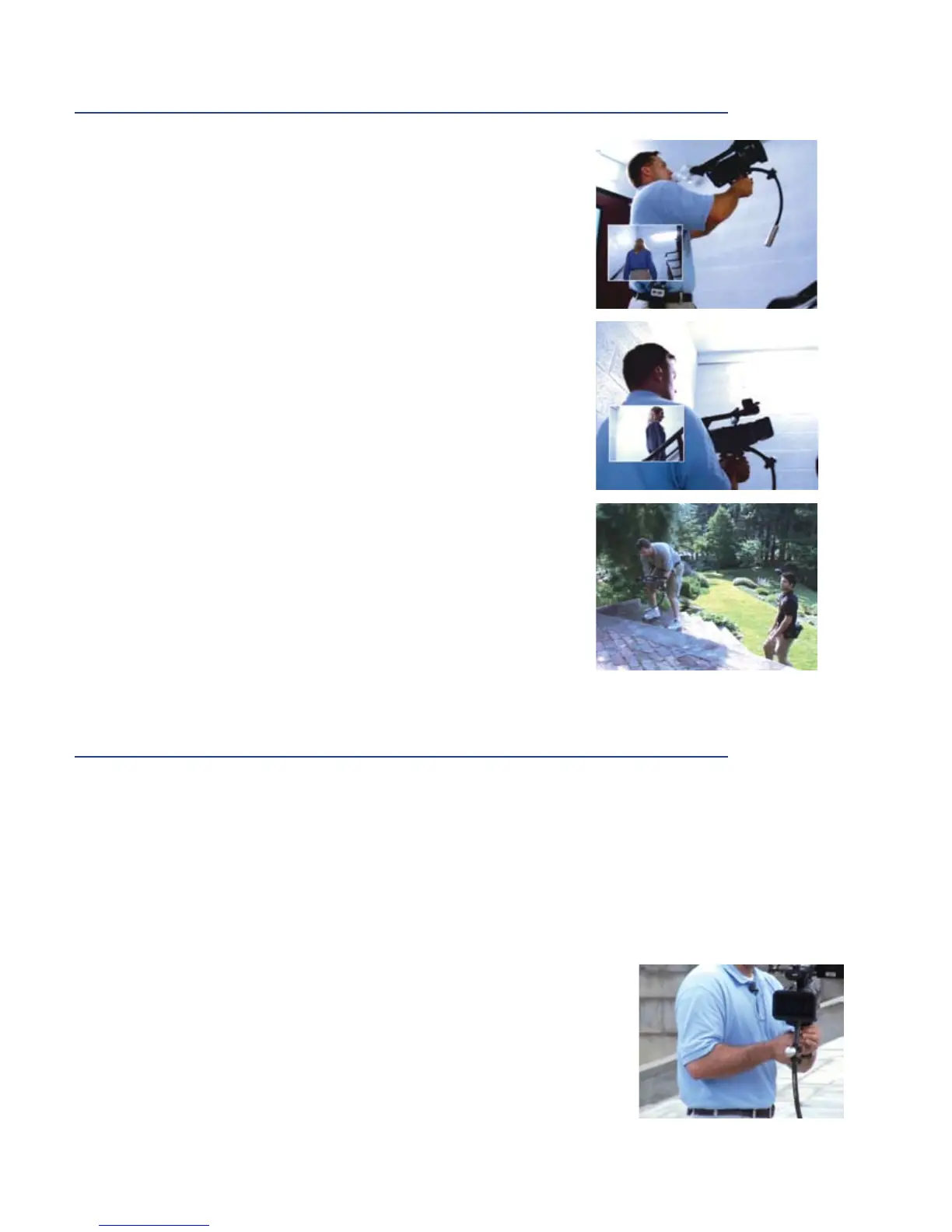
11. Stairs
Stair shots can look great and be easy to shoot,
if you:
Reduce bottom-heaviness by counter-clocking
the Guide one turn, and then trim for the average
angle required for going up or down, including
any landings.
Boom up and down to make additional
adjustments for headroom.
(Your subject will rise and fall in your frame
because you both cross-landings at different
times.)
Trimming & Booming for Stairs
If you’re following someone up the stairs (in
Forward Mode), trim the Merlin so the camera
tilts slightly up and then use the boom range of
your arms to maintain headroom – it’s easier,
faster and more intuitive than constantly trying
to tilt to compensate for the rapidly changing
framing. Booming can also be more accurate,
and has the additional virtue of providing the
least radical camera angle at any moment.
This can help you avoid
the less-than-elegant
look of following
someone’s posterior
wide-angle from below!
If you’re preceding
your subject, shooting
downward, looking to
the rear, for instance, in
the Reverse Mode, trim
the Merlin down and
likewise use the boom
range of your arms to
avoid radical angles
down on someone’s
bald-spot!
This is an advanced
technique, so don’t try it
in earnest until you have
enlisted a stand-in and
gotten lots of practice!
12. Shooting and Resting Positions
The Steadicam Merlin plus camcorder weighs
somewhere between 1.5 and 5 pounds. It acts
weightless but of course it isn’t and it can tire
your Grip arm fairly rapidly (though it gets
easier with practice). Here are some tips to help
with fatigue:
Share the load by also supporting the Grip with
the little finger of your “guide’ hand. Slip your
pinkie underneath the fingers of your Grip hand
and share the load. You can still operate up above
with the lightest touch of thumb and finger on the
Guide.
Rest the elbow of your grip hand on a chair
arm, a table or your knee whenever you don’t
have to move the camera — you can easily fly up
and away from those rest positions without any
visible bump in your shot!
Shorten your moving shots — use cuts between
a series of moving and static shots.
Change hands to share the load. Practice
changing hands safely to avoid dropping your
camera. One way is to shift up your “Grip” hand
to the “one-handed” position, and release the
Grip as your other hand takes over.
Hold the Steadicam as close
to your body as possible. When
shooting in either the Forward
or Reverse Modes, hold it right
beside you instead of out in
front. Stand sideways to your
shot whenever possible so you
can keep it closer, and be extra-
careful not to bump the spar
against yourself when working
that close.


 To Next Page