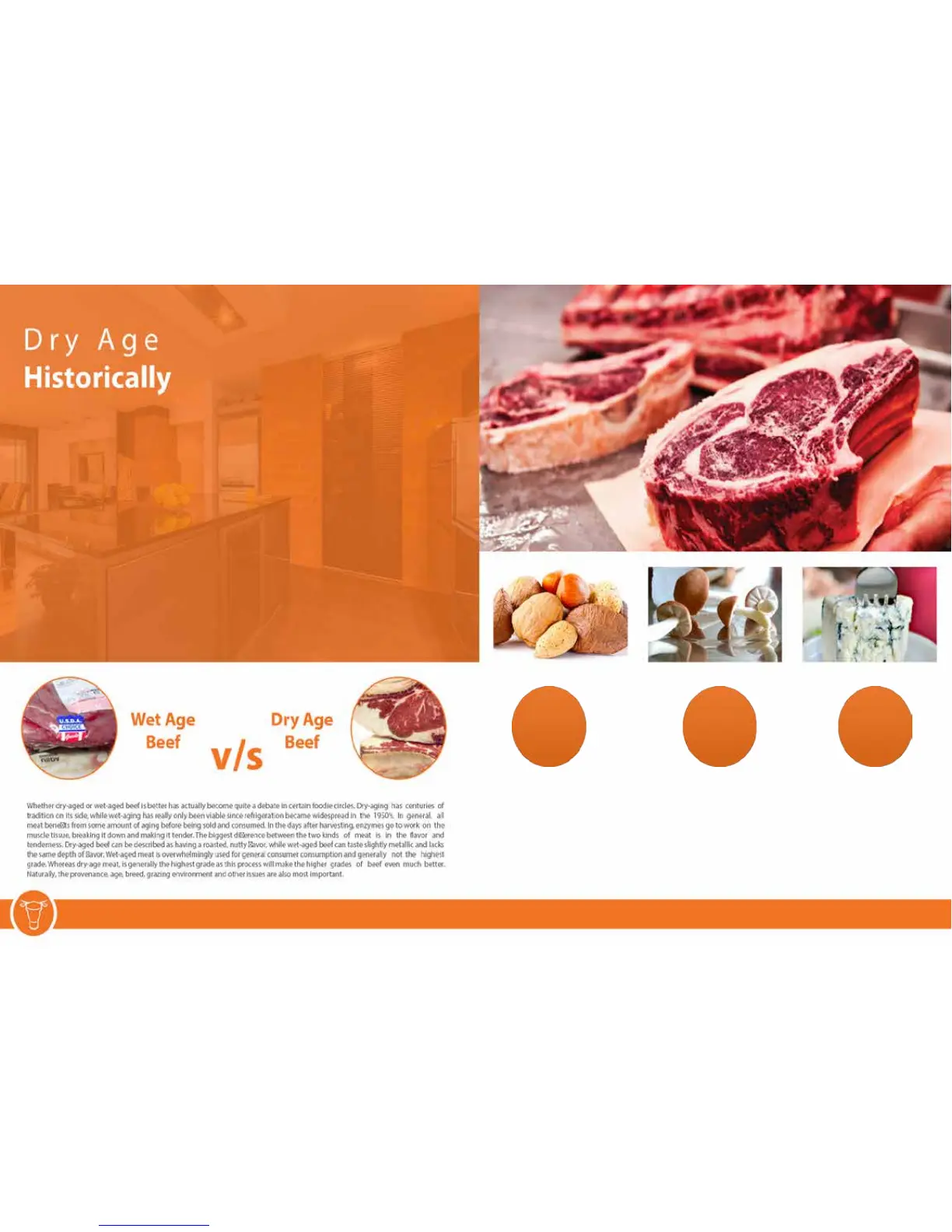
21 days 28 - 35 days 45 + days
bold blue
cheese notes
Subtle nuttiness
slight mushroom
& umami avors
As beef ages, the enzymes present in the meat begin to break down the proteins into amino acids and fats, yielding a
rich and savory avor. The longer it ages, the more intense and complex the avors become, ranging from a subtle
nuttiness to bold blue cheese notes.
Dry Aging Meat is an old artesian process that dates
back to the middle ages. It used to be the only way to preserve
meat longer than a few days, was to cellar it, before it would spoil.
Before refrigeration was introduced in the mid 1940 almost
all meat was dry aged. Cellars and caves were popular choices
as they generally were cool and kept a relatively steady humidity.
Very similar to historic (and in some places still today) cheese
making and charcuterie production.
Dry-Aged
Beef
For dry-aging, whole sides of beef or primal cuts are
hung in constant air ow and kept at a temperature just above
freezing and left to age for several weeks or even several months.
Those cuts are usually the larger muscle cuts that should be on
the bone and still have their natural fat cap intact. This
environment will allow the natural enzymes working on the
muscle tissues and permits the cuts to slowly dehydrate. This
concentrates the meat avor and changes the texture, avor
and tenderness. The benet of this process is very tender meat
with an intense avor. The downside is that a certain weight loss
occurs due to moisture loss, which decreases the yield and
increases the cost per pound. Also, the surface of the meat
usually needs to be trimmed away before the beef is portioned
and sold, resulting in further loss of volume.
8 9 w w w . s t e a k l o c k e r . c o m



 To Next Page