SteFly Canopy Flasher Manual Version 1.2 10
5.2
Switching On the Canopy Flasher / Normal Operation
When the switch is toggled on the ground, it will flash twice with less intensity and signalizes that the
flasher is active. Due to the connection between Control Box and SteFly Canopy Flasher, the latter
will start flashing when FLARM indicates that the aircraft is flying.
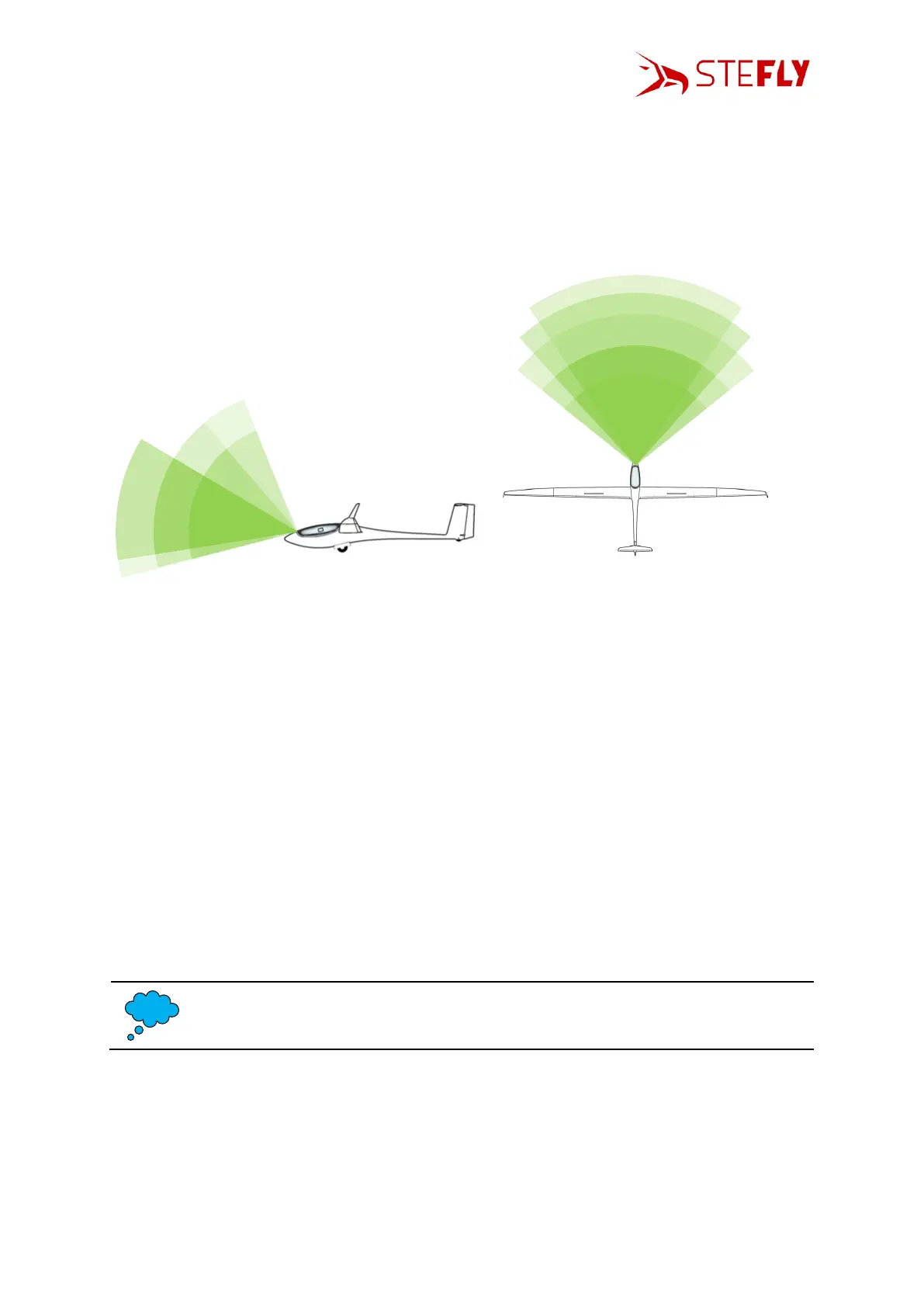
The following drawings illustrate the shape of the light cone.
The brightest area of the flashes is in flight direction in extension of the longitudinal axis. Due to the
green color of the light, which has the best perception of all colors for the human eye, the visible
distance of the flasher is > 3,5 km in the center of the light cone and slowly decreasing to its edges.
Even if the angle of approach of another aircraft moderately differs from your flight direction, your
canopy flasher warns the other pilot. Indicative values for visible angles with reference to the z-axis
of the LED plane are -30° below and +60° above, as well as up to ±45° right and left.
When your glider is in the air, the canopy flasher will flash constantly with a frequency according to
the setting of the DIP-switches. The settings “low / medium / high” have impact on the flashing
pattern (the time between individual flashes).
The intensity of flash frequency increases as soon as there is an aircraft in the vicinity on potential
collision course. This happens in accordance with acoustic and visual FLARM warnings.
If SteFly Canopy Flasher measures a temperature of > 60°C in the flasher housing, the flash mode will
slow down to prevent the components from overheating. Due to the high efficiency of the LEDs as
well as the large aluminium heat sink integrated in the housing, these temperatures do only occur in
exceptional circumstances.
Canopy protection from sunlight
Please always use a canopy cover whenever the glider is on the ground. This
enhances the life-time of all components due to less exposure to heat and UV light.
5.3
Switching Off the Canopy Flasher
Shortly after landing FLARM usually recognizes that the flight has stopped. At the same time, the
Control Box sends a signal to the Canopy Flasher and it will stop flashing. This avoids unintended
dazzling, saves energy and prevents the LEDs from overheating in hot environments.



 To Next Page