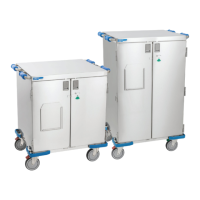
The AMSCO® Case Cart is a device designed for the transport of surgical instrument sets, endoscopes, and other accessories within a hospital setting. This operator manual provides essential information for its proper use and routine maintenance, emphasizing safety precautions and operational instructions.
Function Description:
The primary function of the AMSCO® Case Cart is to facilitate the safe and efficient transport of medical items. It features doors that can be opened by lifting a latch paddle and closed by pressing them until the latch catches. For convenience, the doors can be locked in an open position by rotating them against the side of the unit, pulling up the door catch, pushing the door under it, and then releasing the catch.
The cart is equipped with shelves, which can be either solid or wire, and are available in both standard and roll-out configurations. These shelves are adjustable in height to accommodate various items. For roll-out shelves, adjustment involves releasing a lock, pulling the shelf out until the first two rollers are visible, tilting it up to free the rollers, and then sliding it out further until the second set of rollers are visible before lifting the shelf out. To adjust the height of roll-out shelves, the shelf must first be removed. The rail is released by pressing a button, lifted up, and pushed towards the back, then tilted up and pulled forward. To set the rail in a new position, the rear of the rail is aligned with the slots at the back of the cabinet at an angle, the front is slid down ensuring the pin is behind, pushed down until it bottoms out, and then pulled forward and down until the release button appears. Non-roll-out shelves are adjusted by lifting the shelf, sliding its support hooks from the slots in the uprights, and then relocating it to the desired height, ensuring it is level.
The cart also includes a Clean/Dirty Indicator, which allows users to toggle between red (dirty) and green (clean) by turning it clockwise or counterclockwise, providing a visual status of the cart's contents during transport. Cool Touch Handles are integrated into the design, offering a grasping surface that resists heating during automated washing, enabling users to safely remove the cart from a cart washer after processing.
Important Technical Specifications:
The AMSCO® Case Carts come in various sizes, with specific models listed in the manual:
- ACC242639: Case Cart 27.5 X 36 X 39
- ACC243739: Case Cart 27.5 X 47 X 39
- ACC244439: Case Cart 27.5 X 54 X 39
- ACC242654: Case Cart 27.5 X 36 X 54
- ACC243754: Case Cart 27.5 X 47 X 54
- ACC244454: Case Cart 27.5 X 54 X 54
Standard equipment includes:
- 6" high-temp stainless steel casters: two total lock and two directional lock casters.
- 8-1/2" x 11" card holder.
- Push handles with cool-to-touch handle covers (two on each side, totaling four handles).
- Full Corner bumpers (additional sizes available).
Environmental conditions for cleaning and maintenance:
- The Case Cart Wash Chamber must be non-pressurized.
- Water temperatures for washing should be in the range of 110-194°F (43-90°C) for less than 10 minutes total.
- Hot air drying is allowed with temperatures not exceeding 200°F (93°C) and an exposure period not exceeding 15 minutes. Longer exposure at these temperatures may damage plastic components such as bumpers, shelf wheels, door catch, handle cover, and lock nuts.
Usage Features:
- Ease of Movement: Equipped with four casters (two total lock, two directional lock) for maneuverability. Casters can be locked by pushing down on a tab and disengaged by lifting the tab.
- Content Status Indicator: The Clean/Dirty Indicator provides a quick visual reference for the cart's contents, enhancing workflow and preventing cross-contamination.
- Ergonomic Handles: Cool Touch Handles ensure user comfort and safety when handling the cart, especially after high-temperature washing.
- Adjustable Storage: Adjustable shelves (solid or wire, roll-out or non-roll-out) allow for flexible storage configurations to accommodate various sizes of instrument sets and accessories.
Maintenance Features:
The manual outlines detailed procedures for component repair and replacement, ensuring the longevity and safe operation of the cart.
- Bumper Assembly Replacement: Involves removing four ¼" screws from the bottom bracket and four ¼" SS cap nuts and washers from the top of the bracket.
- Caster Replacement: Requires two technicians. The cart is tipped onto its backside, and the caster is removed by detaching four hex head screws, lock washers, and flat washers from the caster support plate. Installation is the reverse process, followed by verification of smooth rolling and operational locks.
- Clean/Dirty Indicator Replacement: Involves removing four screws from the door plate to access the indicator, then removing the stem knob by detaching a nut from the backside, and finally removing a nylon nut and carefully detaching the indicator disc, ensuring a plastic washer is not lost.
- Door Latch Replacement: Requires removing two #8 SS screws from the backside of the door latch, then inserting a new latch from the front and securing it. Adjustments may be needed if the door's opening or closing is hindered.
- Latch Trap Assembly Replacement: The existing latch trap assembly is removed using an adjustable wrench and Phillips screwdriver. A new assembly is placed, secured with a screw and cap nut (not fully tightened initially), and then the door function is verified for alignment, secure closure, and smooth opening. Red Loctite® 262 is applied to the cap nut threads before final tightening.
- Door Catch Assembly Replacement: Removed using a 5/16" wrench and Phillips screwdriver. A new door catch and spring are installed, followed by the catch frame and door stop support catch, aligning holes. The assembly is hand-tightened with a washer and cap nut, and the door's anchoring by the catch is verified before final tightening.
Cleaning and Maintenance Instructions:
- Regular Cleaning: Case Carts must be cleaned regularly to prevent damage to stainless steel surfaces.
- Cleaning Agents: Use non-abrasive cleaners, rubbing in a back-and-forth motion with the surface grain. Abrasive pads, metal/plastic scrapers, steel wool, wire brushes, hard water (pH > 7), bleach, chlorine-containing products, ammonia, hydrochloric acid, and denatured alcohol are explicitly prohibited as they can damage stainless steel.
- Cleaning Procedure:
- Remove shelves.
- Clean all surfaces (top, sides, back, doors, door interiors, shelves, interior) with a damp cloth or sponge and cleaner, wiping off with a clean, lint-free cloth.
- Clean shelves with warm water and mild detergent, rinse thoroughly, and wipe dry.
- Disinfect all surfaces using an appropriate disinfectant as per facility policies.
- Replace shelves.
- Automated Cart Wash Parameters: Adhere to specified temperature and exposure limits for water and hot air drying to prevent damage to plastic components.
- Precautions for Use: Ensure doors are secured and casters unlatched during transport. Doors should be closed when populated with supplies. Staff handling contaminated items must follow facility guidelines. The cart should be properly decontaminated after use. Shelves, doors, and wheels must be checked for proper function after cleaning. Faulty carts should be taken out of service for maintenance. The Clean/Dirty Indicator should be used when transporting contaminated items.

 Need help?
 General

 To Next Page