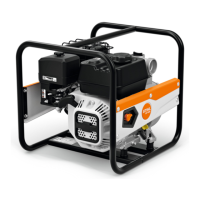
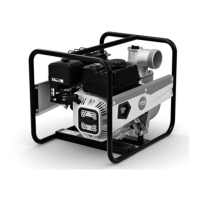
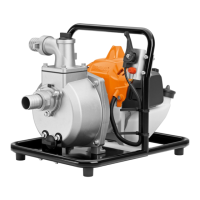
The STIHL WP 230 is a robust water pump designed for efficient freshwater transfer, offering reliability even under demanding conditions. Its primary function is to pump freshwater to a maximum height of 27 meters and from a maximum depth of 8 meters. This makes it suitable for various applications, such as drawing water from rain barrels, cisterns, or natural water sources like flowing or stagnant waters.
Function Description:
The water pump operates using a two-stroke engine that requires a specific fuel mixture of gasoline and two-stroke engine oil in a 50:1 ratio. The engine is started via a starter grip, and its speed is controlled by a throttle lever. A choke lever assists in starting the engine, especially when it's cold. The manual fuel pump bulb primes the carburetor for easier starts. Water is drawn into the pump through a suction hose, which must be dimensionally stable and have a suitable pressure rating, and then discharged through a delivery hose. A strainer is fitted to the suction hose to filter incoming water, preventing debris from entering and damaging the pump. The pump is not self-priming and must be filled with water before starting the engine. A stop switch is provided to shut off the engine.
Important Technical Specifications:
- Displacement: 36.3 cc
- Engine Power (to ISO 8893): 1.55 kW (2.1 bhp) at 9,000 rpm
- Idle Speed: 2,800 rpm
- Approved Spark Plug: Bosch WSR 6 F from STIHL
- Electrode Gap: 0.5 mm
- Dry Weight: 11.3 kg
- Max. Fuel Tank Capacity: 810 cc (0.81 l)
- Hose Connector Diameter: 38 mm (1.5 in)
- Maximum Delivery Head: 27 m
- Maximum Suction Head: 8 m
- Maximum Delivery Rate: 15.6 m³/h
- Sound Pressure Level Lpa (ISO 20361): 92 dB(A)
- Sound Power Level Lw (ISO 20361): 104 dB(A)
- Fuel Mixture: Gasoline (min. 90 RON, max. 10% ethanol) and STIHL HP Ultra two-stroke engine oil (or equivalent high-performance oil meeting JASO FB, FC, FD, ISO-L-EGB, EGC, or EGD) in a 50:1 ratio.
Usage Features:
The STIHL WP 230 is designed for user-friendly operation, with clear controls and safety guidelines.
- Starting Procedure: The engine requires preparation for starting if it's at ambient temperature, stopped after initial acceleration, or ran out of fuel. This involves pressing the manual fuel pump bulb, moving the choke lever to the start position, and turning the throttle lever clockwise to the stop. The starter grip is then pulled quickly until the engine fires and stops. For warm starts (engine running for at least 1 minute and shut down for a short break), the engine can be started without preparation.
- Pumping: Once started, the pump operates at full throttle to move water. The maximum suction height (8 meters) and delivery head (27 meters) must be observed for optimal performance.
- Carburetor Adjustment: For operation at high altitudes, the carburetor can be adjusted to ensure optimum engine power. This involves warming up the engine and then rotating the high-speed screw (H) clockwise until the engine delivers optimum power.
- Securing the Pump: The water pump should be anchored to prevent movement during operation, especially on uneven surfaces.
- After Finishing Work: After use, the pump should be connected to a water source that cannot draw in sand or dirt, started to rinse out sand and dirt from the pump and hoses, then shut off and allowed to cool down. The water pump should be drained of water, and the air filter cleaned.
- Transporting: The engine must be shut off before transport. The pump should be carried by the handle, keeping the hot muffler away from the body. When transported in a vehicle, it must be secured with lashing straps or a net to prevent turnover and movement. Water should be drained from the pump to prevent freezing damage in temperatures below 0°C.
- Safety Precautions: The manual emphasizes wearing safety glasses and hearing protection, avoiding inhaling exhaust gas, and ensuring the operator is rested, in good physical and mental health, and has received proper instruction. It also warns against using the pump for unsuitable liquids (gasoline, oil, acids, saltwater, foodstuffs, water over 40°C), as this can cause serious injury or damage. Long hair should be tied up, and snug-fitting clothing and sturdy, non-slip footwear should be worn. The work area should be clear of bystanders, children, and animals, and the pump should not be left unattended. Hot exhaust gas can ignite flammable materials, so the pump should be kept away from such materials. The pump must be in a safe condition, meaning it is undamaged, free of fuel leaks, with a closed fuel tank cap, clean, and with properly functioning controls and fitted hoses.
Maintenance Features:
Regular maintenance is crucial for the longevity and safe operation of the STIHL WP 230.
- Cleaning: The water pump should be cleaned with a damp cloth or STIHL resin solvent, and cooling air slots with a soft brush. The strainer should be rinsed under running water, and hoses cleaned with a damp cloth and rinsed with water. The air filter should be cleaned by removing the cover, cleaning the area around it, taking out the filter, knocking out dirt, washing it in warm soapy water, rinsing, air-drying, and impregnating with 5 ml of two-stroke engine oil. The spark plug should be cleaned with a damp cloth, and replaced if corroded.
- Maintenance Intervals:
- After every 100 hours of operation: Install a new spark plug.
- Monthly: Have the fuel tank and pickup body (filter) in the fuel tank cleaned by a STIHL servicing dealer.
- Every 12 months: Have the pickup body (filter) in the fuel tank replaced by a STIHL servicing dealer.
- Storing: For storage longer than 3 months, the fuel tank should be opened, drained, closed, and then cleaned by a STIHL servicing dealer. The engine should be run at idling speed until it stops. The water pump should be stored out of reach of children, in a clean and dry condition, and drained of water to prevent freezing.
- Troubleshooting: The manual provides a troubleshooting guide for common issues like the engine not starting, erratic idling, or the pump not pumping water, offering solutions such as checking fuel, cooling the carburetor, clearing the combustion chamber, cleaning the strainer and hoses, ensuring adequate water supply, and verifying suction hose integrity.
- Repairs: The water pump is not user-repairable. Any damage or need for service should be addressed by a STIHL servicing dealer.
- Spare Parts and Accessories: STIHL recommends using original STIHL replacement parts and accessories, identifiable by specific symbols, which are available from STIHL servicing dealers.
- Disposal: The water pump, fuel mix, gasoline, two-stroke engine oil, accessories, and packaging must be disposed of according to local regulations and environmental requirements.


 To Next Page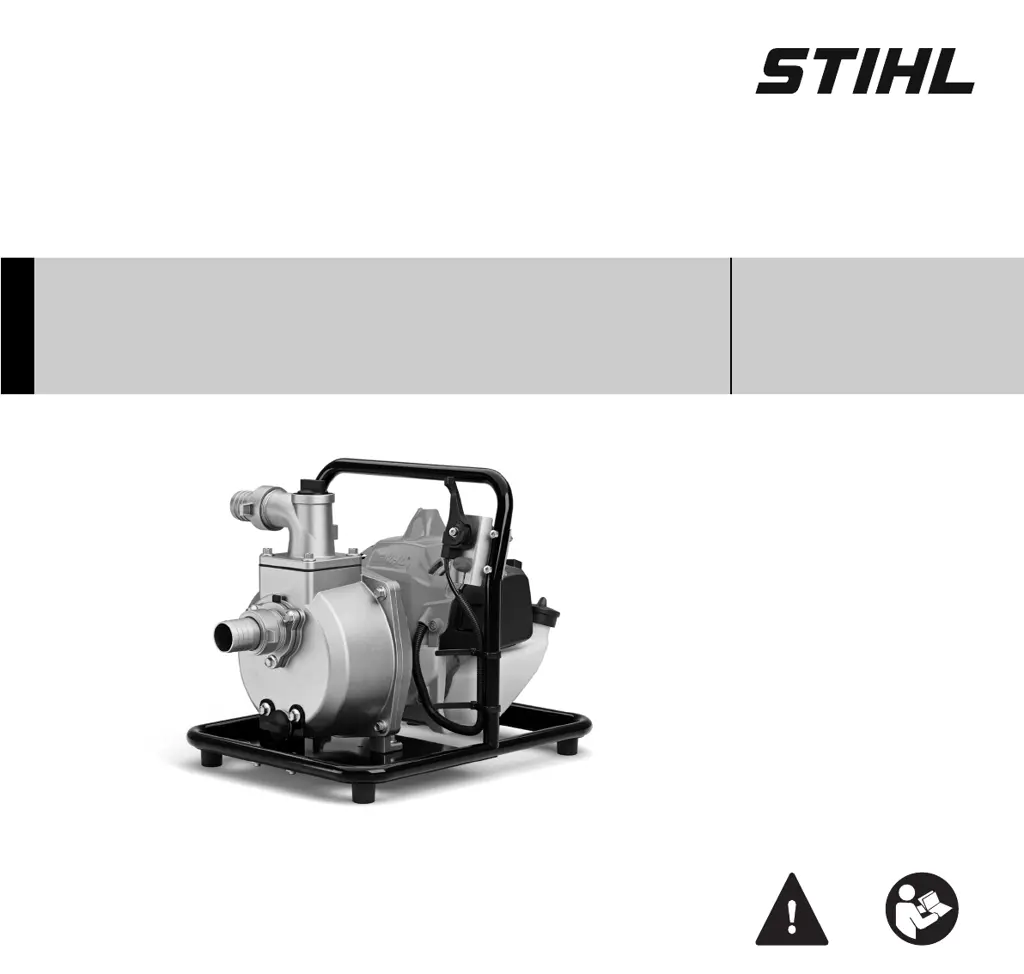
 General