3 (16) CLT Lifting Guideline
Introduction
“Safety first” is one of Stora Enso’s most important principles and we constantly try to improve safety within our company and where it concerns
our collaboration with suppliers and customers. This document is a general guideline and it only can point out the core items needed for planning
of lifting devices delivered by Stora Enso. Therefore, it is necessary that users of lifting devices also know and apply original instructions for use
(manuals, technical data sheets). This also includes a preceding validation of applicability by the customer, according to national and own safety
standards.
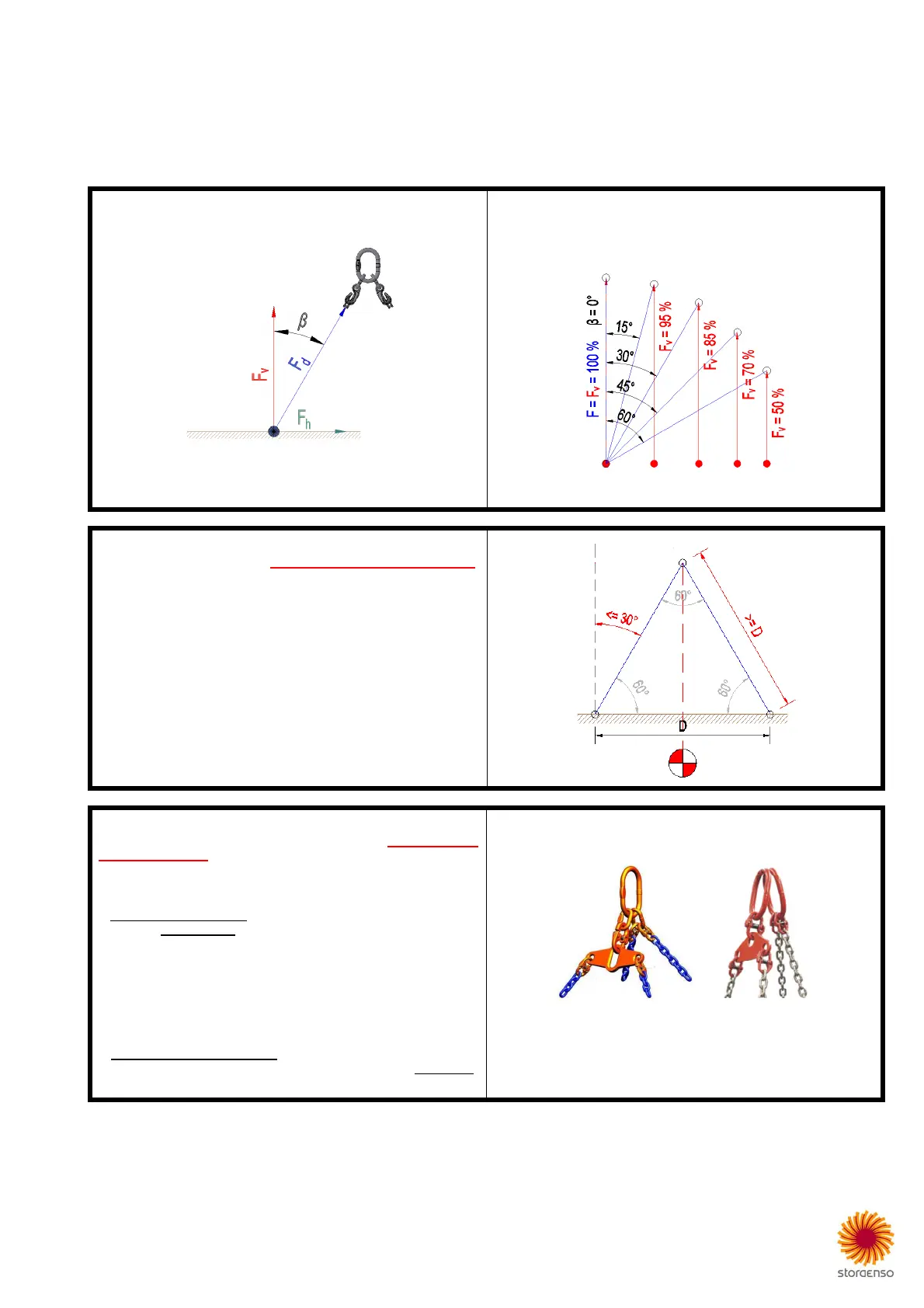
The lifting angle (β) has a significant influence on the load-bearing
capacity of each lifting system:
An increase of the lifting angle decreases the load-bearing capacity
(F
v
) of a lifting system, as you can see in the force diagram below:
If Stora Enso has to plan number and position of lifting points,
we have to assume that the lifting angle is not higher than 30°.
Required exceptions have to be verified and formally agreed:
• Higher lifting angles increase the risk and load-bearing capacity of
lifting devices is reduced. In any case lifting angles higher than
45° are not supported by Stora Enso.
• There is a simple rough-and-ready rule to secure that 30° in
practice is not exceeded: Chain length has to be equal or ideally
longer than the maximal distance between lifting points (D).
• The lifting points have to be aligned symmetrically regarding
center of gravity and lifting direction. Deviations are allowed if load
per lifting point is not increased more than 10 %.
If Stora Enso has to plan number and position of lifting points,
we have to assume a symmetric system and that all lifting points
are loaded equally. Required exceptions have to be verified and
agreements have to be formally confirmed.
Load distribution
If no load distribution gear is used, load-bearing capacity has to be
reduced at least by 25 %.
Symmetry
If lifting points regarding …
• chain lengths
• lifting angles
• center of gravity
…cannot be lifted symmetrically, then the load-bearing capacity has
to be verified by an expert and on demand to be reduced up to 50 %.
Examples: “balancing rocker”. It is an affordable and
very effective load distribution



 To Next Page