GENERAL PROGRAMMING
INFORMATION
When the Master Controller is powered up it always transmits the contents of the program
memory.
(
,'
After programming any parameters, the contents of the memory is transmitted when exiting
EDIT mode.
To transmit the contents of the memory while in play mode press the ENTER/EDIT button twice.
Exiting the EDIT mode automatically stores the newly changed parameters, if any, into the
memory.
When powering down
the
unit
all
information
in
memory
is
retained
and
then
transmitted
again upon power up.
You can
not
enter
the
EDIT
MODE
if
you
are
holding
down
keys
or pressing
the
sustain
pedal.
You must release all pedals and keys before entering into the edit mode.
When
re-entering
the
EDIT
MODE
it
will
be
on
the
parameter
setting
and ZONE
selection
as
it
was
left
when
previously
in
the
EDIT
MODE.
When EDIT MODE is selected, the keyboard does not sound. To test the programmed variations
and
play
the
keyboard
exit
the
EDIT
MODE.
APPLICATIONS USES AND
USER TIPS
These suggestions are
designed
as
a
starting
point
to
help
stimulate
your
own
creative
usage
of these features for your own musical applications and needs.
THE ZONES
The
ZONES
are
the
heart
of
the
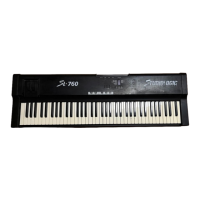
SL-760 Master
Controller.
Creative
use
of
the
ZONE'S
parame-
ters and
the
ZONES
themselves gives
the
player
new
found
flexibility
and
control
over
their
sounds and modules. We've already discussed how to operate the ZONES.
Now we apply them to musical applications. You can use the three (3) ZONES in a number of
different ways: Here are some options and possible applications using the features of this key-
board.
THE BIG LAYER
Set
all
three
ZONES
to
the
same range
of
notes and assign each
of
them
to
three
similar
String
patches or three similar Piano patches.Try two piano patches and a string patch. Experiment
with
disabling
some
of
the
features on some
of
the
ZONES
such as,
AFTERTOUCH
or SUSTAIN.
While playing one section of a song, leave some of the layers turned off and then switch them
on
during
the
"Chorus" by pressing
their
ZONE SWITCHES
to
build
dynamics
in
the
song.
On
your module try setting and storing your PIANO patches to not respond to MIDI volume (CC#7)
then using a Volume Pedal on your Master Controller you can bring up the Strings behind the
Piano when needed.
THE SPLIT
Set
two
ZONES
in
your
left
hand
for
an
Electric
Piano/Pad
layer
and set
ZONE
(3)
in
the
right
hand
for
a
string
or horn
part.
Use
the
TRANSPOSE
feature
to
bring
these
ZONES
into
a
useful
range.
ANOTHER SPLIT?
Try a Bass patch using one ZONE in the lowest two octaves of the keyboard, disable the
SUSTAIN
PEDAL
and
TRANSPOSE
up an octave or
two
to
place
it
in
the
range
of
a
bass
guitar.
Now create
a
SPLIT
in
the
middle
range
with
ZONE
(2)
set
to
a
Breathy Synth or Comping
patch,
and
the
last
ZONE
for
the
top
octave or
so
on
a
Brass
patch
with
the
SUSTAIN PEDAL
disabled.
You
can
play
a
bass
line
with
your
left
hand, sustain chords you've
played
on
the
Pad
sound using the Sustain Pedal and now play Horn stabs or lines above it with your right hand.
*Note
On
Splits:
Always remember
to
use
the
TRANSPOSE
feature
to
place your parts
in
pro-
per performance range no matter where on the 76 keys you may place a ZONES upper and lower
limits.
Think
of
the
whole keyboard
as
76
keys
or
triggers
available
rather
than
the
traditio-
nal note placement and tuning as on an Acoustic Piano.



 To Next Page