(443,1)
北米Model "A8370BE-A" EDITED: 2023/ 12/ 27
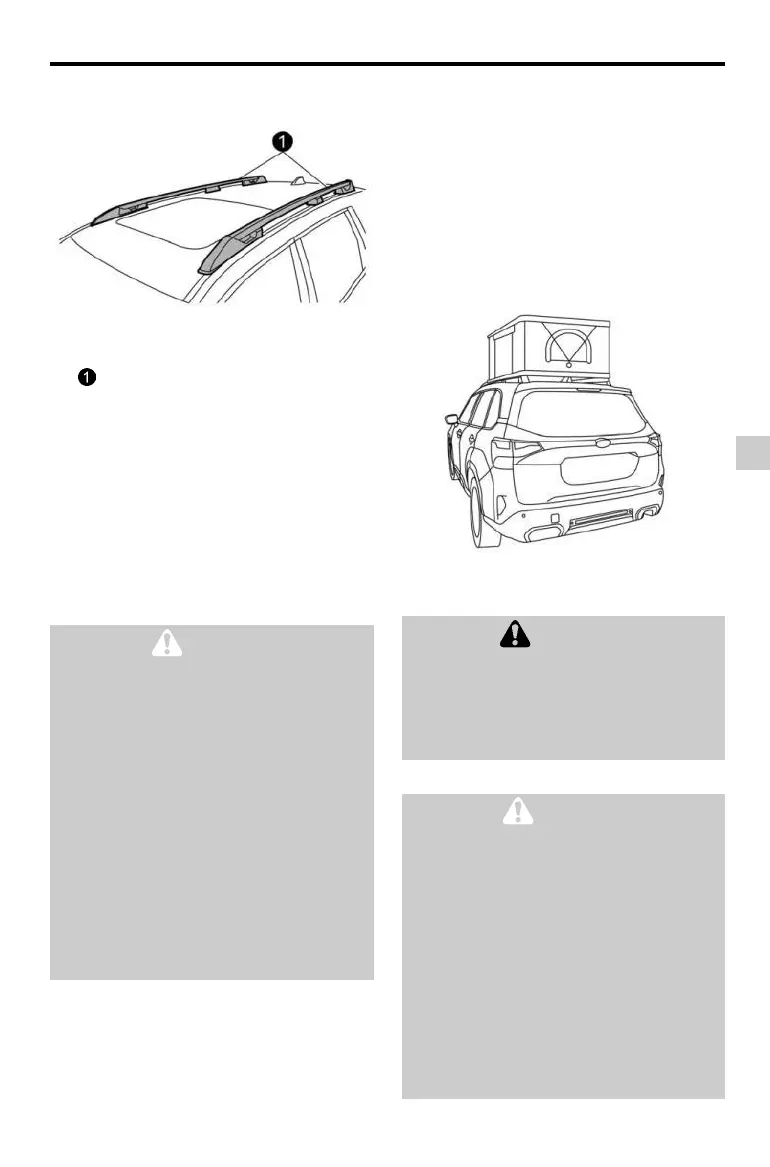
ROOF RAIL
s08aj04
S_801529-W
Roof rails
Cargo can be carried on the roof after
securing the crossbars to the roof rails
and installing an appropriate carrying
attachment. When installing crossbars
and a carrying attachment, follow the
manufacturer’s instructions. The roof rail
system is designed to carry loads (cargo,
crossbars and carrying attachment) of no
more than 176 lbs (80 kg). Be sure not to
exceed your vehicle’s GVWR and
GAWR.
CAUTION
. When using a carrying attachment,
make sure that the total carrying
load of the cargo, crossbars and
carrying attachment does not ex-
ceed 176 lbs (80 kg). Overloading
may cause damage to the vehicle.
. For cargo carrying purposes, the
roof rails must be used together
with the crossbars and any appro-
priate carrying attachment that
may be needed. The roof rails must
never be used alone to carry cargo.
Otherwise, damage to the roof or
paint, or a dangerous road hazard
due to loss of cargo could result.
NOTE
Remember that the vehicle’s center of
gravity is altered with the weight of the
load on the roof, thus affecting driving
characteristics.
Drive carefully. Avoid rapid starts, hard
cornering and abrupt stops. Crosswind
effects will be increased.
ROOF TENT
s08aj14
S_801504-W
Roof tents may be used under certain
conditions at your own risk.
WARNING
Adding weight to the vehicle’s roof can
adversely affect handling, braking,
and rollover resistance. The vehicle
must never be driven with a total roof
rail load in excess of 176 lbs (80 kg).
CAUTION
. The roof rail load limit for stationary
vehicles (700 lbs (317 kg)) applies
only when the vehicle is parked
and the load is evenly distributed
left/right and front/rear and the roof
crossbars and roof tent are tightly
secured to the vehicle. If these
conditions are not met, the load
limit will be lower.
. The maximum load limit of the roof
crossbars must be obtained from
the manufacturer or retailer of the
roof rack. When driving the vehicle,
– CONTINUED –
DRIVING TIPS
441
8


 To Next Page
 Loading...