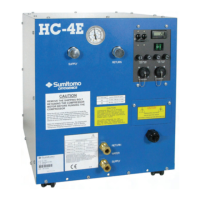
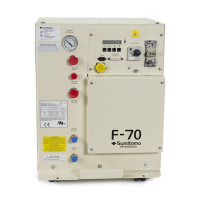
Installation
3. Feed the conductors through the conduit. Insulated conductors should extend
approximately 125 mm (5") from the end of the conduit into the compressor enclosure. Strip
9 mm (0.35”) of cover from the end of each conductor. Twist stranded conductors to prevent
fraying when feeding the wires into the terminal block.
4. Connect the two power leads to the terminal block. Connect the ground wire to the
grounding screw next to the terminal block.
5. Reinstall the terminal block access cover.
When using flexible cable:
1. Strip off 100 to 150 mm (4" to 6") of the cable’s outside cover to expose the individual
insulated conductors. Strip 9mm (0.35”) from the end of each conductor. Twist the stranded
conductors to prevent fraying when feeding the wires into the terminal block. Feed the cable
through the strain relief fitting.
2. Connect the two power leads to the terminal block. Connect the ground wire to the
grounding screw next to the terminal block.
3. Secure the cable by tightening the cap of the strain relief fitting. Use two wrenches to
prevent turning the body of the strain relief fitting.
4. Reinstall the terminal block access cover.
This completes the procedure for hard wiring the compressor.
Compressor Checkout
The compressor should be operated before being connected to the other system components.
1. Be sure the circuit breaker on the compressor is open (handle is down). Plug the power
cord into customer’s receptacle or connect the hard wiring to the electrical power source.
Switch on the supply power to the compressor.
2. Close the circuit breaker. Press the power switch. Power switch indicator will light and the
compressor will start. Run the compressor for ten (10) minutes, then stop.
An internal relief valve will open to prevent overloading the motor when the
system gas lines are not connected to the running compressor.
This completes the checkout of the compressor.
Interconnections
Tools required: Open end wrenches 1", 1 1/8", 1 3/16".
AVOID INJURY. When handling pressurized gas lines and other pressurized
equipment, always wear eye protection. Never apply heat to a pressurized gas
line or other pressurized components.



 To Next Page
 Loading...