Installation
DAMAGE TO GAS LINES can result from crimping by repeated bending and
repositioning.
AVOID GAS LEAKS. Check the condition of the gasket seal on the male half of
each Aeroquip coupling. Be sure the gasket seal is in place and the sealing
surfaces on both the male and female halves are clean before connecting.
Replace the gasket seal if it is damaged or missing.
AVOID GAS LEAKS. Keep the gas line couplings aligned when making or
breaking a coupling connection. Leaks can occur due to the weight of the gas
line or due to a sharp bend near the connection.
Retain the threaded protective caps and plugs to re-cover the couplings when they
are not in use. They protect the couplings from damage and prevent entry of
contaminants.
1. Arrange the system components so that the interconnecting gas lines will be protected from
stress and traffic. Observe the minimum bend radius. Routing of gas lines should consider
the need for gas line supports.
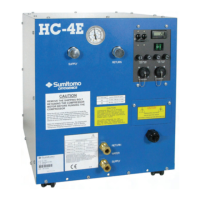
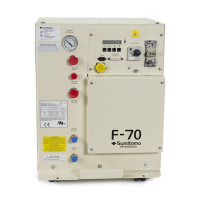
2. Remove the dust caps from the compressor supply and return gas couplings.
3. Remove the dust plugs from the couplings on one end of each of the supply and return gas
lines.
4. Connect the supply (red) gas line to the gas supply coupling on the compressor. Use two
wrenches to tighten the coupling. See Figure 5.
Torque all Aeroquip couplings to 4.87 ± 0.7 kgf m (35 ± 5 ft. lbs.). Tighten each coupling
before proceeding to the next one.
5. Using two wrenches, connect the return (green) gas line to the compressor’s return gas
coupling. Torque the coupling as stated in the previous step.
Figure 5 Connect Gas Line to Compressor or Manifold



 To Next Page
 Loading...