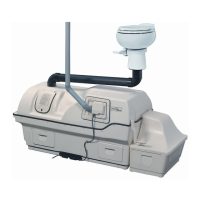
Seasonal Use and Springtime Start Up
Empty Compost from Last Season
Before your first use of the unit, extract compost from the drum by releasing the drum locker (located
above the drawer opening), then rotate the handle counter-clockwise giving the drum one complete
revolution only. Compost from the drum will drop into the finishing drawer. Empty the drawer and
repeat this procedure until most of the compost is removed, leave 3-4” of compost. This will be your
“starter base” for the coming season.
Rake
Remove the finishing drawer completely and use the rake tool to rake any loose material from the
floor of the unit. Pay careful attention to the back two corners of the unit (near the safety drain), to
ensure that your drains do not get clogged.
Add Water & Microbe Mix
Add some warm water to the remaining compost, enough to ensure that it is quite moist. Also, add
some Sun-Mar Microbe Mix (two of scoops) to give the compost pile a “kick-start” and rotate the drum
several times to mix. If your composting toilet is electric, plug it in and use for another season.
Winter Use
No Winter Use
Just add water, lots of water. Soak the compost in the drum to prevent it from drying out before
Spring. Make sure to unplug the unit if electric.
Occasional Winter Use
If the unit will be used for 3-4 weekends throughout the winter season then it is considered occasional
use. All of the same considerations should be taken with these units to winterize them. When the
temperature dips below 55 ° F (13 ° C), composting activity will decrease dramatically. These units do
not need to be kept warm and will act only as a holding tank during the winter months until they warm
up enough in the spring to begin composting again. During the winter, the compost will freeze into a
solid mass so the drum should not be turned as it may damage the composting toilet. With this in
mind, it is a good idea to remove enough compost before it gets too cold to make room in the drum
for winter use.
Heavy or Residential Winter Use
These units should be kept in a heated area and all winterization tips should be followed, including
the following:
1) Vent Pipe - all vent pipe should be insulated if they are exposed to the outside or in an unheated
area. If you are in an area that experiences extreme winter conditions, we recommend that heat
tape should be applied to the exposed vent pipe to prevent ice blockages.
2) Safety Drain - all models; we recommend that the safety drain should be installed and insulated
above the frost line. There will be less evaporation in the winter so this will help with any excess
liquid. If possible, heat tape can be applied to the safety drain to prevent ice blockage.
3) Keep it warm; If the composting toilet is used frequently in the winter then the composting part of
the unit should be kept in a warm place. Below 55 ° F (13 ° C), composting actions slows
dramatically so if it is in a place that falls below this temperature, a source of heat should be
provided for the unit so that it can keep up with constant use.
- 12 –


 To Next Page