SunFounder GalaxyRVR Kit for Arduino, Release 1.0
abilities. However, the color of objects does impact its sensing. Darker objects, especially black ones, are detected at
a shorter range. Against a white wall, the sensor is most efficient, sensing within the 2-30cm range.
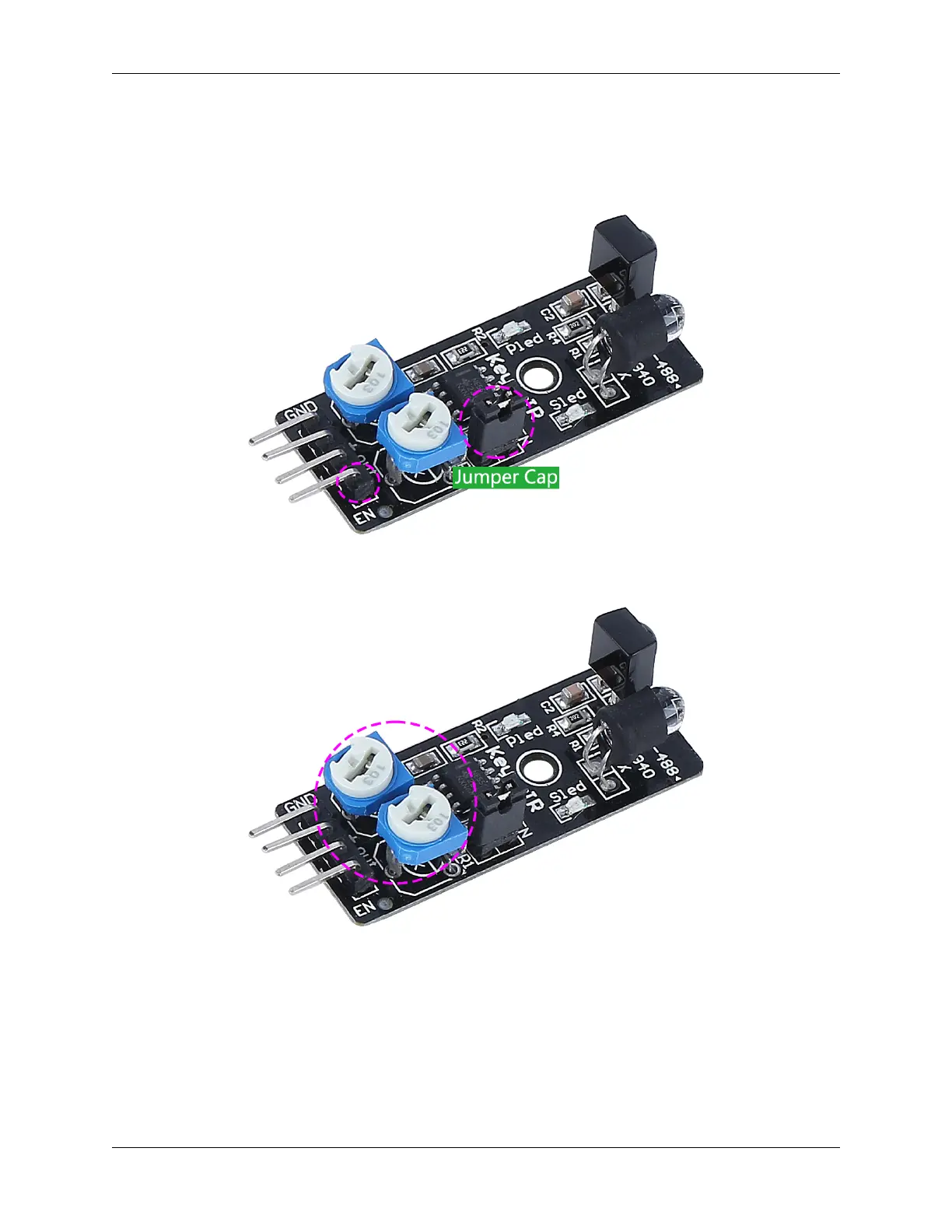
The EN pin’s low-level state activates the module, with the jumper cap securing the EN pin to the GND. If you wish
to control the EN pin via code, the jumper cap needs to be removed.
There are two potentiometers on the module, one for adjusting the transmitting power and one for adjusting the trans-
mitting frequency, and by adjusting these two potentiometers you can adjust its effective distance.
That’s quite a bit about our little module. In the next step, we’ll learn how to integrate it with our rover and control it
using the Arduino. Stay tuned!
Step 3: Read from the 2 Modules
Just like curious space explorers, let’s dive into the universe of codes and sensors!
1. Our Mars Rover is equipped with two special “Alien-Eye” sensors, perched neatly on pins 7 (right) and 8 (left).
These “Alien-Eye” sensors are actually our infrared obstacle avoidance modules, always vigilant to dodge any
“space rocks” (obstacles) in our Rover’s interstellar journey!
3.6. Lesson 6: Exploring the Obstacle Avoidance Module 53



 To Next Page