15
• Limbing a tree
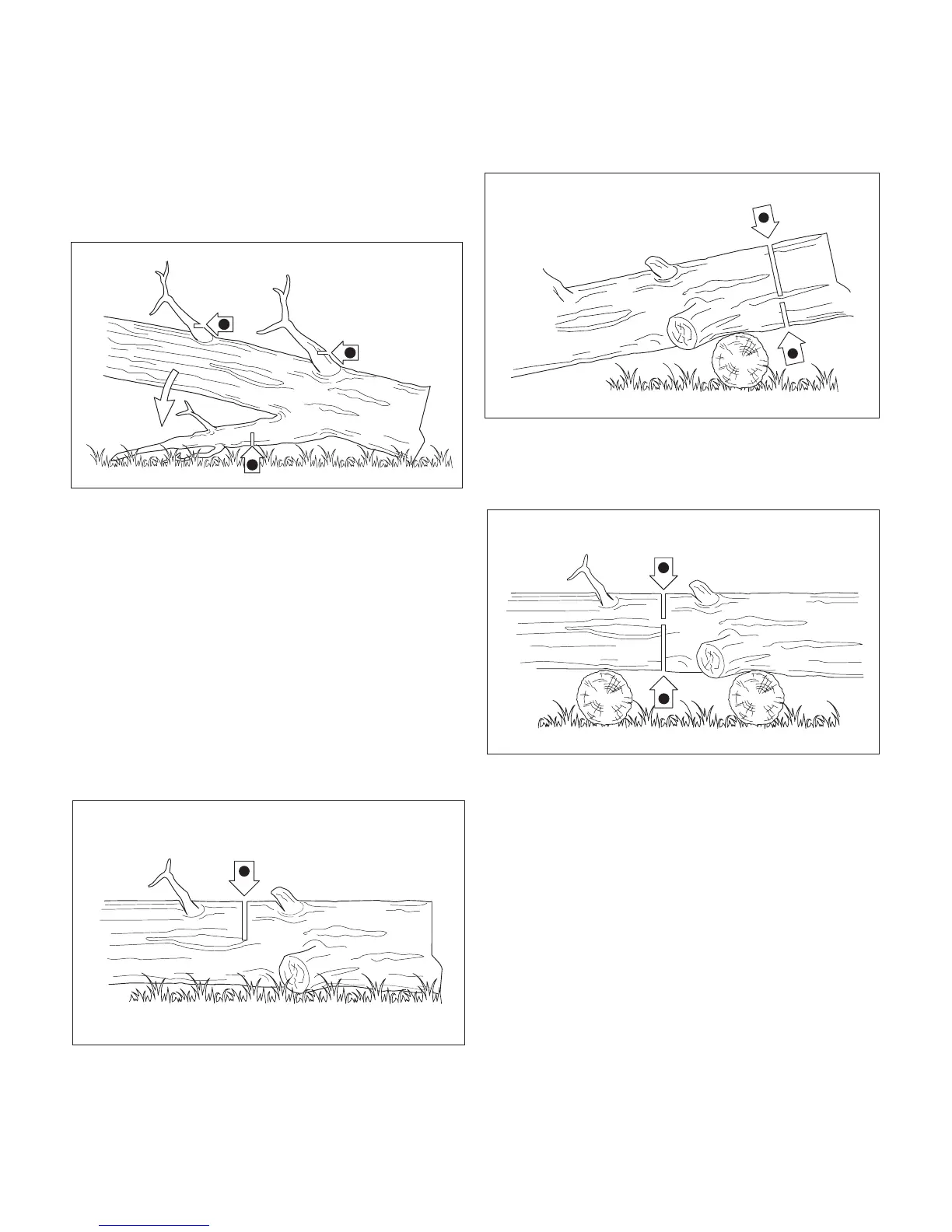
Limbing is the process in which branches are removed from a
fallen tree. When limbing, leave larger lower limbs to support
the log o the ground. Remove the small limbs in one cut as
illustrated (Fig. 18). Branches under tension should be cut from
the bottom up to avoid binding the chain saw.
mWARNING! Pay special attention to where the branches
are lying on the ground and recognize the following risks: 1)
the branches may be under tension; 2) the direction in which
the branch will fall during cutting may dier from what you had
anticipated; 3) the tree may be unstable after the branch has
been cut.
• Bucking a log
Bucking is the process in which a log is cut into lengths. It is
important to make sure your footing is rm and your weight is
evenly distributed on both feet. When possible, the log should
be raised and supported by the use of limbs, logs or chocks.
Follow these simple directions for easy cutting:
i) When the log is supported along its entire length as
illustrated (Fig. 19A), it is cut from the top (overbuck).
ii) When the log is supported on one end (Fig. 19B), cut 1/3
the diameter from the underside (underbuck). Then make
the nishing cut by overbucking to meet the rst cut.
iii) When the log is supported on both ends (Fig. 19C), cut
1/3 the diameter from the top (overbuck). Then make the
nished cut by underbucking the lower 2/3 to meet the
rst cut.
1
2
1
Fig. 18
1
Fig. 19A
1
2
Fig. 19B
1
2
Fig. 19C


 To Next Page