31
6.0 Maintenance
6.2 Troubleshooting
Before assuming anything is wrong with the owbench, verify that all of the electrical connections are
intact, and perform the operation ow test as detailed in "5.1.7 Performing a Flow Test" on page 19. If a
problem with the owbench measuring system arises, check the following:
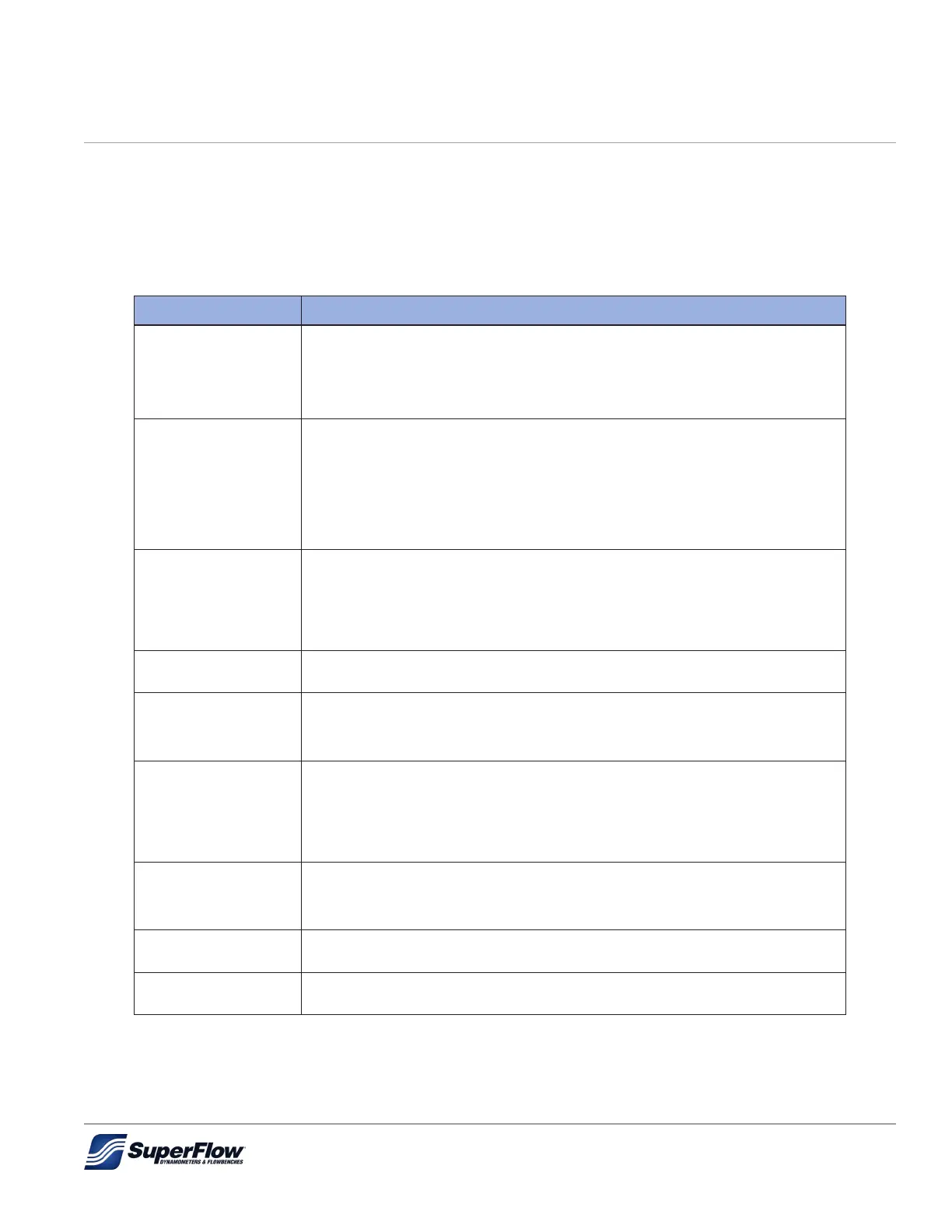
Table 6-1. Troubleshooting
Problem Solution
The owbench will
not power on
• Ensure the power cord is plugged in
• Check the main breaker at the power distribution box
• Check the 5-amp breaker in the power box behind the panel on the right
side of the owbench
The airow motors
shut o after
running for a few
minutes
• The motor is overheating—open the air bypass valve on the back of the
cabinet
• One or more motors are defective and overheating—go to section "6.4.2
Blower Motor Replacement" on page 37.
• The motor temperature sensor is defective or giving an incorrect
reading—go to section "6.4.3 Temperature Probe" on page 39.
Surging motor
• Bi-stable phenomenon due to port in head
• Line voltage varying
• Motor is failing
• Motor controller malfunction
The range selected
cannot be set
• The range orice stepper motor is defective (see section "6.4.4 Orice
Stepper Motor Assembly" on page 39)
No Test Pressure
Reading
• Check internal pressure transducer tubing. Ensure the hose has no kinks
or has not come o of the transducer connection port.
• The internal pressure transducer is defective or needs calibrating
No communication
between owbench
and the Modbus
TCP/IP network
• Disconnected or defective cable
• Modbus TCP/IP connection is not congured properly
• Communication port malfunction on computer or control device
• Internal PLC malfunction—contact SuperFlow Customer Service
No Test Pressure
Reading
• Check internal pressure transducer tubing. Ensure the hose has no kinks
or has not come o of the transducer connection port.
• The internal pressure transducer is defective or needs calibrating
Flow readings are all
too high or too low
• Perform the owbench ow tests according to the procedures in section
"6.3 Flowbench Flow Tests" on page 33.
Excessive leakage
• Perform the no-ow test according to the procedure in section "6.3
Flowbench Flow Tests".


 To Next Page