
 Need help?
Do you have a question about the SuperFlow SF-1020I and is the answer not in the manual?
Explains the purpose of the manual for the SF-1020i Flowbench.
Identifies skilled operators proficient in using the SF-1020i Flowbench.
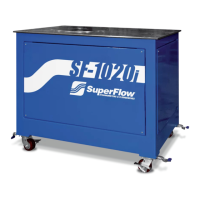
Lists key features of the SF-1020i Flowbench, including its construction and capabilities.
Details safety precautions and hazards during the operation of the machine.
Outlines procedures for safely disconnecting power and preventing accidental startup.
Covers important safety decals, hazard alerts, and PPE requirements.
Introduces the SF-1020i flowbench and its primary function in measuring airflow resistance.
Lists the key features and capabilities of the SF-1020i flowbench.
Describes available optional features like HMI display and air filter.
Explains factory calibration and the need for a calibration kit.
Lists various applications and unique capabilities of the SF-1020i.
Details the technical specifications including capacity, instrumentation, and power requirements.
Provides a detailed description of the SF-1020i's components and airflow path.
Details the baseplate design, dimensions, and mounting features.
Explains the function, specifications, and labeling of the test orifice plate.
Describes the muffler assembly's purpose in reducing noise and its design.
Mentions the availability and function of the optional HMI touch-screen display.
Details the air filter assembly for capturing airborne contaminants.
Mentions available adapters and fixtures for mounting various test devices.
Covers the general steps and considerations for installing the flowbench.
Specifies placement and environmental conditions for the flowbench.
Provides instructions for safely unpacking the flowbench from its shipping carton.
Details electrical connection requirements and safety warnings.
Explains how to connect the flowbench to a network using Modbus TCP/IP.
Lists Modbus registers and their functions for communication and control.
Demonstrates using Modbus registers for flowbench control and data exchange.
Explains how to set the flowbench to test pressure or flow rate mode.
Details how to set the desired test pressure for testing.
Explains how to set the desired flow rate for testing.
Guides on selecting the appropriate flow range for accurate measurements.
Instructions for turning the flowbench motor ON and OFF.
Explains how to measure and compensate for air leakage.
Step-by-step guide for conducting a flow test on the flowbench.
Tips to avoid errors during test procedures for accurate results.
Guidance on interpreting and analyzing test results.
Details the Wago Webvisu application for flowbench control.
Steps to connect and access the Wago Webvisu interface.
Overview of the USER and SETUP control screens and their functionalities.
Explains the functions within the Controls section of the Webvisu interface.
Describes the display of current operational readings in the Webvisu interface.
Details PID controller tuning values for flow and pressure.
Covers adjusting optimal range and orifice position settings.
Explains how to calibrate flowbench sensors, including pressure and temperature.
Provides general maintenance recommendations for the flowbench.
Maintenance for the blower motor, including inspection and lubrication.
Maintenance for the blower belt, including inspection and replacement schedule.
Lubrication advice for caster wheel swivel bearings.
Lists common problems and their solutions for the flowbench.
Procedures for no-flow, low-flow, and high-flow tests to check performance.
Procedure for performing a no-flow test to check for leaks.
Procedure for performing a low-flow test to check baseline flow.
Procedure for performing a high-flow test to check accuracy.
Procedure to determine the maximum flow capacity of the flowbench.
Step-by-step guide for replacing the blower belt.
Detailed instructions for replacing the blower motor.
Information on the air-temperature probe and its verification.
Maintenance for the orifice stepper motor assembly.
Procedure to test filter clogging and its effect on performance.
Steps to remove the air filter assembly for maintenance.
Instructions for cleaning the air filter elements.
Covers sensor calibration procedures for accuracy.
Overview of sensor calibration for pressure and temperature.
Steps for calibrating test and flow pressure channels.
Procedure to verify existing calibration accuracy.
Instructions for calibrating the barometric pressure sensor.
Introduction to flow testing and its purpose.
Explains the basics of flowbenches and flow testing.
Defines a flow test and its measurement process.
Provides historical context for flowbenches and SuperFlow.
Explains how to compare flow numbers at different test pressures.
Describes how to correct flow numbers for variations in test pressure.
Provides a method to predict pressure drop at flows outside capacity.
Details the steps and formulas for calculating mass flow (ACFM).
Explains why air density correction is not required for SuperFlow flowbenches.
Lists default values for flow, position, PID, and calibration.
Provides tables for converting units of flow, length, speed, power, and area.
Tables for converting units of flow.
Tables for converting units of length.
Tables for converting units of speed.
Tables for converting units of power.
Tables for converting units of area.
Lists suggested books and SAE technical papers for further reading.
States that following pages contain specific equipment drawings.
 General
| Brand | SuperFlow |
|---|---|
| Model | SF-1020I |
| Category | Water Pump |
| Language | English |

 To Next Page