51
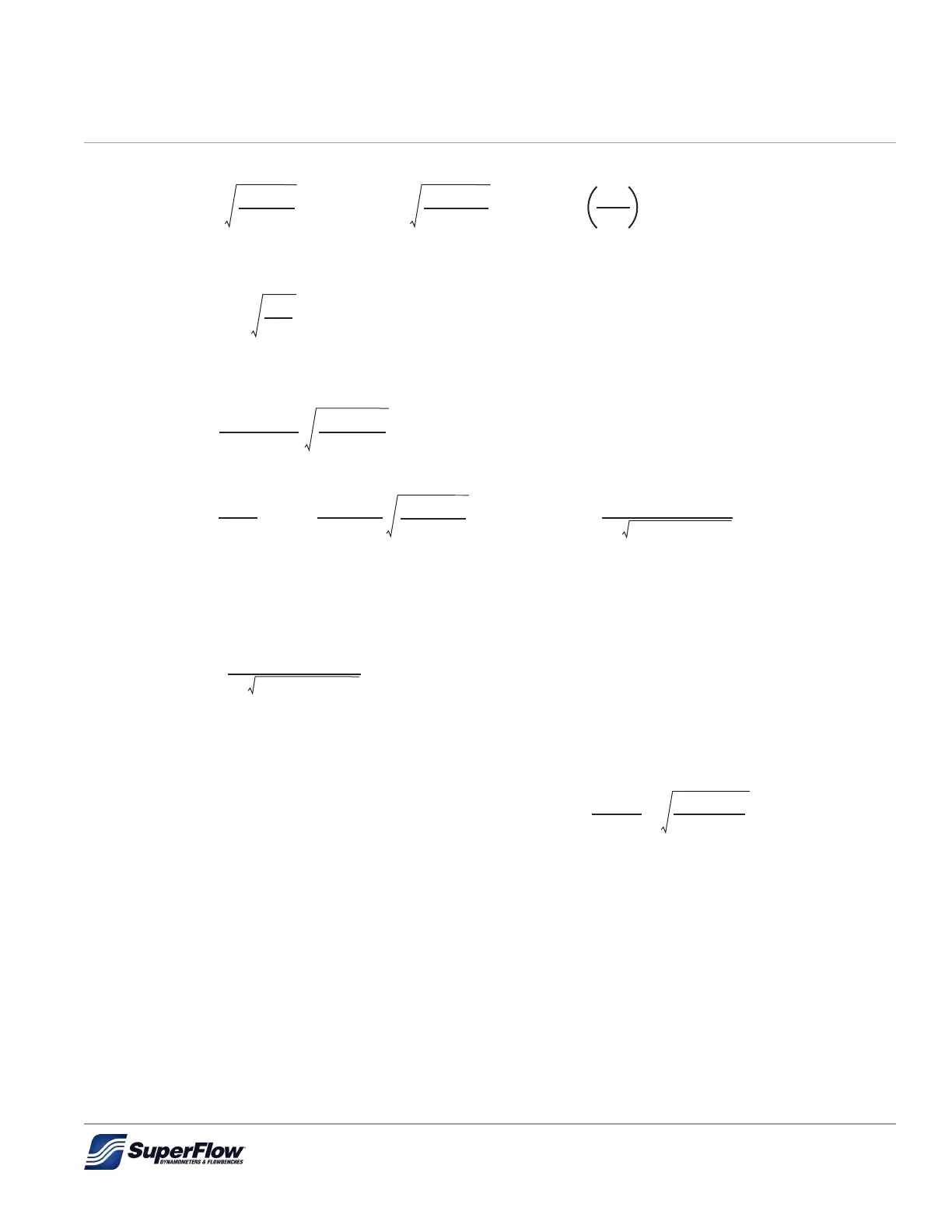
Equation 2:
Q K
f
flow
ambient
= Q
1
K
f
fl
0
-
1
=
P
fl
1
K
f
=
X
(P
0
- TP
1
)
The owbench ow is calculated from the ow pressure (P
f1
) with this formula, where FSF is the full-scale
ow for the current ow range.
FBF FSF
P
fl
=
Where P
fs
is the full-scale ow pressure—the pressure at which full-scale ow is reached.
When substituting for P
f1
from Equation 2, we get:
FBF
1
P
0
- TP
1
FSF x Q
1
=
When substituting for Q
1
from Equation 1:
FBF
1
Q
0
P
0
- TP
1
FSF
= X
P
0
FBF
1
FSF x Q
0
P
0
=
This last equation expresses owbench ow as a function of constants: the intake ow, the atmospheric
pressure, and test pressure.
We can perform the exact same steps for the diagram on the right-hand side in gure 6.12, where the test
pressure is TP
2
instead of TP
1
. When we do, we get a similar equation for owbench ow:
FBF
2
FSF x Q
0
P
0
=
In reality, the two owbench readings (FBF) should be the same, but they are not. FBF
1
is correct
because the bench was calibrated at TP
1
. We can dene a correction factor that will yield FBF
1
even when the test pressure is TP
2
.
FBF
2
FBF
1
P
0
- TP
2
= X corr(TP
1
,TP
2
) = = corr(TP
1
,TP
2
)
FBF
1
This correction factor has been veried experimentally.
7.0 Flowbench Theory


 To Next Page