

EasyManua.ls Logo

Supra 148C - User Manual

Supra 148C
16 pages
Print Icon
To Next Page IconTo Next Page
Loading...
GB 1/16
25254-11-08
INSTRUCTIONS FOR INSTALLATION AND USE 11-08 25254
CLOSED FIRE
148C / 150C / 152C
162C / 168C / 163
1. Technical characteristics and dimensions 2
2. Preparation of the existing site 4
3. Assembly and connection 6
4. The fireplace and the hood 12
5. Use 13
6. Maintenance 15
7. After-sales service 15
148C 150C 152C
162C
168C 163VL
RCS Saverne B 675 880 710 - SIRET 675 880 710 0032
BP 22 - 67216 OBERNAI Cedex- FRANCE
www.supra.fr
Illustrations non-contractual.
(2)
We recommend the HOMY range of products: a complete range of suitable connections and accessories. Documentation on request from your dealer.
(3)
FR-DTU 24.1 dealing with smoke flues, FR-DTU.24.2 dealing with chimneys equipped with a closed fire; NF EN 13229 Open fires and inserts burning solid fuel. (available
from the AFNOR
).
IMPORTANT
This appliance has been designed with care. To get the best out of it, as you are entitled to expect, and for your safety, please read carefully
these instructions for installation and use before starting work on the installation. The appliance must be connected using suitable fittings
(2)
to an individual smoke flue specific to this appliance. A number of accessories are also available
(2)
, some of which must be fitted before
installation.
Question and Answer IconNeed help?

Do you have a question about the Supra 148C and is the answer not in the manual?

Summary

Instructions for Installation and Use

1. Technical Characteristics and Dimensions

Overview of technical specifications and physical dimensions for different models.

2. Preparation of the Existing Site

Guidelines for preparing the installation site, including floor, walls, and ceiling requirements.

3. Assembly and Connection

Steps for assembling the appliance and connecting it to the flue system.

4. The Fireplace and the Hood

Information on designing and installing fireplaces and hoods around the appliance.

5. Use

Instructions on how to operate the appliance safely and efficiently.

6. Maintenance

Routine maintenance tasks for the appliance.

7. After-Sales Service

Information regarding warranty, spare parts, and customer support.

Technical Characteristics and Dimensions

Preparation of the Existing Site

2.1 Floor

Requirements for the floor supporting the appliance, including load capacity and covering.

2.2 Walls

Precautions for walls around the appliance, including insulation and clearances.

2.3 Ceiling

Insulation requirements for the ceiling area above the appliance.

2.4 Evacuation of the products of combustion

Procedures for safely removing combustion gases via the flue.

2.5 Going through ceilings and floors

Safety clearances for smoke flues passing through building structures.

2.6 Exterior air inlets

Requirements for providing fresh air to the appliance for proper combustion.

Assembly and Connection

1 Tools required

List of tools necessary for the assembly and installation process.

2 Content of bags of screws delivered with different fires

Details of screw bags provided for assembly with specific fire models.

3 Unpacking the fire

Steps for safely unpacking the fire appliance from its packaging.

4 Assembly of the stand and fixing of the fire to the stand

Instructions for assembling the appliance stand and securing the fire to it.

5 Assembly of the warm air distribution box

Guidance on installing the warm air distribution system for heating multiple rooms.

6 Fixing of the warm air distribution cover

Instructions for attaching the cover to the warm air distribution system.

7 Fixing the warm air distribution nozzles and plugs

Steps for installing nozzles and plugs for the warm air distribution system.

8 Assembly of the fixed frame (fires with lift-up doors)

Detailed instructions for assembling the fixed frame for models with lift-up doors.

10 Installation of the top stoppers (fires with lift-up doors)

How to install top stoppers to hold the door in the open position.

9 Lifting mechanism (fires with a lift-up door)

Instructions for installing the lifting mechanism for doors.

11 Fitting of a solid side (fire 163)

Steps for fitting a solid side panel to the fire appliance.

12 Installation and removal of the smoke baffle

How to install and remove the smoke baffle for efficient operation.

13 Placing of the andirons

Instructions for positioning the andirons inside the firebox.

14 KTE 152 Convection accelerator (optional)

Information on installing the optional KTE 152 convection accelerator.

15 Connection to the smoke evacuation flue

Guidelines for connecting the appliance to the smoke evacuation flue system.

The Fireplace and the Hood

4.1. The fireplace

Design considerations for custom fireplaces to ensure proper installation and clearance.

4.2. The wooden mantel beam

Guidelines for installing a wooden mantel beam safely near the appliance.

4.3. The hood

Requirements for designing and installing the appliance hood, including ventilation and access.

Use

5.1. Fuel

Recommended and prohibited types of fuel for the appliance.

5.2. The draught

Information on measuring and maintaining the correct chimney draught.

5.3. The control mechanisms

Explanation of the appliance's controls for air adjustment and door operation.

5.4. Operation

Instructions for starting the fire, reloading, and different operating modes.

Maintenance

7.1 Ash Removal

Procedure for safely removing ashes from the appliance.

7.2 Cleaning the Front of the Fire

Guidelines for cleaning the appliance's door frame and glass.

7.3 Cleaning the Window

Method for cleaning the fire's window, including the 'clean glass' system.

7.4 Obligatory Chimney Sweeping

Legal requirements for regular chimney sweeping and record keeping.

7.5 Annual Service

Recommendations for annual servicing and checks of the appliance.

After Sales Service

8.1 Removing the Door

Procedure for safely removing the appliance door for maintenance.

Overview

The SUPRA Closed Fire series, encompassing models 148C, 150C, 152C, 162C, 168C, and 163, are heating appliances designed to burn wood logs, with lignite as a replacement fuel. These devices are intended for installation within a fireplace and are designed for continuous or intermittent operation, depending on the specific model.

Function Description:

The primary function of these appliances is to provide heating through the combustion of solid fuels, specifically wood logs and lignite briquettes. They are designed as "closed fires," meaning the combustion chamber is enclosed, which enhances heat exchange and efficiency compared to open fireplaces. The design incorporates a smoke baffle to improve heat recovery and facilitate soot removal. Warm air distribution systems are available, allowing heated air to be channeled to adjacent rooms or upstairs, thereby distributing heat more evenly throughout a dwelling. Some models feature a lift-up door mechanism, offering the option of operating as an open fire for aesthetic enjoyment, though with reduced heating output. The appliances are equipped with controls for air adjustment and, in most models, a flue valve to manage burning speed and prevent heat loss when the fire is out. An ash compartment is integrated for easy ash removal.
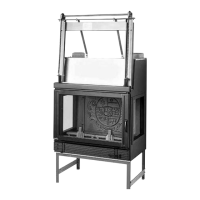
Important Technical Specifications:

Fireplace Characteristics:

  • Rated Power Output (1):
    • 148C, 150C, 152C: 13 kW (Continuous operation)
    • 162C, 168C, 163: 11 kW (Intermittent operation)
  • Operation Door:
    • 148C, 150C, 152C: Closed/Open (yes/no)
    • 162C, 168C, 163: Closed/Open (yes/yes)
  • Average Temperature of Smoke:
    • 148C, 150C, 152C: 380°C
    • 162C, 168C, 163: 314°C
  • Efficiency:
    • 148C, 150C, 152C: 71%
    • 162C, 168C, 163: 70.4%
  • CO Rate (13% O2):
    • 148C, 150C, 152C: 0.46%
    • 162C, 168C, 163: 0.21%
  • Fuel: Wood logs; replacement fuel: lignite. Prohibited fuels include coal and its derivatives.
  • Max. Log Size: 50 cm for all models.
  • Nominal Hourly Load: 4 kg for all models.

Dimensions (HxLxP mm):

  • 148C: 750x760x518
  • 150C: 1084x760x518
  • 152C: 1618x760x518
  • 162C: 1618x760x518
  • 168C: 1326x760x518
  • 163: 1620x760x518
  • Connection Type: Vertical for all models.
  • Distance Rear-Flue Axis: 165 mm (148C), 170 mm (150C, 152C), 220 mm (162C, 168C, 163).
  • Ø of Smoke Outlet: 200 mm for all models.

Characteristics of the Smoke Flue:

  • Min. Chimney Block: 20x20 cm for all models.
  • Tubing or Metal Flue Min. Ø: 180 mm for all models.
  • Min. Height of Flue Above Fire: 4 m for all models.
  • Ventilation of the Room: 1 dm² for all models.

Draught (10 Pa = 1 mm water column):

  • Nominal Speed: 12 Pa±2 for all models.
  • Reduced Speed: 6 Pa±1 for all models.
  • Max. Admissible: 20 Pa for all models.
  • Weight Netto/Brutto: Ranges from 115/132 kg (148C) to 180/197 kg (163).

Options Supplied (varies by model):

  • Stand (optional or to be mounted)
  • Fairing (yes or no)
  • Fairing Cover (yes, no, or mounted)
  • Warm Air Nozzles (optional or to be mounted)
  • Plugs (optional or to be mounted)
  • Cast Iron Side (optional or to be mounted)
  • Side Cover (optional or to be mounted)
  • Cool Handle + Bag of Screws (no or to be mounted)

Options Available (for specific models):

  • CDA 150C, CDA 168C, DA 168C
  • KTE152 Ventilation Kit (yes for all models)
  • Kit Grill (yes for all models)

Usage Features:

  • Fuel: Designed for natural wood logs (air-dried for 2-3 years) and lignite briquettes. Hard deciduous woods (hornbeam, beech) are recommended; coniferous woods (pine, fir), soft deciduous woods (lime, chestnut, willow), treated wood, and domestic waste are prohibited.
  • Starting the Fire: A gentle, gradual increase in load is recommended for the first use to allow materials to dilate and stabilize. Windows should be open during initial heating to dissipate presentation paint smells.
  • Operation as a Closed Fire: For lighting, crumpled paper, small wood, and split logs are used. Once embers form, the fire can be loaded and controls set to "normal burning speed." Reloading should ideally occur when only a bed of embers remains.
  • Operation at Reduced Speed: Involves spreading embers, loading 2-3 logs, and adjusting air control. Prolonged reduced speed operation is discouraged due to insufficient smoke temperature and potential condensation in the chimney.
  • Operation as an Open Fire (162C/168C/163 only): The lift-up door allows for direct enjoyment of the fire, but with reduced heating output. The window should be closed for overnight use or short absences.
  • Air Adjustment: Lever-controlled, limited to a zone between position (0) and semi-open position (1).
  • Flue Valve Control (except 163): Allows closing the evacuation flue when the fire is out to prevent heat loss and reduces burning speed.
  • Ash Compartment Door: Must remain closed during operation to prevent excess air intake, which can lead to overheating and deformation.
  • Cold Handle: Essential for operating all controls to avoid burns.
  • Warm Air Distribution: Optional or supplied, channels warm air to other rooms. Closable grilles must never all be closed simultaneously; at least two outlets must remain open. Ducts should be lagged if passing through cold spaces, have minimal elbows, and maintain a positive incline. Outlets must be at least 30 cm from the ceiling. Maximum duct length: 6 meters for natural convection, 9 meters for forced convection.

Maintenance Features:

  • Ash Removal: The ashbox should be emptied regularly after the appliance has cooled to prevent air restriction and potential deformation of the grate.
  • Cleaning the Front of the Fire: The door frame should be cleaned with warm soapy water and a soft cloth/sponge, avoiding abrasive products.
  • Cleaning the Window: The window should be cleaned when cold, using a damp cloth dipped in wood ash. The "clean glass" system helps keep it clean, but some blackening may occur, especially at reduced speeds.
  • Obligatory Chimney Sweeping: The chimney must be swept twice a year (including once during the heating season) by mechanical means. A chimney sweeping book should be filled out by the service provider. The smoke baffle (if present) should be re-placed after sweeping.
  • Annual Service: After each heating season, the fire should be completely cleaned, and all moving parts checked for proper function.
  • Removing the Door: The door is fitted with a system to prevent accidental detachment from hinges. The top left bolt can be removed if necessary.

Supra 148C Specifications

General IconGeneral
BrandSupra
Model148C
CategoryStove
LanguageEnglish