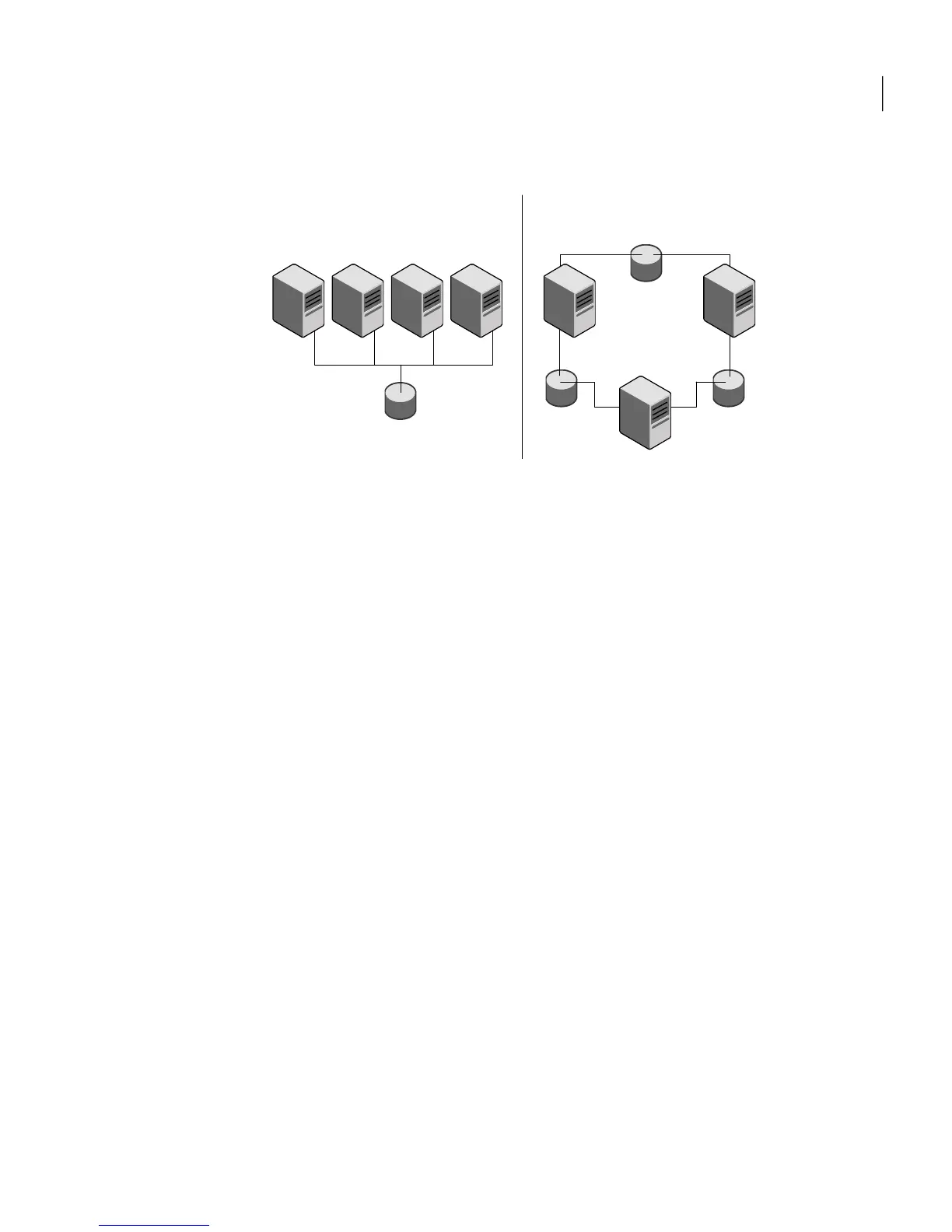
About LLT and GAB
VCS uses two components, LLT and GAB, to share data over private networks
among systems. These components provide the performance and reliability that
VCS requires.
LLT (Low Latency Transport) provides fast, kernel-to-kernel communications,
and monitors network connections.
LLT configuration files are as follows:
■ /etc/llthosts—lists all the nodes in the cluster
■ /etc/llttab file—describes the local system’s private network links to the other
nodes in the cluster
GAB (Group Membership and Atomic Broadcast) provides the global message
order that is required to maintain a synchronized state among the nodes. It
monitors disk communications such as the VCS heartbeat utility. The /etc/gabtab
file is the GAB configuration file.
See “About the LLT and GAB configuration files” on page 105.
About network channels for heartbeating
For the VCS private network, two network channels must be available to carry
heartbeat information. These network connections also transmit other VCS-related
information.
Each Linux for IBM Power cluster configuration requires at least two network
channels between the systems. The requirement for two channels protects your
cluster against network partitioning. For more information on network
partitioning, refer to the Veritas Cluster Server User's Guide.
15Introducing Veritas Cluster Server
About VCS basics



 To Next Page