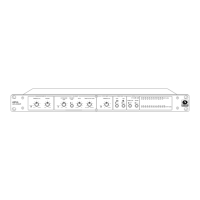
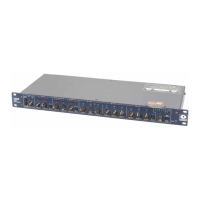
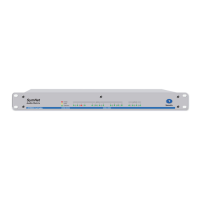
421m
10
Applications Chapter 6
An AGC-Leveler has many applications in recording studios, auditoriums or theatres, commercial
or industrial PA systems, tape duplication systems, and broadcast. Here follows a small sample of
applications.
Conference or Courtroom Recording
If you’re recording conferences or courtroom proceedings, you are faced with the same problem at
the lectern microphone; i.e., some people speak too softly while others are too loud. If possible,
install a separate 421m on each microphone and feed the outputs of the 421m’s into the line inputs
of your mixer.
If separate 421m’s for each mic are not an option, then place a single 421m between the mixer output
and the input of the tape recorder.
Broadcast Telephone Line Driver
At sometime or another every broadcast engineer ends up having to send audio down a telephone
line. Of course, you need to keep levels hot, but if you hit the line too hard the phone company
frowns. It’s good practice to ensure that there is a hard limit to any signal that ends up going down
a phone line. The 421m is well suited to the task of unobtrusive, yet unyielding control of audio
levels.
As a starting point, use the SLOW recovery rate, low RATIO (2:1), and a low AUTO-RELEASE
LEVEL. Set the TARGET LEVEL control for the desired average level into the line, and then dial in
enough peak limiting to keep the peaks under control. You may want to back the TARGET LEVEL
off slightly so that you don’t need as much peak limiting. Peak limiters are more inaudible if you
only limit occasional peaks.
Foreground Music
The CD changer has propelled canned music into a new era. The problem, of course, is the wide
dynamic range of CD’s coupled with the fact that different CD’s as mastered at diverse and unpre-
dictable levels. Most CD’s simply have too much range for foreground or background music
applications. The 421m helps reduce the overall dynamic range, while retaining some semblance of
the music’s original dynamics. You can link two units together for stereo if desired.
There’s probably no need to use the downward expander in this application, so turn the THRESH-
OLD control to the BYPASS position. Set the AGC-Leveler RATIO to 2:1 and use the SLOW
recovery rate setting. Set the AUTO-RELEASE LEVEL to 9:00 o’clock or lower. Experiment with the
PEAK LIMITER threshold, and use the PEAK LIMITER only if necessary.
Americans with Disabilities Act
The American Disabilities Act (ADA) of 1990 (Public Law 101-336) affects any of us who supply
equipment to or operate public gathering places. There are five major aspects (Titles) to this law, all
of which have staged implementation dates.
Title I deals with employment issues, Title II deals with public services, Title III deals with public
accommodations and services operated by private entities, Title IV deals with telecommunications,
and Title V deals with miscellaneous issues. Of particular interest to sound system providers or
installers is Title III, which says that many of the places where you find sound systems must
provide assisted listening devices for persons with sensory impairment. Some of the solutions
employed are: headphone jacks at certain seats, low powered AM or FM transmitters broadcasting
to Walkman (R) type radios or to facility-supplied radios, and infrared transmission systems.
Regardless of the transmission method, these systems all require a signal of reduced dynamic
range so that the users can hear both the softest and loudest parts of a performance. The 421m is
ideally suited to this application. Try moderate to high ratios (2:1 and up), and long release times.
Pick an AUTO-RELEASE level that keeps the AGC action somewhat unobtrusive. Use the peak
limiter to keep the transmitter out of clipping.


 To Next Page
 Loading...