528E
11
zero). The maximum output level of a circuit is the upper limit of the operating level, and is the
level at which clipping begins and is a function of the internal power supply voltage. To put levels
in perspective they must be referenced to some nominal operating level, like 0 dBm. That’s why
noise specs are stated as negative numbers.
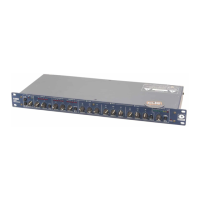
In the case of the 528E, noise is referred to the input, and stated as equivalent input noise (EIN).
The noise spec i fi ca tion is given this way because the gain of the 528E’s input stage is variable, so
the actual signal-to-noise performance of the unit becomes a function of how much gain is used in
the preamp. To fi nd the signal-to-noise ratio at 0 dBm output, algebraically add the preamp gain to
the EIN.1
Since maximum output level is usually greater than 0 dBm, it’s stated as plus something. The
528E’s maximum output level is +18 dBm into a 600-ohm balanced load, which is 18 dB above 0
dBm. The difference between the noise fl oor and the onset of clipping is the dynamic range. To fi nd
the 528E’s dynamic range with 50 dB preamp gain, subtract -89 from 18. The result (113 dB) is the
dynamic range.
Dynamic Range of Sounds and Signals
The other defi nition of dynamic range describes actual level changes, or the range over which
signals fl uctuate. The signals under discussion here are electrical representations of sounds, so it
follows that sound has dynamic range. The dynamic range of the human voice, from a whisper to a
shout, is well over 100 dB. Thus, the microphone converts the sound pressure of a voice going from
a whisper to a shout into an electrical output signal having the same dynamic range.
Why Dynamic Range Processors are Necessary
For signals to stay below distortion and above noise, their actual dynamic range must be kept within
the specifi ed dynamic range of the circuits through which those signals fl ow. Unfortunately, the
actual dynamic range of real world signals often exceeds the available dynamic range of even the
best equipment.
For example, the dynamic range of the best analog tape recorders is around 80 dB, while digital re-
cord ers top out at around 96 dB. As good as these machines are, there’s still not quite enough room
for very wide dynamic range signals. In order to maintain a 60 dB signal-to-noise ratio (to keep the
signals 60 dB above the noise fl oor), the dynamic range of signals stored on the analog tape ma-
chine would have to be restricted by 20 dB, while the digital recorder would be restricted by 36 dB.
A compressor or limiter is often used to reduce dynamic range by setting an upper limit on the
larger signals. In some cases, it’s better to put processing to work on the lower end of the dynamic
range than on the upper end. In other words, instead of reducing the amount of change at the up-
per end of the dynamic range with a compressor or limiter, increasing the amount of change at the
lower end of the dynamic range with a downward expander or gate.
Compressors are to Downward Expanders as Limiters are to Gates
Compressors reduce the dynamic range of their output whenever the input signal is above thresh old,
while downward expanders increase the dynamic range of their output whenever the input signal is
below threshold.
Compressors, limiters, expanders, and gates increase or decrease signal levels by some ratio.
Compressors usually have an adjustable ratio, the ratio of the input level to the output level, which
is generally user-adjustable. A compressor operating with a 2:1 ratio allows only a 1 dB increase in
output level for every 2 dB increase in input level.
Limiters usually have a nonadjustable ratio that is very high (greater than 10:1). At 10:1, the limiter
allows only a 1 dB increase in the output level for every 10 dB increase in the input level. Limiters
can be thought of as high ratio, high threshold compressors. They are intended to “stay out of the
way” until the level goes above threshold. However, above threshold their action is very defi nite.


 To Next Page
 Loading...