528E
28
Applications Chapter 8
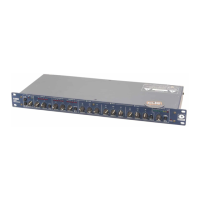
The 528E Voice Processor was designed to make the same kind of specialized processing that’s ap-
plied to voice-overs and vocal tracks in recording studios available for use in broadcasting, paging,
public address and sound reinforcement. In a recording studio, four or fi ve separate pieces of equip-
ment are usually patched together to obtain the kind of processing provided by the 528E.
For the highest level of versatility, we recommend making the output/input patching and sidechain
connections available by wiring the unit to a patch bay. Be sure that the interstage patch points are
normalled together (we recommend half-normalling) and that the sidechain connection ter mi nates
in two half-normalled jacks. This allows access to the individual sections of the 528E, provides for
easy use of the sidechain, and allows the processing order to be changed at will (to place the para-
metric in the sidechain, for instance).
The following discussions illustrate some of the more useful applications for the 528E. Because of
its versatility, combinations of the applications described here will normally be used.
Broadcast Applications
With the 528E, a variety of common problems can be corrected, and overall sound quality can
be greatly improved. In addition to its “normal” use with announce mics, there are several more
specialized uses for the Voice Processor. This section provides general operating guidelines for the
various parts of the 528E, and also describes typical applications used in the production room for
special effects, in the news room for cleaning up actualities and phone feeds, and in television for
PA feed to a studio audience.
The applications that follow are merely operational guidelines for the Voice Processor. The particu-
lar kind of processing applied in any given situation must be determined by the problems encoun-
tered, and by the dictates of the format. What’s necessary or appropriate in one case, may not be at
all proper in another.
Announce Mics - Compressing, Limiting, Expanding
The 528E’s dynamic range processor is used to control both over-modulation and noise. Noise, in
this case, may be electrically induced (hum, buzz, etc.), or acoustically transferred (paper rattling,
cart solenoids, air conditioning, etc.), since the downward expander attenuates all below threshold
signals without regard to origin. Careful adjustment of the two threshold controls allows the opera-
tor to put the 528E to work on any portion of the dynamic range. The expand threshold control gov-
erns the 528E’s activity in the lower part of the dynamic range, while the comp thresh old governs
activity in the upper part of the range.
For smooth overall dynamic range processing that will tend to “homogenize” the sound and remove
only very low level noises, use a gentle compression ratio with a relatively high comp threshold,
and a relatively low expand threshold.
The soft-knee transition characteristic of the interactive processor allows the use of much higher
compressor/limiter ratios with much lower thresholds. The expander’s rapid rise below its thresh-
old, combined with the compressor’s smooth transition through its threshold, makes processing go
unnoticed. Use this application to “tighten up” voice-overs. The expander eliminates noise and adds
“punch.”
The expander may be used without the compressor to remove background noise. Be sure the
expand threshold is set low enough to allow even the lowest level speech sounds to pass, and the
compression ratio is set to 1 (so the compressor/limiter is essentially out of circuit).
Likewise, the compressor/limiter may be used without the expander to control only the upper end
of the dynamic range. For general purpose overall gain control, use compression. Set the ratio be-
tween 2:1 and 3:1, with a comp threshold setting that results in 6dB to 10dB attenuation.
Limiting is used for very defi nite control of the maximum level. As the name implies, limiting sets
the upper limit, but is not intended for general purpose oveall gain control. For limiting, set the
ratio at 10:1, with the comp threshold control set to provide no more than 3dB to 6dB attenuation.


 To Next Page
 Loading...